
Over the course of the past several years, asphalt plants were faced with challenges brought on by the economy. As customers maintained tighter budgets, contractors were left with fewer projects resulting in lower production by asphalt plants. Despite the state of the industry during the recession, the owner Chuck Calvert found an opportunity to break into the asphalt production market. After operating a paving business for several years he made the switch from paver to producer. With the help of his daughter and President, Jennifer Latier, and son, Executive VP, Chase Calvert, they opened Hot Mix Materials, Inc. in 2007.
Allen Conway, general manager, was hired in 2007 to move Hot Mix Materials from the purchase to the setup of the plant. With one location in Kansas City, MO, the plant started production in the spring of 2008.
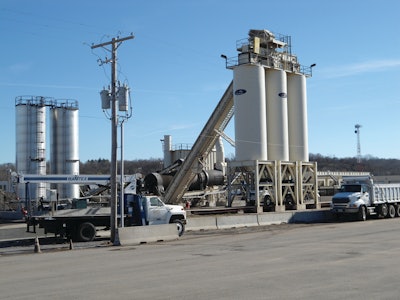
The Tarmac, Intl. counter-flow drum mix plant operates at 300 tons per hour. Currently, Hot Mix Materials sees an average sale of 200,000 tons per year producing roughly a dozen mixes including virgin asphalt, reclaimed asphalt pavement (RAP), recycled asphalt shingles (RAS) and warm mix. With the variety of mixes produced roughly 50 percent of material is the commercial mix design while the remaining 50 percent is a variety of specifications used in and around the Kansas City metropolitan area.
Mix materials
Hot Mix Materials utilizes reclaimed asphalt pavement (RAP) and recycled asphalt shingles (RAS). Due to the competition in the area, it was essential for Hot Mix Materials to include the materials in its asphalt production. “In 2009 we hired John Harris, and added a milling division to our company,” Conway says. John was a key component to getting this division up and going. “This addition gives us the best control over the amount of incoming RAP which is needed for our production purposes. Not only is this necessary to remain competitive in our marketplace, but it is also important for the environment.”
As a result, nearly 99 percent of sales are to private/commercial customers with a small percentage of sales going to surrounding cities in the Kansas City Metro area.
Since the plant has been opened, a warm mix package has been added to meet the demand for WMA. A track-mounted mobile RAP crusher has also been purchased to process the RAP that comes into the facility. “Many specifications are moving toward fractionated RAP (FRAP)—a fine, coarse gradation of material,” Conway says. “This unit allows us to process it to the gradation needed for the specific asphalt being produced.”
Currently, Hot Mix Materials purchases its RAS product from ARC, located in Kansas City, MO. ARC is able to provide a quality product at a reasonable price.
While the variety of mixes has offered several opportunities of growth for Hot Mix Materials, the introduction of RAS into the mixtures has been a challenge. “While it does save money and has great benefits for the environment, it has become a challenge on the production equipment,” says Conway. “The ingredients that make the asphalt shingles are different from the road asphalt mix. When adding to the plant, it creates many headaches for those who use them.”
As a result, Hot Mix Materials has implemented a few changes to the plant. “To meet the tough challenges that we were faced with in introducing RAS, we have made several changes in our drum flights that have helped us to increase our RAS percentage,” Conway says. “These were necessary due to the RAS sticking and plugging up the system.”
Gaining momentum in a competitive market
In order to find success in any industry, it is crucial to differentiate the company from its competitors. Hot Mix Asphalt has achieved such success by focusing strictly on production. Unlike most plants, the decision to be strictly a producer versus a producer that has its own paving crew has proven fruitful for Hot Mix Material because it is not bidding against customers.
“We are no longer in the lay-down business, and it was Chuck’s decision to only be a producer,” Conway says. “We felt this would be the best for our business so that we wouldn’t be a ‘competitor’ to our customer base.”
Conway also believes that customer service continues to set the company apart from its competitors. “Our philosophy is and will always be customer service,” he says. “We believe that Hot Mix Materials does a better job with customer service than our competition.”
He credits the quality of the plant staff for maintaining a high-level of customer service. “We do our very best to meet all of our customers needs each and every day,” Conway says. “We don’t believe on waiting for the call, we make it. Our Plant Manager, Ted Knight and his crew realize the importance of being ready to provide our customers their material on time. Our milling division and office staff work equally as hard to satisfy the customer.”
As the economy turns around, Conway has plans to continue offering customers top-notch service. “We will do whatever it takes to give the best service possible,” he says. “That could be increasing the size of our current facility or adding another facility down the road.”