The Senate Environment and Public Works Committee released a draft of the transportation bill late last Friday and plans to mark up the bill today. The EPW committee’s portion of the bill covers what’s known as the “highway” title. (The Banking Committee is responsible for writing the “transit” title and the Commerce Committee covers rail and safety. Those sections of the bill have not been released yet.)
We’ve prepared a short few pages on what MAP-21 means for the federal transportation program. This top-line analysis is a bit on the wonky side, but hopefully it’ll be helpful if you’ve been trying to summarize the 600 pages of bill text.
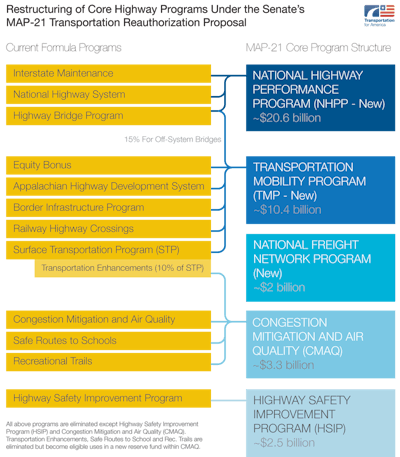
One of the most visible changes MAP-21 makes is to restructure seven core highway programs and 13+ formula programs into just five core highway programs. This graphic below illustrates those changes.
MAP-21 consolidates numerous FHWA programs into five core programs. The new program structure is as follows.
National Highway Performance Program (NHPP): ~$20.6 billion
This new program focuses on repairing and improving an expanded National Highway System (NHS). The NHS is expanded from ~160,000 miles to ~220,000 miles. States are required to develop asset management plans and as a part of these plans establish performance targets for the condition of roads and bridges and the performance of the system. In addition, the program includes provisions to hold states accountable for the repair of Interstate pavement and NHS bridges by requiring that they spend a certain amount of funding on the repair of those facilities if they fall below minimum standards established by USDOT.
Transportation Mobility Program (TMP): ~$10.4 billion
TMP replaces the existing Surface Transportation Program (STP) and allows states and regions to invest flexible dollars in a broad set of highways, transit projects, freight rail projects, and bicycle and pedestrian projects, as well as other activities like travel demand management. Fifty percent of these funds are suballocated to areas in the state based on their population. While this percentage is lower than the current 62.5 percent, the absolute amount of funding to be suballocated will remain the same due to an increase in program size.
Highway Safety Improvement Program (HSIP): – $2.5 billion
Funding is provided to states to improve safety for all road users on all public roads. A road user is defined as both motorists and non-motorized users. States are required to collect extensive data on crashes and create a database containing information on safety issues for all public roads including identification of hazard locations. (8% of all funds in this program are set-aside for data collection.) States must also develop a strategic highway safety plan using the data collected. If states do not develop a strategic highway safety plan within a year using a process approved by USDOT, they are required to spend additional funding on safety projects. States are also required to develop performance targets on fatalities and serious injuries.
Congestion Mitigation Air Quality Program (CMAQ): ~$3.3 billion
In the CMAQ program there are two pots of funding – one that funds typical CMAQ projects and another “reserved” fund.
CMAQ pot. Funds are provided to states and tier I Metropolitan Planning Organizations (MPOs) to address the impacts of the transportation system on national ambient air quality standards. In states with non-attainment or maintenance areas, 50 percent of the funds are suballocated to tier I MPOs based on the area’s status with national ambient air quality standards. Funds cannot be used to construct new travel lanes except for HOV or HOT lanes. USDOT is required to develop performance measures for air quality and congestion reduction. Tier I MPOs that receive funds under this program are required to develop a performance plan that outlines baseline conditions, targets for each of the performance measures developed by USDOT, and a description of projects to be funded, including how those projects will help meet the targets.
“Reserved” pot. This pot of funding is equal to the amount of funds provided for the Transportation Enhancements set-aside in FY09. Eligible activities under this pot include the following: transportation enhancements, safe routes to school, recreational trails, environmental mitigation, and certain types of road projects (including street redesigns and HOV lanes). States are allowed to use these funds for CMAQ projects (the first pot) if they build up an unspent balance of year and a half worth of funds.
National Freight Program: ~$2 billion
USDOT is directed to establish a primary freight network consisting of 27,000 miles of key freight corridors. States can use funds for highway projects that improve freight movement with a focus on the primary freight network and key rural freight corridors. A state may use up to 5 percent of funds for rail or maritime projects subject to certain conditions. USDOT must also develop a National Freight Strategic Plan, which will analyze performance and conditions on the primary freight network, identify bottlenecks, estimate future freight volumes and identify best practices for mitigating impacts of freight movement on communities. USDOT shall publish a Freight Condition and Performance Report on a biennial basis. States must establish performance targets and report on progress every two years.
Other key components
TIFIA program – $1 billion. MAP-21 expands the TIFIA program from $122 million to $1 billion and modifies the program from a competitive application process to a rolling application process. Provisions have been added that allow for applicants to enter into master credit agreements to provide funding for a suite of projects at once. In addition, there are modifications that make it easier for public transportation agencies with dedicated revenue sources to apply for TIFIA loans.
Planning and Performance. MAP-21 creates performance measures for conditions on the National Highway System (NHS), NHS performance, safety, freight, congestion mitigation and air quality. As part of the development of the plan, states and large MPOs shall analyze the baseline conditions for the performance measures and establish performance targets for each performance measure. The plan must include the future performance of their transportation system with regards to these performance measures including whether or not they will achieve their performance targets. Large MPOs may undertake scenario planning as a part of the development of their long-range plans. Smaller MPOs are required to develop long-range plans and USDOT will establish rules that provide for the standards they must meet regarding the performance measures required for the larger MPOs.
Statewide transportation improvement programs (STIPs) and metropolitan transportation improvement programs (TIPs) must include performance measures and targets used in assessing the existing and future performance of the transportation system. A system performance report must include progress toward achieving state performance targets.
Project Delivery. MAP-21 includes numerous provisions intended to accelerate project delivery. Most of these provisions relate to administrative actions to be taken by USDOT. There are also provisions that relate to expanding the types of projects that can be undertaken through a categorical exclusion (a more limited environmental review). In addition, it allows for the earlier acquisition of right-of-way.
MAP-21 – Possible Impacts of Revised Core Transportation Programs (TransportationIssuesDaily.com)