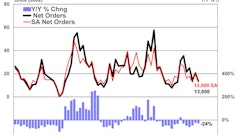
Associated Builders and Contractors (ABC) today reports its Construction Backlog Indicator (CBI) rose 4.3 percent in the second quarter of 2012 after declining the two previous quarters. Despite the quarterly expansion, CBI is 0.3 months, or 4.2 percent, below the second quarter of 2011. CBI is a forward-looking economic indicator that measures the amount of construction work under contract to be completed in the future.
“The CBI accurately predicted both the broader economic softness experienced during the first half of 2012 as well as a flattening of the nation’s nonresidential construction recovery,” said ABC Chief Economist Anirban Basu. “The latest CBI data is now projecting gradual acceleration in nonresidential construction spending, and perhaps a slight increase in the overall pace of construction activity going forward.
“Unfortunately, any improvement in nonresidential construction activity is likely to remain modest given the ongoing uncertainty regarding America’s fiscal cliff - a number of tax increases and spending cuts that take effect at the end of the year - as well as European sovereign debt issues and increasingly volatile energy prices,” Basu said. “While there is pent-up demand for new construction in the power, manufacturing and infrastructure segments, the level of economic and political uncertainty remains far too elevated to permit more aggressive nonresidential construction spending recovery in the near term.”
Regional Highlights
- During the second quarter of 2012, construction backlog expanded in three of the four regions of the country compared to the first quarter, with the exception of the South. Despite its quarterly decline, the South continues to report the lengthiest backlog at 8.75 months.
- The West registered the largest quarterly gain among the four regions, with construction backlog rising from 6.6 to 7.5 months.
- The Northeast had the smallest gain in construction backlog at .05 months for the quarter, and is now at 7.28 months.
- Construction backlog in the Middle States dropped .21 months from one year ago and is the shortest in length at 6.73 months.
“The South continues to lead the way in construction backlog, due to commodity related production, including food processing, oil and natural gas as well as substantial investment in manufacturing plants and equipment,” said Basu. “However, average backlog has declined for three consecutive quarters in the South, which may be due to a bit of a slowdown in energy-related investment because of the low price of natural gas.
“In contrast, the West has experienced increasing backlog for two consecutive quarters and arguably enjoys more forward momentum than any of the four regions monitored by ABC,” Basu said. “California’s innovation economy, Washington’s active aerospace and technology industries and Arizona’s overall economic improvement are creating new opportunities for contractors, both directly and indirectly.”
View complete regional trend data.
Industry Highlights
- During the second quarter of 2012, average construction backlog rose for all monitored industry segments after declining the two previous quarters.
- The infrastructure segment registered the largest quarter-to-quarter construction backlog increase, up 1.4 months to more than 10 months - the first time infrastructure backlog has been above 10 months since the second quarter of 2010.
- Construction backlog in the heavy industrial category is at its highest level since the first quarter of 2011 but at the lowest level of all the industry segments at 5.92 months.
- Construction backlog in the commercial and institutional segment is 0.85 months lower than one year ago and now stands at 7.78 months.
“Both the infrastructure and the heavy industrial categories experienced meaningful and significant increases in construction backlog during the second quarter,” said Basu. “From a macroeconomic perspective, there is significant demand for more competitive infrastructure and for American alternatives to foreign-manufactured goods. The re-shoring of production to the United States appears to be creating new opportunities for construction workers, particularly in the South.
“Progress in the commercial and institutional category may be a bit slower in the near future,” Basu said. “Spending continues to be hamstrung by a combination of weak investment returns and cautious financiers; however the CBI data indicates gradual increases in construction spending in this sector in the coming months.”
View complete industry trend data.
Highlights by Company Size
- Construction backlog for the largest construction firms expanded during the second quarter to nearly 10 months. This includes firms with annual revenue in the $50 million to $100 million category and the $100 million or more category.
- Firms with annual revenues in the $30 million to $50 million category saw a slight decrease in construction backlog from the first quarter but remain above 9 months for a second consecutive quarter.
- Construction backlog among firms with less than $30 million in annual revenue was below 7 months for the second consecutive quarter.
“For several quarters, much of the improvement in backlog had been among smaller firms,” said Basu. “However, much of the expansion in the second quarter occurred among larger firms as a result of improved construction spending dynamics in the infrastructure and heavy industry categories.
“Smaller firms have tended to benefit disproportionately from improvements in commercial construction and construction related to lodging,” Basu said. “Consumer spending growth has become more erratic of late, implying that the pace of improvement in commercial construction and other forms of construction dependent upon consumer spending may not be as rapid going forward. Correspondingly, backlog among the smallest contractors, those with less than $30 million in annual revenue, has not improved significantly during recent quarters.”
View company size trend data.