Sparked by rising home prices across much of the nation, the housing recovery is now under way, but fiscal uncertainties and other challenges could result in a bumpy ride in the coming months, according to economists participating in the October 17 National Association of Home Builders (NAHB) webinar on the construction and economic outlook.
“We’re seeing a more robust housing sector than many other parts of the economy,” said NAHB Chief Economist David Crowe. “One of the reasons is we have finally begun to see on a national scale that house prices are picking up again.”
Crowe cited a number of other factors that are carrying the housing momentum forward, including:
- Pent-up household formations
- Rising consumer confidence
- Increasing builder confidence in all three legs of the industry: remodeling, multifamily and single-family construction
- Growing rental demand
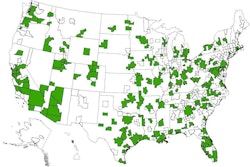
- More than 100 metros currently on the NAHB/First American Improving Markets Index
However, Crowe offered several cautionary factors that continue to put a drag on housing activity at this time – including builders who are experiencing difficulties in obtaining production credit, qualified buyers who are unable to obtain mortgage loans, inaccurate appraisals, seriously delinquent mortgages that are at least 90 days late or in foreclosure, and a limited inventory of developed lots in certain markets.
Other causes contributing to uncertainty in the marketplace include the looming “fiscal cliff” that will trigger mandatory budget cuts and tax increases at the beginning of next year, pending Dodd-Frank Act regulations that are making financial institutions hesitant to lend since they don’t know how the new rules will affect them. Other areas of uncertainty include tax reform and the future role of Fannie Mae and Freddie Mac in the nation’s housing finance system.
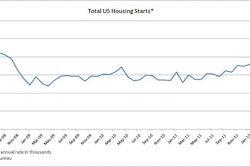
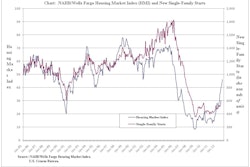
NAHB is forecasting a 21 percent increase in single-family starts this year to 528,000 units and a further 26 percent climb to 665,000 units in 2013.
Multifamily housing starts are expected to rise 26 percent this year to 224,000 units and 6 percent in 2013 to 238,000 units.
Optimistic housing outlook
Expressing a more bullish outlook on housing and economic growth, Mark Zandi, chief economist for Moody’s Analytics, forecast that GDP growth will range in the 2 percent range this year and next and “double that growth closer to 4 percent in 2014 and 2015.” At the same time, he expects job growth to go from two million per year to closer to three million in 2014 and 2015.
“A big part of this optimism is the housing market,” said Zandi. “I expect 1.1 million total housing starts in 2013, 1.7 to 1.8 million in 2014 and over 1.8 million in 2015.”
Zandi noted a range of assumptions behind this rosy forecast, including the expectation that mortgage rates would remain very low, the availability of housing credit will improve as private mortgage lending begins to pick up, and the job market gains traction as policymakers work to resolve fiscal issues, which will ease market uncertainties.
Specifically, Zandi cited three critical fiscal policy concerns:
1. The fiscal cliff. If policymakers do nothing, the combination of pending tax increases and spending cuts set to take effect in January could produce a fiscal drag of four percentage points, Zandi said, which would throw the economy back into recession. “Hiring will remain weak until this is resolved,” he said.
2. Treasury debt ceiling. By late February or early March, the Treasury is expected to hit its debt ceiling. A failure to raise the ceiling would prevent the U.S. government to borrow to meet its existing legal obligations, including the issuance of monthly Social Security checks.
3. Achieve fiscal sustainability. Zandi said that federal government expenditures as a percentage of GDP is 24 percent and revenues are 17 percent. He said this seven-point gap needs to be slashed to closer to two percentage points of GDP. “We need spending cuts and tax revenues to narrow future deficits,” he said. “If we can’t do that, bad things will happen.”
Acknowledging that these challenges won’t be easy, Zandi said his forecast is based on the assumption that Democrats and Republicans will eventually strike a deal on these contentious issues because each side has much to lose. Democrats, he said, don’t want to see tax cuts for the wealthiest Americans, and Republicans don’t like the defense cuts mandated by sequestration.
If the nation has the “political will to address the fiscal issues in a reasonable way, I think we will be off and running,” said Zandi.
A gradual climb to normal
Robert Denk, NAHB’s assistant vice president for forecasting and analysis, cited a range of differences among the states in the amount of pain suffered during the recession and the progress that is being made in recovering.
The hardest hit states - such as Arizona, Florida, California and Nevada - bottomed out the furthest during the downturn and still have much ground to make up.
Meanwhile, several energy producing states - North Dakota, Texas, Oklahoma, Montana and Wyoming - will be back to normal levels of housing production by the end of 2014.
On a national basis, housing starts are projected to get back to 55 percent of normal production by the end of next year and 70 percent of normal by the end of 2014, Denk said.