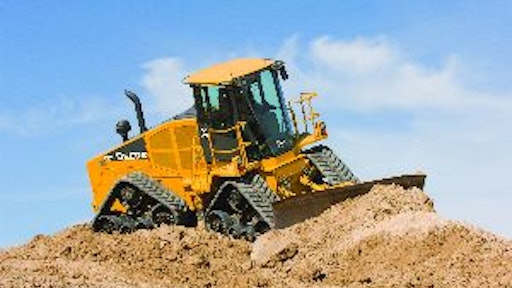
After a decade of slow evolution, 2008 marks the advent of revolutionary change in dozer designs. Convention has been placed on the sideline as ?clean sheet? designs have resulted in the introduction of unique solutions to previous limitations. Following is a look at three of the most innovative concepts introduced this year.
Defining a new machine category
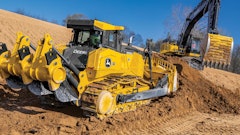
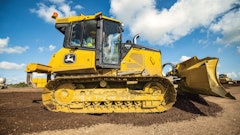
This Spring, the John Deere 764 HSD (High-Speed Dozer) took CONEXPO-CON/AGG attendees by surprise. With a profile unlike any dozer currently on the market, the quad rubber-tracked 764 HSD is intended to bridge the gap between a dozer and a motor grader in certain applications.
?It is going to show really well in any application that requires a machine with pushing ability that can work around finished pavement, plus requires mobility on a jobsite,? says Dan Drescher, product market manager - crawlers, John Deere Construction & Forestry. ?If you are targeting primary applications, they would be roadbuilding and large site development.
?[It] is not going to do everything that a motor grader does, nor everything that a dedicated dozer will do,? he admits. ?It will bridge that gap and do a little bit of both.?
There are many utility applications where a small dozer and a motor grader would be under utilized. For example, the 764 HSD could replace a finish dozer and a grader in applications where you are simply finishing up a building pad or a section of road. ?It has the potential on a site to replace some of the machines that are only working part of the time,? says Drescher. ?You can then dedicate those machines to another job where they are working all of the time.?
The unique specifications of the 764 HSD give it advantages in certain applications. With a 22-ft. 5-in.-long base, it is longer than a traditional dozer, enabling faster grading speeds. ?We are able to final grade at up to twice the speed of a steel track machine,? notes Drescher. ?As the technology advances for grade control systems, we will probably exceed that a little bit.?
The length combined with 6.2-psi ground pressure and center-pivot articulation offer some unique operating characteristics. ?It allows you to do some pretty close in and precise work, like fine grade rock in a finish parking lot,? says Drescher. ?It has the flotation of a dozer and the grading ability of a motor grader in that case.? He claims the 764 HSD would actually be more maneuverable than a grader in this situation.
In addition, an 18-mph top speed through its hydrostatic transmission allows the 764 HSD to move quickly across large jobsites. ?Because it does have rubber tracks, you can go across any paved or finished structures without damage to the surfaces,? says Drescher. ?You eliminate the need to either board over the surface or put the equipment on a lowboy and haul it to the end of the site.?
For jobsites that are close together, the 764 HSD can easily be roaded. ?It has turn signals, flashing warning lights and slow-moving vehicle license plate capability,? notes Drescher.
At 200 hp, the 764 HSD is not going to replace a primary scraper tractor. But it is equipped to pull rear-mounted attachments such as sheepsfoot compaction wheels, land planes or smaller pull-type scrapers. ?We have shown it is a real versatile machine with an 11- or 12-yd. dolly wheel scraper,? says Drescher.
The cab-forward design isolates the operator from the drivetrain and provides visibility to the six-way blade. This reduces operator fatigue.
The 764 HSD does have its limitations. It is not well suited to deep cut or virgin dozing, land clearing and rocky soils. It is also less efficient at grading large sections of road compared to a dedicated motor grader. However, in applications where versatility and multiple uses are keys to success, it will provide an attractive solution.
The goal is to increase the utilization rate of all equipment on the jobsite. ?To utilize it right, you are going to be replacing [under-utilized] machines today and also taking advantage of the mobility and high speed,? says Drescher. ?The mobility and speed allow you to just do some jobs a lot quicker.?
Electric drive increases efficiency
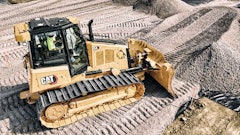
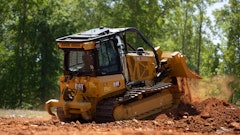
The Caterpillar D7E is generating a lot of excitement due to its revolutionary drivetrain design. But don?t get confused ? this is not hybrid technology.
?The D7E has electric drive. There is no complex switching back and forth between the systems,? explains Amy Moore-McKee, new product manager, Caterpillar. ?Essentially, the engine drives a generator to continuously supply electricity to power the drive motors and the other machine systems.?
This translates into increased fuel efficiency. ?The engine is optimized to run at a lower rated speed and in a narrower operating range,? says Moore-McKee. ?In addition, the electric drivetrain is also much more efficient than a powershift transmission with a torque divider. There is no gap between gears on the shift curves. When you bring both the engine and the drivetrain together, that?s where we get up to a 20% reduction in fuel usage.?
The continuously variable transmission allows maximum power to the tracks at all speeds, increasing productivity. ?We have demonstrated on average that 10% more material can be moved per hour,? says Moore-McKee. ?When you combine the productivity increase with the fuel efficiency, the result is 25% more material moved per gallon.?
With these types of gains, why wasn?t this technology implemented sooner? ?What enabled this to happen is the recent developments in the semi-conductor power control industry,? Moore-McKee notes. ?You can now get silicon semi-conductors that handle very large power flows with more capacity and at a lower cost. That is really the technology enabler that gives us the ability to use AC systems in large drives like this, compared to the old DC systems. Those used to be very maintenance intensive, hard to control, hard to maintain.?
The electric drive used on the D7E is not exactly the same technology used on mine haul trucks. ?In order to meet the really demanding application needs of a track-type tractor, all of the electric components had to be fully sealed,? says Moore-McKee. This means the electric motors can?t be air cooled, like on the trucks.
?We sealed and liquid cooled the motors, which makes it more robust. Everything is sealed electrically so it can operate in all the same conditions that the D7R can, even partially submerged in water up to the fan blades,? Moore-McKee states. ?We really wanted to design a tractor that could eventually replace the D7R.?
In terms of reliability, the company expects the D7E to perform as good, if not better, than the D7R. ?The D7E has 60% fewer moving parts,? says Moore-McKee. ?So there are fewer components to wear out or potentially break. The components it does have require less service than on any other drive system available.? For example, there are no friction clutches. ?That contributes to a longer drivetrain life and low service requirements.?
Despite a higher initial price, the customer payback is less than two years. ?We are able to do much more in a D7 size class in terms of productivity for the operating cost of a D6. We are doing more with less,? Moore-McKee asserts.
And it is scalable to both larger and smaller tractors. The D7 was purposely designated as the first model. ?It is the perfect mix of heavy-duty dozing and light-duty applications,? says Moore-McKee. ?We wanted to prove this kind of powertrain can work in both applications. The D7E has been able to optimize both. We have superb speed control for fine grading. We have incredible AccuGrade performance.?
Being a totally new design allows designers to address reliability nuisance items that can create downtime and plague some equipment ? for instance, belts, friction clutches, engine-mounted compressors and alternators and long refrigerant lines. ?Those things are not just fixed, they are eliminated,? says Moore-McKee. ?When you design a whole new tractor from the ground up, it gives you an opportunity to look at the whole system anew. The D7E is a quantum leap not only in drivetrain efficiency, but reliability as well.?
Cab forward eases operation
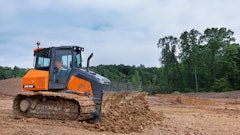
For its D51-22 dozers, Komatsu completely re-arranged the traditional dozer configuration by using a cab-forward design with a Super Slant nose. Then it followed suit with its D39-22, D37-22 and D31-22 models.
The cab-forward design would not have been possible with a traditional dozer design, since it is essential to keep the tractor balanced. ?One of the advantages of having a new ground up design is you have a clean slate from which to start,? says Bruce Boebel, product marketing manager - dozers, Komatsu America Corp.
A cab-forward design ? which moves the operator about 2 ft. forward on the machine ? has several advantages. ?With the smaller machines, the operators are more productive,? says Boebel. ?They are able to see obstacles a lot sooner. They are able to react a lot quicker, especially in tight spots. You can easily take a younger operator, put him in our machine and he is going to get up to speed a lot faster. The learning curve is a lot less.?
Operator placement on the machine also influences comfort. ?You are actually more forward on the machine, which is closer to the center of balance. The end result is you are not getting jarred as bad in the rear of the machine as in the past,? Boebel comments.
To aid visibility even further, the cooling package has been moved to the back of the tractor and the nose is steeply sloped. This also allows for increased cooling efficiency. ?We have an electronically-controlled, hydraulically-driven fan,? Boebel explains. ?Basically, it runs only at the speed it needs to; therefore, it is more efficient. We had enough room open up that we could put all of the coolers side by side so they are not stacked, increasing cooling efficiency.?
In addition, these dozers use new generation hydrostatic transmissions. For example, past drive motor designs had three steps or positions that would abruptly shift under varying loads, says Boebel. ?Our drive motors are now infinitely variable along with the hydrostatic pumps, so they don?t lose pushing power in turns with a heavy load on the blade,? he states. ?It increases productivity and fuel economy, as well. The machine is always running at optimum performance.?