As warm mix continues to develop as a viable option for asphalt paving projects, Knife River, an MDU Resources Company, spearheaded three test projects in 2007 to gain a better understanding of the technology and prove to road agency customers that it meets the same performance specifications of hot mix in a more environmentally-friendly manner.
One project in particular, Nebraska Department of Roads' Highway 12 between Verdel and Monowi in Knox County, also demonstrated that a long haul from plant to paver posed no challenge in achieving density compaction.
In early summer of last year, Knife River Midwest and Jebro Inc., another MDU Resources Company which supplies liquid asphalt binder, proposed a research project using the warm mix technology.
The asphalt producer/paving contractor proposed using one of three additives ? Evotherm, Evotherm DAT or Sasobit ? to produce the warm mix, with the Nebraska DOR finally specifying the Sasol wax brand, which Jebro blended into two different percentages ? 1.5 percent and 2.5 percent ? for test purposes that would allow Knife River to evaluate the benefits of using an extra 1 percent of the additive.
"We've been interested in exploring warm mix and we thought this would be a good project for our tests. We wanted to evaluate the fuel savings, increased workability, rolling patterns, increased haul distance, emissions (blue smoke), decreased aging of the binder, and the properties of the binder when Sasobit is added," notes Mike Collins, Knife River Midwest AMA Manager.
The 6.9-mile-long, two-lane project was located on Highway 12 approximately 85 miles northwest of Sioux City, IA. It was a typical mill and fill, with 1.5 inches of the oxidized and rutted surface course removed and replaced with a new 2-inch SP-4 Special (Superpave) overlay rated at 10 million ESAL mix design with gyratory level of 117 gyrations.
The binder for the project was a PG 64-28. Total mix required to complete the project was 11,570 tons, with the first 6,000 tons consisting of conventional hot mix asphalt and the remaining 5,570 tons of warm mix (half of the warm mix was produced with 1.5-percent Sasobit in a mix design containing 6-percent liquid asphalt and the other half with 2.5 percent).
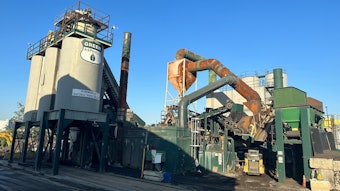
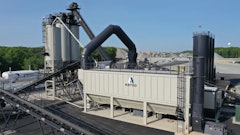
Since the warm mix project was relatively small, Jebro blended the Sasobit with the binder at its terminal in Sioux Falls rather than Knife River installing equipment to blow in the additive at its production facility. All the mix required for the project was produced with a portable Cedar Rapids 400-tph parallel-flow plant that was set up in Tabor, SD, approximately 60 miles northeast of the project.
Determining the temperature drop during the long haul from the plant to the project was somewhat of a concern when planning the project. With hot mix, Collins said it was determined that the mix would have to leave the plant at around 325 degrees F in order to maintain a temperature of 290 degrees behind the paver screed.
"It's a typical temperature for us when working with a polymer modified hot mix," Collins says.
Mix for the project was constructed of quartzite and locally crushed gravel, with both materials presenting low absorption rates. Start-up temperatures on the conventional hot mix ran as hot as 340 degrees, but eventually settled in at 315 to 320 degrees. Because of the higher temperatures and long haul, blue smoke was an issue.
"We monitored the load (speed) on the hot leg conveyor and the baghouse temperature (265 degrees when producing the hot mix) to help gauge changes during production of the warm mix," Collins says. "We also monitored temperatures at the plant and the paver. Monitoring those temperatures were important in determining the rolling pattern required to achieve density for both the hot mix and the warm mix. With the hot mix, the temperature generally dropped 10 to 15 degrees during the haul and another 20 to 25 degrees from its windrow placement to the screed. But with the hot mix we were still able to achieve an average density of 94 percent (specifications required a 92.5+ percent density)."
From hot to warm
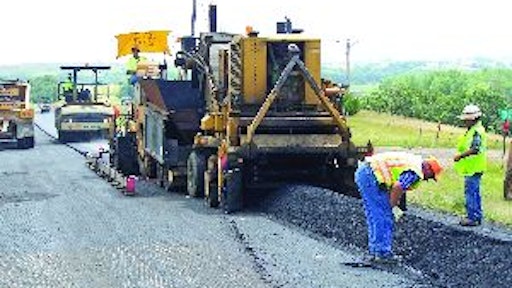
After three days of hot mix placement, the Knife River production and paving crews switched over to the warm mix portion of the project. The warm mix portion was divided in two, with the first half containing 2.5-percent Sasobit (the first project in the United States to use that percentage of the additive) and the second half with the conventional 1.5-percent Sasobit content. As Collins noted, European warm mix projects use 2.5-percent Sasobit because of the harder binders used in the mixes designed.
"We wanted to try a higher Sasobit content to determine if there were any added benefits," Collins says. Sasol told us to anticipate a temperature drop of 50 to 60 degrees with a 1.5-percent Sasobit content and by adding an extra 1 percent we were hoping for a temperature drop (during production) of 70 degrees."
With the recorded amperage pull on the hot leg motors during the hot mix production, Knife River's production crew started out producing the 2.5-percent warm mix at 70 degrees lower temperature than what they produced the hot mix. The amperage pull was similar to that during hot mix production, so the production crew maintained the temperature for the day's production to see what kind of density would be obtained out on the project.
The noticeable difference in placement of the warm mix was in how fast density was achieved in the rolling pattern. While there was virtually no difference during the breakdown phase of the rolling pattern, there was very little additional compaction achieved during the intermediate phase of the rolling pattern.
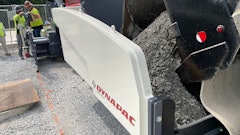
With a density reading of 94 to 95 percent, Collins production and paving crews decided to lower the production temperature from 255 degrees to 225 degrees on the second day of the warm mix application. They were still able to achieve 93 to 95 percent density, but the paving crew also learned the screed heater had to be left on during the day to prevent a 3-foot-wide "shadow" in the center of the mat, which was caused by a cold screed dragging across the cooler mix.
After placing the 2.5-percent mix, crews switched over to the 1.5-percent mix. The only adjustment made to compensate for lower Sasobit additive in the mix was to increase the production temperature to about 265 degrees.
"We could have lowered the temperature about 20 degrees and still maintained our density requirements, but we were concerned about the drop in the baghouse temperature," Collins says. "When your baghouse temperature is running around 265 degrees with a conventional hot mix, you become a little concerned about the temperature dropping to 200 degrees during warm mix production. When you drop below the boiling point of water (212 degrees), you run the risk of moisture build-up in your baghouse which could cause the bags to plug and reduce airflow."
Project benefits
The primary benefit for most asphalt producers/contractors in utilizing warm mix technology is the cost savings generated in the fuel required to produce the mix. While some reports project a fuel savings of 30 to 50 percent, Collins says on this particular project Knife River achieved a 15-percent reduction in overall fuel usage.
The average fuel usage for convention hot mix was from 1.3 to 1.7 gallons per ton of mix produced, 1.3 to 1.5 gallons per ton when producing the warm mix with 2.5-percent Sasobit content at temperature 70 degrees lower than the hot mix.
The fuel savings on this particular project basically offset the additional cost of the Sasobit additive. With hot mix costing approximately $30 a ton and warm mix $32 a ton (Sasobit for the project cost $1.12 per pound), it's easy to question the cost-savings advantages when comparing only the fuel savings. But Collins believes additional savings can be achieved by eliminating the intermediate roller in the rolling pattern.
But what's probably a more notable benefit of warm mix, according to Collins, is the reduction of blue smoke and other emissions.
"From an environmental perspective for customers, neighbors around your plant facility, and crews producing and placing the mix, warm mix eliminates a lot of those concerns while delivering the same density requirements and quality mix," Collins says. "So for us, the project did prove we can produce a quality mix at a lower temperature, eliminating emissions in the process; haul that product a long way and place the product (without the blue smoke) and achieve density and ride specifications. We also know it will extend our paving season, and the lower temperature required to produce warm mix will extend the life of the binder."