
Safety doesn't just happen; you must recognize the potential hazards, then work to mitigate them. With cranes, the biggest risks include tipovers, electrocution and bystanders getting crushed by loads.
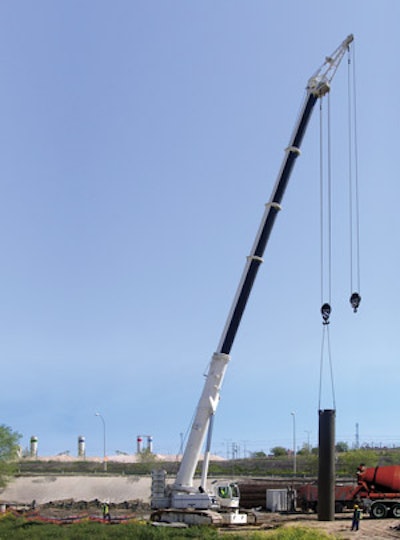
"For mobile cranes, the leading cause of accidents is the tipover," says LeRoy LaMar, trainer for Arxcis, Inc. "Improper crane setup is the primary cause."
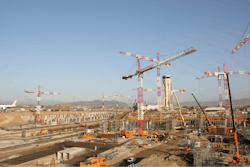
Ingo Schiller, vice president of sales, Liebherr Cranes, Inc. reports that as many as 80% of crane tipover accidents are caused by either insufficient support for the crane, or failure of the ground to support the crane. "A lot of the cranes are used in urban environments," he adds. "There are cases where they set up cranes on top of a concrete collection point for a sewer system and it punches through. There is a void under the ground, the outrigger is set on top of it and it goes through."
Improper operation is another factor. "More tipovers occur with smaller cranes, such as rough-terrain cranes and boom trucks, than with larger all-terrain cranes. One of the reasons is that owners of the larger cranes are more selective of who is operating the crane," LaMar notes. "The smaller cranes, especially the boom trucks, are often operated by workers with little training or experience and the result is often the crane tipping over."
Check ground conditions
Ensuring proper ground support goes a long way toward preventing tipovers. You need to know what is under the ground. "Most large cities require a survey and an engineering company to come out and determine where to set up the cranes," says Schiller. "They have to do research and see what is underground. Every once in a while, something is not where it is supposed to be."
In more remote locations, the primary focus may shift toward soil conditions. "When you talk about greenfield projects, it is more a matter of seeing that you have sufficient mats underneath the outriggers to support the crane on raw earth," says Schiller.
On smaller cranes and boom trucks, always make sure the outriggers or stabilizers are fully extended. Also make sure the crane has been correctly leveled, and you are not working on slopes with poor cribbing under the outriggers/stabilizers.
Computer-based lift planning software can be useful for large cranes. "Lifts can be laid out and determined ahead of time so that exact ground pressures will be known," says Schiller. "You can quickly determine how large the mats need to be in order to properly support the crane. We also offer optional pressure monitoring systems to measure the pressures on outriggers so the operator can observe that. If changes occur over the course of his work, he can see if there is a soft spot in the ground."
Stick to the charts
Trying to lift too much weight can also result in a tipover, so don't "fudge" safety factors. "It is never safe to operate outside of the load chart," says LaMar. "Load charts are established assuming the crane is in perfect operating order; on solid, level ground; [there is] no wind or other adverse weather condition; and the operator is competent. Many construction sites have less than perfect areas for setup. The assumption that the cranes have a large safety factor is not correct."
In addition, not all cranes are comparable in their design. "The challenge is that cranes built 20 years ago were built differently than they are today," says Schiller. "They were not optimized as far as the sizes of components and the weight of the crane. So with very few exceptions, the crane would tip over before it would break. You started doing more and more until the crane started to tip and then you would back off. That doesn't work anymore."
The designs have progressed. "With the cranes being designed in a more sophisticated manner, and weight being a concern, there are more areas on the chart where the crane will break before it tips over," says Schiller. "You really need to stay within the load chart."
When using load charts, the operator must know how to calculate all of the variables. "There are tables to calculate deductions to the load chart based on the sail area of the load," says Schiller.
You must also consider environmental conditions. "Rain can cause ground conditions to change, which may decrease the crane's stability," says LaMar. "Wind will affect load control and can increase stress on the boom. Even though a crane manufacturer may state an upper wind speed limit, the operator is responsible for determining how safe it is to work under any wind conditions. Low temperatures may affect the structure of the crane and the manufacturer should be consulted."
Personnel safety
Common sense says you want to keep as many people clear of crane operations as possible.
"The swing area around the crane should be barricaded," says LaMar. "When loads will be lifted over areas where workers are, they need to be warned and a clear travel route established. All workers need to receive safety training with regard to crane operations, and must be required to wear the proper personal protective equipment (PPE)."
Also pay attention to the surroundings. "The simplest thing is don't put yourself under the load," says Schiller.
"In addition, what makes for good crane operation, makes for safe ground operation," Schiller points out. This means ensuring correct support of the crane, correct positioning, working within the chart, correct configuration and proper crane maintenance.
Prevent electrocution
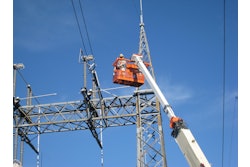
The first step in preventing electrocution is to try to avoid power lines. "Select a site as far away from the power line as possible," says LaMar. "Whenever a crane is working where it is possible for it to come in contact with a power line, a spotter should be assigned to monitor the crane and alert the operator via some type of audio device (horn) when he is coming close to the lines. Proximity alarms are sometimes used to warn the operator, but they should not be solely relied on."
The legislated clearances for power lines are:
- 50 KV - 10 ft. of clearance
- 50 to 200 KV - 15 ft. of clearance
- 200 to 350 KV - 20 ft. of clearance
"But in many cases, the operator is not aware of how many volts a power line is carrying," says LaMar. "Some power company managers suggest staying 20 ft. away from them." Whenever working over power lines, he advises contacting the power company.
The use of the latest technologies, such as insulated links, can also protect ground crew and operators. According to Schiller, insulated links can be provided between the hook and the rigging and for use on the tag lines. "Rubber gloves and rubber boots are also supplied for the folks on the ground," he says. "The insulated link will protect the crane and also protect the people handling the tag lines because they are also going to be insulated."
When a crane does hit a power line, it is important for the operator to stay in the cab. "It's the nature of a crane that when the boom hits, electricity travels on the outside surfaces of metal. So the operator inside a cab is somewhat protected," says Schiller. The problems arise when operators step out of the cab and onto the earth where they ground themselves.
Don't rely on aides alone
"Manufacturers are providing fairly sophisticated computer systems that monitor various aspects of the crane during loading and lifting, and will stop the machine when it reaches its upper limit," LaMar notes. "But these are operator aides and should not be solely relied on. Also, these limit controls can be overridden. It's the [duty] of the operator to operate the crane responsibly."
The Load Moment Indicator (LMI) helps the operator identify the exact load on the crane at any given time. But it is not a substitute for a knowledge of the basics. "The crane remains simple in its basic concept," says Schiller. "It is simply a temporary structure from which you are lifting a load. It needs to have sufficient ballast to compensate for what it is trying to lift."
LMI systems help the operator figure out what the crane can lift and how far it can lift it. "But this information is also contained in the paper load charts," says Schiller. As such, if the LMI fails, it is still possible to conduct safe lifts. However, he adds, "The regulations are now written such that if the LMI system fails, it needs to be repaired as soon as practical."
Start with certified operators
According to the National Commission for the Certification of Crane Operators (NCCCO), currently 15 states and six cities require licensing for crane operators. (To find out requirements for specific states and cities, visit www.nccco.org.) However, licensing is only a starting point.
"Regardless of a state's requirements, the employer is responsible to see that the operator is properly trained, is evaluated for competency and is capable of performing the job," says LaMar. "Credentials may include a [certified crane operator] CCO certificate, records of formal training, operator log books and union documentation."
While not required in many states or cities, there is a very good argument to write CCO certification for crane operators into every project requirement. "At the macro level, from a risk management perspective, it makes total sense, because the project owner is in the position of needing all of the various subcontractors on site to meet a certain level of safety," says Graham Brent, executive director, NCCCO.
"With CCO certification, you know that the operator has the knowledge and the skill because we have a written and a practical test that the industry has determined to be sufficient to operate a crane safely," Brent adds.
The CCO was put together by the industry to provide an independent assessment of the crane operators' skill and knowledge. However, the NCCCO is not an educational entity. "We don't provide training because we want to be able to offer an independent assessment," says Brent. "If we also trained, we might have some investment in seeing those people that we trained certified. So it is really up to the operator and employer to decide what kind of training is going to be required."
CCO is an easy way to ensure that you are OSHA compliant. "OSHA requires a qualified operator," says Brent. "We were recognized by Federal OSHA in 1999. We have an official agreement that recognizes the program as meeting OSHA and ANSI requirements for crane operator qualification."
The CCO program is also accredited by the National Commission for Certifying Agencies. NCCCO is the only national organization accredited to certify crane operators.
NCCCO offers six categories of certification: four mobile crane categories, one tower and one overhead. "Right now, we are working on rigging certification and signal person certification," says Brent.
It is easy to check on the status of an operator. "Any operator who achieves any level of certification on at least one category gets a personal laminated ID card," says Brent. "That is his identification as to which categories he is certified." You can also call the NCCCO to have the operator checked against the database.
Due to the risk mitigation of using certified operators, many insurance companies support the program. Brent says he is aware of one company that offers up to a 10% premium discount incentive if you have a certain percentage of your operators certified. "Those insurance companies that are offering that premium discount," he adds, "know their insurance through certified operators is a better risk."