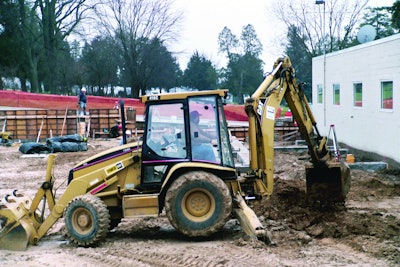
The backhoe-loader is one of the most popular pieces of construction equipment in the world, which should place safe operation as a top priority. Because the person in the operator’s seat is the one responsible for what the machine does, responsibility for safety largely rests on that individual’s shoulders.
Ironically, accidents often involve experienced operators. One reason is the overconfidence that comes with years of experience without an incident. According to VISTA Training, a firm specializing in heavy equipment operator training, working too close to an edge and operating on steep or uneven grades are the leading causes of accidents.
Clearly, operators need to think about every single move they make before they make it. But some loads change the center of gravity and affect machine stability. Slow, steady movement is the safest way to maintain control, VISTA Training advises. If the machine starts to feel unstable, stop everything until you regain control. Always keep the load as close to the ground as possible and don’t raise it until you arrive at the spot where you are going to set it.
Safety first
Safe practices should begin before the machine is even started. First, perform a walkaround inspection. Next, make sure all functions are operating properly and the machine is set for safe, comfortable operation.
“After crawling into the cab, make sure the parking brake is engaged,” says Jim Blower, JCB. “Then make sure all of the controls are moving free. Get the seat into a position where you can reach all of the controls that you need to reach.” Then fasten the seat belt. “The machines are rated to be able to roll over, and the safest place for the operator in the event of a machine rollover is sitting in the seat.”
Greg Worley, marketing development engineer, Caterpillar, echoes the importance of fastening the seatbelt, adding, “Make sure you are familiar with all the controls. If you are going to road the machine, make sure your independent brake pedals are locked together. Then, adjust the seat and the steering wheel into the correct position for comfort and for being able to reach all controls safely.
“Make sure the boom is locked and the swing lock is in place if you are going to road the machine,” he continues. “Survey your surroundings once again before moving the machine, and sound your horn before moving off. Before you start to dig, make sure you are aware which control pattern has been selected for your machine (backhoe or excavator pattern).”
One of the biggest dangers of using the loader is vehicle and pedestrian traffic around you. Checking to ensure the backup alarm is working must be part of your routine daily inspection.
Create a stable digging platform
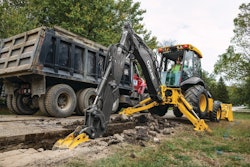
Backhoe-loader stabilizers serve two purposes. “You want stability over the side and you also want to stop the machine from sliding around when you are digging a trench,” says Blower.
According to VISTA Training, the best setup for backhoe work is when the stabilizers are spread to their full width and the loader bucket is in solid contact with the ground. If the tires are carrying the weight of the machine, it will bounce slightly, transmitting vibration to the operator and into the controls. This causes the machine to shake even more. For extra holding power, roll the bucket all the way over and dig in the cutting edge and sill plate.
“You really should not ever use the backhoe without the stabilizers down,” Blower emphasizes. “You will pick them up to move a machine when repositioning for trenching, but you really need to have the most stable platform you can get for digging and lifting purposes. The only way to stabilize a backhoe is to put those stabilizers down on firm ground.”
“We would not recommend using the hoe of a backhoe-loader without the stabilizers being down enough to support the weight of the machine,” agrees Worley. “We also recommend the front bucket to be down, lifting the front of the machine for maximum stability. However, for some applications, it is possible to operate with the front bucket up off the ground but not fully raised up in the air.”
Sometimes the ground conditions are too soft, causing stabilizers to sink in. “In this case, you should use blocks or cribbing so you can get a good footing for the stabilizers,” says Blower.
Prepare for excavations
Digging a trench or excavation takes proper preparation. Whenever you go to a new jobsite, walk it with someone who is familiar with it, advises VISTA Training. Ground depressions can be clues to things like old, buried storage tanks or a drain tile that has been caved in. You need to know everything you possibly can about what is down there before you stick that bucket in the ground for the first time.
Always call before you dig to have the local buried utility locator service mark buried utilities. There can be everything down there from telephone and electrical transmission cables, to natural gas and liquid petroleum gas lines.
Remember, the operator is responsible for the safety of everyone in the trench or any other excavation. Make sure you place spoils in the most appropriate location depending on the jobsite and soil conditions. Per OSHA requirements, the minimum distance of the spoil pile from the trench is 2 ft. But with many types of soil, it is much farther than that.
Safely lift heavy loads
Backhoe lifting operations require extra care. “It is not just the lifting strength of the backhoe, it is the stability of the machine,” says Blower. “We pride ourselves on having a stable machine. We have a very wide stabilizer stance to get that stability even higher.”
“A best practice for heavy lifting is to have the machine as stable as possible,” says Worley. “The machine should be level with the front and the rear tires raised clear of the ground by around 6 in. Keep the stabilizers spread as far apart as possible without letting any tires touch the ground. Beware of the ground conditions under your stabilizers.” Flip stabilizers to get maximum flotation in soft underfoot conditions.
The operator needs to know how much the load weighs and how much can be safely picked up at a given angle. “Before you lift, check the spec sheet so you know what the machine is capable of lifting — the distances and heights, etc.,” says Blower. “All of those specs are done with the boom straight off the back of the machine, and typically you are lifting over the side to pick something up. Perform a test lift to make sure the machine is stable before you start moving the [object] around.”
“Keep the weight as close to you as possible by keeping the boom close in,” adds Worley. “Use the stick function for maximum capability, and use your extendible stick if needed to move the weight outward. And be sure any laborers are well clear of the object being lifted.”
Don’t use homemade rigging. “Lift using proper lifting equipment and use the integrated lifting eye on the power link of the backhoe,” Worley stresses.
“Use the shortest chain possible so you are not lifting the dipper all the way up to get the load off the ground,” Blower recommends. “Have the chain strapped as short as you can.”
Worley also advises, “Lift at low idle for maximum control and for being able to communicate to your ground workers.”
Lowering the engine rpm reduces the flow going through the hydraulics. “The backhoe will move slower,” Blower explains. “You still have all of the power there because power is pressure. You just slow the engine down and move nice and steady, so the load is not swinging around on the end of the chain.”
Transporting materials
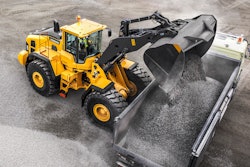
You will often see operators move a bucket full of material around with the bucket too high in the air.
“When you lift the bucket way up in the air, you lose your visibility and you raise the center of gravity so you have a more unstable machine,” says Blower. “The most cautious thing to do is to keep the bucket as low as possible — a foot off the ground, depending upon the terrain.”
Also be cautious going up and down hills. “Avoid going across the hill with a loaded bucket,” says Blower. “Make sure the bucket is pointing up the hill to keep the machine balanced. If you have to come down the hill, reverse down it... The last thing you want to do is come down the hill with a fully loaded bucket, hit the brakes and all of the weight goes toward the loader.”
Many of the problems encountered are the result of operators trying to run too quickly. “Many machines have ride control and the operators just drive faster across the site,” says Blower. “They are running over uneven terrain too quickly and bouncing all over the place. People try to push the machine quicker and quicker and they compromise safety.”
Understand the limits of the backhoe-loader you are operating. “Do not carry more than the machine can safely handle,” Worley stresses. “Depending upon what materials you are handling, carry them in a level or racked-back position. Use ride control, if equipped, and keep loads as close to the ground as possible until you have to raise them up to load or dump.”
Operation on slopes
Slopes present challenges for almost any type of construction equipment, including backhoe-loaders.
“The stability of a backhoe-loader is at its greatest risk on a hill when it is being driven, not operated,” says Worley. “When you are in operating position, you should try to level the machine as much as possible using the independent stabilizers and your front bucket.”
When operating on a hill, take special precautions. Swinging a bucket of dirt downhill changes the center of gravity in a negative direction. “You should always push a bucket up the hill and dump the spoil on the uphill side of the trench at a distance where it doesn’t roll back into the trench,” says Blower. “We all realize in real-world applications that is not always possible. If you do have to swing the loaded bucket downhill, be very slow and keep your bucket low to the ground.”
Pay careful attention when repositioning on a slope. “If you are trenching, the machine is facing uphill and you are ready to move, you should put the hoe into its tucked, stored position,” says Worley. “Turn your seat to the forward-facing, ready to drive position before you raise the stabilizers. This will give you control over the brakes and transmission, preventing the machine from rolling backwards.”