In the world of road builders and asphalt haulers, the subject of release agents is sometimes considered one part snake oil and two parts science. Mixture rates vary from release agent to release agent, with no clear guidelines for various asphalt mixtures. State DOT approvals differ from state to state. Wheeled compactors favor one type of chemistry, paving rollers require another, while dump truckers would just as soon use diesel fuel. With state fines for improper use ranging as high as $10,000 and lost production costs soaring, the stakes are high and the information seems cloudy at best.
For years, diesel fuel was the release agent of choice. A pint or two sprayed directly onto the truck bed or tailgate prior to loading was all one needed. The cost was not prohibitive and best of all — it worked. The entire load came out as slick as a whistle with no residue left to form hard spots. Unfortunately, those days are gone forever. Environmental issues and state regulations prohibit the use of diesel fuel as a release agent and the fines are substantial.
New technologies vs. old technologies
Newer formulations challenge the notion that you can't have your cake and eat it too. Cost efficiency and operational effectiveness are being combined in new formulations.
Larry Ludwig, chief chemist for St. Louis-based Schaeffer Mfg. Company, is a leader in developing "hybrid" products that borrow the best characteristics from proven technologies to create formulas that outperform traditional products in polymer and conventional mixes.
"Products can be stable and still be miscible, if you design it that way from the beginning," Ludwig says. "Most companies engineer their products for a particular mix or for a certain piece of equipment. The key is to design the formula around the environment it will be used in."
Ludwig's theory seems to be working. Schaeffer recently received approval of a soy-based product in Illinois, one of the toughest states in which to gain Department of Transportation certification. Illinois requires that the release agent pass all evaluations without being mixed with water. Since most agents are designed to be diluted 20:1 or 30:1, they usually soften the asphalt when evaluated in their undiluted strength. Those that do pass are most often detergent/soap-based products whose effectiveness on tacky, polymer mixes is limited.
Truck beds and compacting equipment
The two primary applications for asphalt release agents are dump truck beds and asphalt compacting machinery. In both types of equipment, the goal is the same: keep the hot asphalt from sticking to the cooler surfaces.
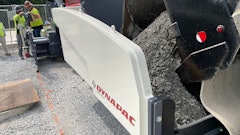
With compactors, when sticking occurs, new asphalt is pulled away from the road surface. Pits form in the layers leading to uneven spreading. Often, expensive and time-consuming removal of the asphalt layer is the only acceptable remedy. Modern release agents are designed to spray continuously onto wheels and drums without clogging nozzles or plugging lines. The best products stay soluble overnight and work well on a variety of asphalt types. With proper adjustment, only a trickle of release agent is needed to perform well in all types of wheeled and drum compactors.
Truck beds need to release the entire load of asphalt so that hard spots don't form in the bed. If they do, the next load could pull a large chunk of cold asphalt into the hot mix making it impossible to get a smooth, even surface. Additionally, truckers often haul other materials that may be discolored or contaminated by residual asphalt from the day's hauls. Many truckers have spent hours cleaning and knocking asphalt out of a bed or off of a tailgate to make sure they can haul white rock the next day. A few have even experienced the pain of a rejected load when an inspector notices clods of asphalt among tons of white stone. Effective release agents not only ensure that the current load is released properly, but can also clean up asphalt deposits that have accumulated from prior loads. This is especially important around the tailgate and nose of the bed.
Pumps and spray equipment
No matter how effective the product may be, it only works if it gets where it needs to go. Spray systems are sometimes provided by the release agent supplier, but can also be purchased at a reasonable cost, usually less that $700. Dema Engineering Company makes an adjustable system capable of 10:1 to 50:1 ratios. Wand, hose, pump, and mounting brackets sell for less than $800. The system can pay for itself in no time.
Of course, some haulers prefer the old-fashioned bug sprayer to an automated system. While these sprayers are inexpensive and will get the job done, mixing each bottle of release agent generally leads to overuse or under-performance. With the cost of automated systems coming down, it's hard to justify the trial and error methods of the past.
Field results
Fred Weber, Inc., the largest aggregate and asphalt producer in St. Louis, MO, has been using bed release products since the diesel fuel era. The company recently celebrated its 75th anniversary and, as a full-service concrete and asphalt-paving contractor, has seen lots of changes in road building techniques over the years. Tom Bindbeutel, general manager of asphalt operations for Fred Weber, remembers the transition from older technologies to modern soy-based bed release products.
"We used fuel oil like everybody else until the soap products came along," Bindbeutel says. "Our philosophy was to use the cheapest stuff we could get and then use a lot of it. Now we're looking for products with better performance and lower overall cost."
Bindbeutel recalls how Fred Weber began to test solvent products for use on Super Pave® and polymer modified mixes.
"Our first tests were simple," he explains. "We just got a five-gallon bucket of solution for the guys to dip their shovels in. When that seemed to work, we used Hudson sprayers for the beds of the dumps."
These days, Fred Weber uses an adjustable spray rack to alternate bed release spray ratios between commercial asphalt mixes and high polymer mixes. Bindbeutel installed this type of system to cut waste and improve the effectiveness of the release agent.
"Any good product can keep a bed clean, but you know you've got a superior product when you start seeing dirty beds ending up clean," he says.
When asked how important it is to Fred Weber that a particular asphalt release product meets state DOT requirements, Bindbeutel indicated that it is a primary selection criteria.
"We can't afford to take chances on our jobs. If a product isn't certified in the state we're in, we don't use it. It's that simple," he says.
The company is currently using one of the new soy hybrids developed by Ludwig and Schaeffer in its Illinois operation. The Illinois DOT is notable as one of the toughest regulatory branches in the United States and has extremely tough standards for bed release products. This new formula is among the first of its type to be approved in Illinois and, according to Bindbeutel, it's doing the job.
Conclusion
Asphalt release agents are becoming more effective and easier to use. Between $0.60 and $1.40 per gallon in its diluted form, there is no reason to risk the fines and lost production costs of non-compliance. Older soap formulas do a good job for light commercial asphalt mixes, while petroleum and citrus products perform well in heavier mixes in the state where they are approved. Customized spray systems and new formulations are increasing effectiveness and cutting costs, even in areas with tough DOT guidelines.
States should standardize their testing to insure uniform performance throughout the United States and manufacturers must continue to push for new formulas that deliver performance, ease of use, and cost efficiency.
Stephen Brewer, CLS, is vice president of Schaeffer Mfg. Company, 102 Barton St., St. Louis, MO, 63104, www.schaefferoil.com.