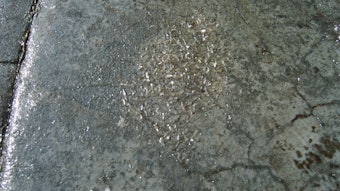
There are too many unrealistic expectations in many specifications for new construction that cite "defects" requiring repair. For instance, the latest revision of AIA MasterSpec lists the following as formed-surface defects:
- Color and texture irregularities
- Cracks
- Spalls
- Air bubbles
- Honeycombs
- Rock pockets
- Fins and other projections on the surface
- Stains and other discolorations that cannot be removed by cleaning
This is not a list of defects for architectural concrete formed surfaces. It's for any kind of structural concrete formed surfaces exposed to view. And that's a problem. Let's consider a few of these so-called defects.
Four of the worst offenders
Color and texture irregularities is a vague phrase and has no valid place in a properly written specification. Off-the-form finishes for structural concrete are not uniform in color or texture. A look at any exposed formed concrete surface reveals this immediately. So what are color and texture irregularities? They are useful reasons for holding the contractor's feet to the fire during construction, and especially during the punchlist construction phase when alleged defects can be used by owners to withhold the contractor's retainage hostage in hopes of keeping some of it.
Cracks are inevitable in reinforced concrete structures. The concrete in the tension zone is expected to crack. That's why reinforcing steel is used in the concrete. Some cracks may be defects, but all cracks are not defects. The AIA specification, however, classifies all cracks as defects. And the repair costs can be large, whether epoxy injection or routing and filling are required. What's worse, the repaired cracks are usually more unsightly than the original cracks.
Air bubbles (bugholes) are a common feature of any off-the-form concrete finish for structural concrete. Even self-consolidating concrete will exhibit some air bubbles. They are almost always viewed as a cosmetic problem with no structural significance. In some cases, though, air bubbles can be an attractive feature. The bughole punctuated exposed concrete walls in an award-winning museum led the judging architects to describe the surface as "richly textured" with a "porous surface that resembles a sea-tossed shell."
For a reasonable approach to managing bugholes, see Section 5.3.3.3 of ACI 301-10, "Specifications for Structural Concrete." It lists three different surface finish classes that can be specified for formed surfaces not identified in the contract documents as architectural concrete. The specification requires patching of surface voids larger than 1½ inch wide or ½ inch deep for the lowest classification (SF-1.0) and patching voids larger than ¾ inch wide or ½ inch deep for the highest classification (SF-3.0). Just as with crack repair, the voids may be more conspicuous after patching than before.
Fins are also a common feature of any off-the-form concrete finish for structural concrete. Unless the joints between form panels are taped or caulked - a process usually required only for architectural concrete - fins or offsets that must be removed range in height from 1 inch to 1/8 inch depending on the surface finish class. This again is a requirement from Section 5.3.3.3 of ACI 301-10. Removing all fins, as required by AIA MasterSpec, is unlikely to produce a more attractive surface because chipping or grinding them down to the plane of the wall will not make them disappear.
There is one instance where the presence of fins or air bubbles may result in a performance problem. When a spray-applied waterproof coating is to be applied to foundation walls, the applicator may require a very smooth finish so there are no holidays in the coating. If the concrete contractor is required to provide the smooth finish, however, a rubbed or sacked finish should be specified so the cost of grinding fins and filling bugholes can be estimated and included in the bid.
Contractor defenses against the impossible specification
Two tactics can be used when the defects section of AIA MasterSpec is incorporated in project specification. The first, excluding the requirements in the bid as impracticable, is considered to be too risky by contractors who fear that such exclusions may cause their bid not to be accepted. In today's tight construction market, that may be true. But it's also true that enforcement of the impracticable requirements could result in a loss instead of a profit on the job. Thus, bid exclusions should be a risk management decision.
The other tactic is using contract exclusions after the bid has been accepted. Listing the exclusions at this time gives the contractor a better opportunity to discuss the reasons for the exclusions with the design professional. Such discussions are unlikely at the bid stage.
As a last-ditch-effort, use the rationale for the legal theory of impossibility. This theory acknowledges that a contractor can't, even if asked or agreed to, complete the impossible. The legal basis of impossibility is that the contract contains an implied condition that the specified performance will in fact be possible. The court provided this definition: "A thing is impossible in legal contemplation when it is not practicable; and a thing is impracticable when it can only be done at an excessive and unreasonable cost." As discussed, AIA specifies and expects the impossible.
Whether any of these options are chosen, it's essential for contractors to recognize impracticable specification requirements so they aren't blindsided by them when it's time to get paid.