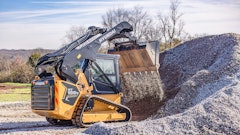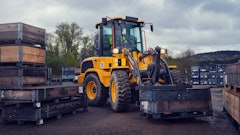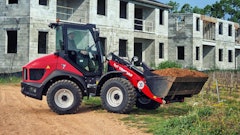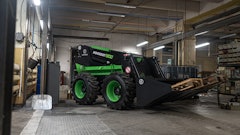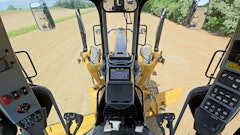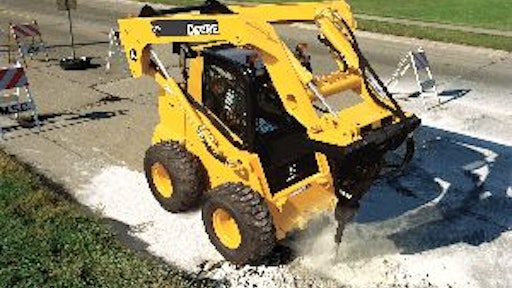
Several manufacturers offer skid steers with over 3,000-lb. rated operating capacities (ROC) and approaching 100 hp. These units cross the boundary from utility to production machine, yet offer a relatively compact package.
"The largest skid steers are most appropriate for applications in which compact size and the ability to work in confined spaces aren't particular advantages," says Curtis Goettel, marketing manager for skid steers, Case Construction Equipment, "for example, working out in the open on construction site prep jobs or in agricultural settings, where a large skid steer can prove its versatility on a number of demanding applications. The largest skid steers deliver the most benefit in demanding applications like breaking and removing concrete, and digging in hard soils."
Larger buckets equate to faster production. For loading dirt, excavating or loading trucks, you can work with a 1-yd. bucket as compared to, say, a .5-yd. bucket. As a result, if you are excavating and loading material into a truck, your productivity and the amount of work completed per hour is just that much quicker.
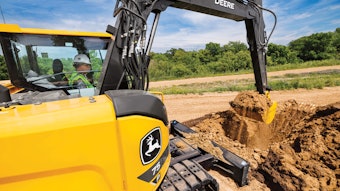
Gregg Zupancic, product marketing manager for skid steers and compact track loaders, John Deere, notes that the largest skid steers are mostly used for outdoor operations. "The benefit will come in the form of more performance in a more stable platform with the ability to load high sidewall trucks and hoppers," he says. "Typical applications might include larger excavation projects and high loading applications in the construction or ag segments."
Higher hydraulic output
Large skid steers also make optimal platforms for hydraulically intensive attachments. "You have a tremendous amount of hydraulic performance when you have the bigger skid loader," says Kelly Moore, product manager for skid-steer loaders, Gehl Company.
For example, the Gehl 7810E with the high-flow option offers more than 40-gpm flow, so the hydraulic horsepower is sufficient for any high-performance attachment. "A cold planer would be ideal; so would a larger trencher or auger. The big skid steer really performs because you have the engine power and torque," Moore says. "You couple that performance with high flow from your auxiliary hydraulics and you get an amazing amount of productivity with a high-flow attachment."
Bobcat took a different approach that also leads to greater hydraulic output. "The standard hydraulics have increased approximately 15% to 20% when compared to the next largest Bobcat machine," states Mike Fitzgerald, Bobcat Company. "These larger machines with extra engine horsepower have the capability to run that hydraulic horsepower longer and more consistently. So your actual net performance at the attachment is better."
Based on internal testing, the customer should see a 30% increase in performance at the attachment, says Fitzgerald. "So it is a balancing setup. It is not just hydraulic horsepower that gives you the performance," he says. "For those attachments that require a lot of power to run them, this machine has the hydraulic power to work the attachment, as well as the engine horsepower to back the hydraulics and keep it working."
Heavier attachments also favor the use of the larger skid steers. "It is a larger machine, so it has a higher rated operating capacity," says Fitzgerald.
Forklift-type applications are greatly enhanced, as well. "Pallet forks are excellent with this machine," says Moore. "It is a vertical-lift type of machine. The lifting ability of handling pallets is outstanding."
Drawbacks of upsizing
Of course, there are downsides to larger machines. As Zupancic points out, larger, heavier skid steers require a CDL to tow around, they burn more fuel and they have higher ground pressure, which decreases flotation.
Maneuverability may also decrease as machine size increases."Using the largest models may require sacrificing some of the maneuverability advantage of skid steers," says Goettel. "A good rule of thumb is don't buy more machine than you need. It might be a better choice to take some of the money you would spend on the biggest skid steer and use it for more attachments and operator comfort options on a mid-size machine."
The need for beefier wear components can add to skid steer operating costs. Consider the Bobcat S850. Its wheelbase is 52.9 in. vs. 48.3 in. for the S330, the next largest model in the company's lineup. "[The S850] is a bigger machine. It has larger structures. The weight is more," says Fitzgerald. "The sizing is going to affect wear items. We use larger tires, thicker cutting edges on buckets, heavier duty buckets." These components will probably last as long as on smaller skid steers, but will cost a little more to replace.
Heavier machines also create higher friction on both the tires and surface and, with every turn, the tires work against each other. "All things being equal, a heavier machine will put more wear on the tires, especially if the operator does a lot of zero-radius turning," says Goettel. "But the application and operating surface have more to do with tire wear than machine size."
"Smaller loaders would be easier on the tires," Moore asserts. "On the 7810E, for instance, you have nearly 55 in. of wheelbase on the machine, so it is spread out pretty considerably as compared to mid-size skid loaders. You are getting more 'scrubbing' action. So the tire wear will be higher than on a smaller loader."
Yet, tire selection can help to maximize longevity. For example, a severe-duty/rock tire can be an effective option. "It is still a flotation-type tire, but it has a much thicker surface and thicker depth of lug that is made to last longer," Moore points out. "So even though there is a fair amount of wear on tires, there is an alternative for a customer who can look to this severe rock-type tire."
Encroaching on compact loaders
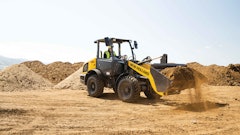
The largest skid steers are approaching compact wheel loader territory. "We already have some overlap in wheel loaders with our current machines when you look at the smallest wheel loaders," says Fitzgerald. It boils down to application. "Do you want a smaller machine that will fit into a smaller, tighter area or do you want an articulated machine?"
The purchase price typically favors skid steers. "When you look at a large-size skid loader -- close to the 100-hp range and having over 3,800 lbs. load capacity -- and compare that to a wheel loader, the skid steer is going to be more economical," says Moore. "The skid steer is a fixed chassis. You have two drive motors with a large chain on the left and right sides in an oil bath. With a wheel loader, you have specialized axles and a reduction and a transmission, either with a torque converter or hydrostatic. So when you look at all of the components to build a wheel loader that would be a comparable machine to a very large skid-steer loader, you are going to have a more costly machine."
That doesn't mean a large skid steer can replace a compact loader in all applications. "Compact wheel loaders have larger buckets and offer more lift capacity than skid steers, which is important in applications like handling aggregates and repetitive lifting and loading," says Goettel.
"Some of the key difference are that the compact wheel loader has a higher travel speed," adds Zupancic. For example, maximum speed is 19 mph for a typical compact wheel loader vs. a John Deere 332 with a 12-mph maximum speed.
"The wheel loader comes into play when a customer wants a machine that will articulate and not have skid steering," says Moore. "Naturally, a wheel loader is not going to have to skid. So your wear factor and ground disturbance factor on a wheel loader is minimal. With a skid loader -- especially a bigger skid loader -- simply by its nature, you are going to have more ground and surface scuffing."
So how large can they grow?
"We may be approaching the practical size limits for skid steers, but we're not there yet," says Goettel. "At some point, the cost will become prohibitive, especially as you get into a different class of equipment, and you will reach an effective capacity limit for certain components."
Yet, he foresees, "It's very likely that we'll see a new generation of skid steers that break out of the 3,000- to 3,200-lb. operating capacity range. How much beyond that level, it's difficult to predict. It's safe to say, though, that the vast majority of skid steers will continue to be in the 1,500- to 3,000-lb. ROC range. The largest skid steers represent a niche, but it's a growing niche."
Bobcat actually has a history with skid steers larger than those currently available. "In years past, Bobcat Company manufactured machines that were physically larger than our current S850," says Fitzgerald. "While the machines were viable, the overall market for those machines was more limited. As a manufacturer, you look at what fits the majority of the customers. We ceased production of those large machines and stepped back into the mainstay of what the market wanted."
Now, demand for larger units is on the rise. "The general construction industry is finding that smaller, compact equipment is doing the kinds of work they need to get done," Fitzgerald states. "There are more in-city, smaller space-type projects, which leads to the compact equipment business."
For example, Bobcat introduced the S850, rated at a 3,875-lb. ROC, to address a specific need. "Our customers are requesting a piece of compact equipment that has additional horsepower to do more work in the same amount of time, yet fits into those small space projects," says Fitzgerald.
Moore has also seen a shift in the size of skid loaders. "There is definitely a slight shift upward," he acknowledges. "Customers are looking for just a little more horsepower, a little more load capacity and machine performance."
The trick is to instill more performance while maintaining a compact package. "The true definition of a skid steer is a compact, powerful and yet nimble machine in most applications," Zupancic says. "However, some applications just want the machine dimensions to lift over 10 ft. high, for example, and do not desire to ever work the machine in tight areas."
"Skid steers offer the advantages of compact size, extreme versatility and relative affordability," Goettel points out. "It's possible that a large skid steer could sacrifice maneuverability, for example, which would limit its value."
Moore believes the industry has already reached its practical size limit with models such as the Gehl 7810E, which offers 99 hp and a 3,850-lb. ROC. "If you go any larger, you are encroaching into the territory of wheel loaders at that point," he states. "If you go to the next level -- for instance, maybe a 4,500-lb.-capacity skid loader at 120 hp -- you have to upsize the components. Your costs to build a machine like that are going to escalate. They are going to get closer to what a wheel loader is. At that point, a wheel loader is a more practical machine."