Roadbuilder Shelly & Sands Inc., Zanesville, OH, received 97% of the available bonus for smoothness attained in constructing dual-lane Ohio S.R. 161 on new alignment in Franklin and Licking counties, just east of Columbus.
The asphalt paving was so exemplary that the contractor received Flexible Pavements of Ohio's Quality Award for Asphalt Paving for 2008.
Shelly & Sands received the award from the state asphalt contractor association for "achieving the highest quality in asphalt paving as exhibited by superior workmanship and riding quality".
While Shelly & Sands did all drainage, paving, bridge and wall construction, earthwork was subbed to Beaver Excavating Company of Canton, OH, and lime stabilization was done by Specialties Company LLC of Indianapolis.
Compaction was a minimum 93% on every course, which provided the 100% pay factor for intermediate and surface courses. The firm averaged 94% to 95%.
Smoothness was tested with a high-speed profiler and attained an average of below 40 IRI (International Roughness Index). That equates to fewer than 40 inches per mile, with 60 to 70 IRI required to achieve 100% of pay.
Placing a winning pavement
Placement of a super-smooth pavement that garners nearly the entire available bonus is the result of crew training using the right equipment. Training begins with the delivery of the paver, when factory personnel join with the distributor to make sure the customer knows how to use the machine to its best advantage.
"Our crews executed an exceptionally well-done job," says Shelly & Sands' quality control manager, Ed Morrison. "I've been in this business for three decades, and it was a delight to work with all of the crews on this project. They took an assertive role in this high profile job and wanted to do very well.
"I was very pleased at the response of the crews, from the quality control team, to the paving crew, to the screed men, to the plant crew," he continues. "They took ownership of the project and that's key."
"First off you need people who care and who have pride in what they do," says Steve Schlosser, equipment superintendent for Shelly & Sands. "I would say that group out there had that."
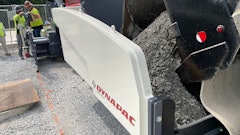
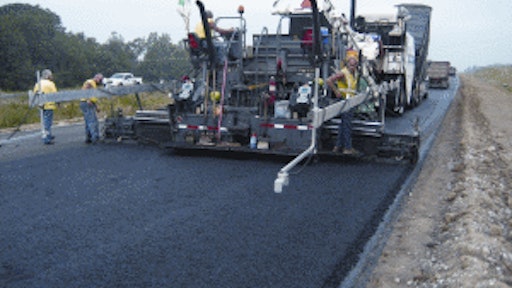
The award-winning pavement on Ohio 161 was placed using a Vision 5200-2 10-foot tracked paver from Vögele America Inc. The paver was equipped with a 23-foot paving kit plus Vögele's Niveltronic Plus control system.
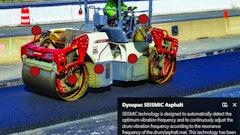
Three rollers were used on the project, a 78-inch HD 120 HV for breakdown, a 78-inch high-frequency double-drum roller for intermediate compaction, and an HD O120V compactor combining exclusive Hamm oscillation compaction for finish rolling.
"Typically the oscillation gives us another 1% compaction, even at lower temperatures and materials with a tender zone," Morrison says. "We also don't have to cross our fingers hoping we won't break any aggregate with the oscillation, because when the black turns to white, we have to get off it."
"We have 11 Vögele pavers, more than any other contractor in North America," Schlosser says. "We have five of the new Vision Series models in our fleet, all 5200-2s. The crews had never seen these new pavers before, and we put them in the saddle right out of the chute. You always expect some bugs or problems along the way. Instead we won an award for the good job they did."
"Good paving practices with virtually any machine will get you a result like we had," Morrison says. "But we did not have any downtime with the machine. And we were able to pave on new alignment without traffic issues. In the end, the IRI results proved that good paving practice was used on this project."
The advanced control system worked to optimize placement.
"A big difference was the Niveltronic system," Morrison says. "We got a larger footprint when we went to dual sonic averaging skis of 40-foot-plus [actually 50 foot] length, which helped us watch our longitudinal swales for averaging."
It's essential to have the paving crew knowledgeable about the technology at their fingertips.
"The knowledge of the crew and the automation - their making sure it's set up properly - had the positive effect on the end result," Schlosser says. "The crews said the Vision paver with Niveltronic Plus controls reacted a lot smoother than other systems we've used.
"The use of a material transfer vehicle helped, although at added cost, even though it was not required by the state," he says. "The MTV eliminated the contact of the truck against the paver, and helped remix the material to fight segregation issues. Again, paver setup was critical."
The new Vision pavers have constituted a major leap forward in terms of technology.
"There are improvements in visibility, and it's a cooler-running machine, with less heat around the operator," Schlosser says. "The track system is another item I like, especially after having issues with competing makes. With them, you could never keep those tracks aligned, no matter what you did.
"But with the Vision 5200-2's independent tensioning cylinders in the track, they run perfect," he continues. "We have never had an alignment problem with our Vision pavers as we had with the other pavers, one of which rode so hard to the outboard side that it wore a hole in the screed tow point cylinder. The benefit is reduced owning and operating costs for our tracked machines."
Training for smooth pavements
Training is so important to Shelly & Sands that earlier this year, it opened a corporate Safety & Training Center in Zanesville. The facility can accommodate up to 75 students in a classroom, with an attached garage for equipment or mechanical training. Classes began in December 2008 even before work on the facility was complete.
Training also comes from the distributor.
"At startup, I'm there as an ombudsman and to do additional training on the machine," says Scott McLean, The McLean Company, area distributor for Wirtgen Group products. "Our service technician, as well as Vögele America's, will be there as well. We make observations to see what's not happening, and then will try to correct it as a team.
"As a result of their training, the crew became very proficient going 23 feet wide, then a week later having to tear it down to place a narrower temporary pavement," Schlosser says. "They became adept at putting the screed plates and tunnel guards back on without any assistance. They weren't afraid of wide-width paving, and attacked the challenge and did a good job."
Typically a mechanic might have done the width changeovers, but not with this well-trained crew.
"We let the crew do it," Schlosser says. "Normally an on-site mechanic might have done it, but with a little bit of training, this crew did it all by themselves."
Shelly & Sands gives credit to its paving crew foreman, Neil Prouty; paver operator Matt Schlosser; screed men Sam Freese and Andy Cox; roller operators Pat Burton and Steve Dunlap; distributor operator Doug Hoskins; MTV operator Jason Davis; and MTV ground man Don Atkins.
Credit also was due Shelly & Sands' Marzane Asphalt Plant 12 crew, including foreman Larry Ewart, operator Chad Evans, and quality control technician Bill Miracle.
Paving 23-feet wide
Also beneficial to smoothness plus long-term performance were the wide paving widths used, with paving of 23-foot width for the base course, 22 feet 6 inches for the intermediate, and 22 feet for the surface course. With this wide paving, longitudinal joints are eliminated.
"The screed kit was set up properly for best paving practice," Schlosser says. "Augers were within the right distance, a foot and a half to 2 feet at the end gate. The tunnel guards and auger hanger bearings were mounted correctly, plus the tunnel supports and the aft supports for the bracing and bracketing were all put in place."
The project started in June 2006 and involved the complete reconstruction of an existing two-lane blacktop to new dual-lane highway between Granville and New Albany.
The completed project included 7.15 miles of new four-lane divided freeway, but also the construction of five service roads for local traffic, the construction of new interchanges at Beech Road and Ohio 310, and re-routing a portion of existing SR 161 to proposed Dublin-Granville Road.
The original $55 million contract consisted of 1.36 million cubic yards of excavation, 1.73 million cubic yards of embankment, three bridges, 41,000 lineal feet of storm drainage, 340.000 lineal feet of underdrain, four box culverts, and 12,000 square feet of mechanically stabilized earth walls. Some 290,000 tons of asphalt were placed, plus 52,000 square yards of concrete pavement.
Shelly & Sands began work on Ohio 161 in June 2006, and had 24 months to complete by May 30, 2008. But utility conflicts and near-endless rain delayed the project six months right after the project started. In 2006 Shelly & Sands lost 88 calendar days on the schedule due to unusually wet conditions.
"We were greatly delayed by the weather when we first started out in 2006, but 2007 started out dry, and we were able to get underway with no problems," says Brian Varrato, Columbus area manager for Shelly & Sands. "We started from the east end of the project and headed west."
For this project on new alignment, a 12-inch lime stabilized foundation was topped with 6 inch No. 304 crusher-run aggregate, followed by base courses of 5 inches of asphalt with No. 302 aggregate, and 2.5 inches with No. 301 aggregate. This was topped with 1.75 inches of Type 2H intermediate course with 3/4-inch max nominal size aggregate and 1.25 inch of Type 1 with 3/8-inch max nominal size aggregate for friction or driving course.
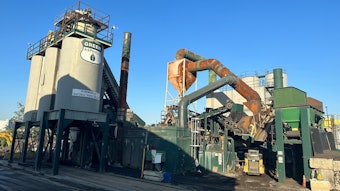
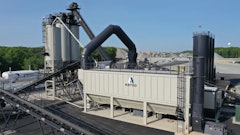
The hot mix asphalt was provided by the Mar-Zane Materials division of Shelly & Sands. The PG binder was provided by S&S Terminal, the liquid asphalt division of Shelly & Sands. The HMA was made by a portable plant of composite manufacture, at 350 tph at 5% moisture removal.
Reclaimed asphalt pavement (RAP) was used at a maximum 40% in the base, 35% in the intermediate lift, and 10% in the friction course.
"This was a seven-year warranted project," says Morrison. "We had flexibility in our design criteria, but had to meet aggregate quality specs for the material used.
"As far as the design of the structure, we could use Superpave or Marshall design," Morrison says. "We chose a hybrid, with 10% RAP in the surface course. We also added at the plant, at our own option, 1.5% Rub-R-Road latex modifier to the intermediate and surface courses. It was not required by the state spec because the average daily truck (ADT) estimate was lower than 1,500, which is the ODOT requirement for PG 64-22 liquid.
"But with the anticipated added traffic once an additional section is opened, we wanted to add a little more cushion to the mix to help it fight rutting and cracking. The extra percent and a half latex brought it up to a 70-22 grade."
Information for this article provided by Vögele America Inc.