When selecting a boom lift for a project, maximum lift height is the most obvious spec that comes to mind. Yet, other considerations can have just as much influence on the size, type and configuration of lift required.
For example, it's not uncommon for conditions in and around the work area to necessitate higher lift or reach capacities. "A lot of times, you will see people getting a larger machine than they really would need because of the conditions on the jobsite," says Mark Mohn, product and market development, JLG Industries, Inc. "For example, you might have to reach 50 ft. in the air, but you might need an 80 footer to get there because you can't get close enough to the work site. You have to sit back further [due to] ground conditions, something is in the way or other people are working in that area."
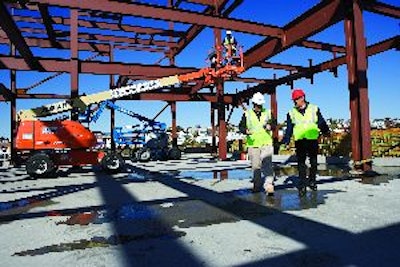
Such is often the case for All Erection Co., Inc., a structural steel company based in Naperville, IL. It erects structures for Menards, Wal-Mart, Home Depot, Lowes and others, as well as multi-story residences. While many of its projects average between 22 and 30 ft. in height, the contractor often rents 40-ft. telescopic lifts.
One reason is safety. "You don't want to over extend the boom. You want to be comfortable and you want the machine to be [at a comfortable position]," says Kenneth Roeske, safety and equipment manager for All Erection. "You don't want to stretch it to the extreme."
Conditions around the work area are also a factor. "We're one of the first ones onto a construction site... The actual pad itself will be to a certain elevation and the footings and everything will be poured, but the perimeters around the jobsite aren't the most ideal," Roeske says. "Terrain and elevations have a lot to do with it — what does it take to get to the job and how high do we have to go."
When obstacles get in the way
Site conditions have considerable influence on the type of lift that is most practical for a project.
Telescopic (stick) booms are the most popular lift type, thanks to their extended reach capabilities, straightforward design and ease of operation. Their single telescoping boom means fewer controls and slightly faster cycle times compared to articulated (knuckle) booms.
"As far as the iron workers go, you want it as simplified as possible," says Roeske, "with as few controls as needed." This is why he prefers to rent JLG telescopic lifts. "You have one [control for] the travel forward and back, left and right, then you have one major control for up/down and swing. You might have an occasional toggle switch for boom extension or retraction. But it's simplified; it's easy to understand and it's easy to operate."
By design, articulated booms are more complex. "With an articulated boom, you have multiple boom sections to lift up, and you need to be a little more cautious with what you're trying to reach over and around," Mohn points out. This translates into slightly longer cycle times and a higher operator learning curve.
On the other hand, articulated booms can reach up and over obstacles or reach elevated positions not easily approached by a telescopic boom lift, notes Michael Disser, vice president of marketing, NES Rentals.
"When a contractor/operator doesn't have a direct line of sight to the work area, or when physical obstacles prevent the use of a telescopic boom, articulating booms are the appropriate choice of equipment for the job," adds Phil Harvey, product manager, Genie Industries.
"Articulated booms are generally appropriate for industrial plants, manufacturing settings, power stations," says Joe Conley, sales and marketing manager, Aerial East Region, United Rentals, Inc., "any area where you need to get up and over substantial structures in order to perform the work."
Their smaller chassis and 360° turntable rotation provide added maneuverability in narrow passageways or congested work areas. "Normally, smaller articulating booms are more compact than their telescopic 'kin.' Therefore, their applications are usually industrial and maintenance," says Harvey. "The larger booms are built for outdoor, rough-terrain applications and large complex structures."
"Their main limitation," says Conley, "is that most articulated boom models do not have the extended reach capacity of a stick boom."
Mohn clarifies, "Whenever you have a telescopic boom and an articulated boom in the same height class (e.g., 60 ft.), the telescopic boom will always have more horizontal outreach."
Terrain's influence on features
OSHA regulations require general contractors to provide surface conditions that enable easy site access, Roeske comments. "But sometimes you do have dirt conditions mixed with gravel, and you have Mother Nature to deal with," he says.
Consequently, Roeske almost always specs four-wheel drive on boom lifts. "We work 12 months out of the year, whether it's cold or hot, wet or dry," he points out. "Four-wheel drive is normally a very valuable asset."
Four-wheel drive has become almost standard on models for outdoor use. "Most of the combustion-powered machines we sell are four-wheel drive with an oscillating axle," says Mohn. "That's what people generally want, I think as much for the versatility — because they never know what kind of job they're going to run into — as for the resale value. A four-wheel drive is going to bring more when you go to sell the machine than a two-wheel drive."
Gradeability is another consideration if the lift will be driven over slopes. However, Mohn suggests taking this a step further to assess "terrainability" of the lift. "How does it get around the jobsite? If one tire starts to spin, are you going to be stuck? Do you have the proper flow division to transfer the power to the wheels to still have traction to pull you through?" he asks. "To us, that's more important than a straight gradeability number — whether you can get around the jobsite in different types of conditions."
Ground conditions influence the type of tires required, as well. Indoor applications may require non-marking tires, while sensitive landscape, such as a golf course, may dictate turf tires. Areas such as South Florida, where sugar sand is prevalent, may call for high-flotation, non-aggressive sand tires, or even tracks.
Both removable and fixed track options may be available, depending on the manufacturer. For example, Genie offers a flexible track option for use on approved wheeled models, plus the S-60 and S-65 Trax lifts with a dedicated track undercarriage.
As with other tracked equipment, tracked lifts tend to be easier on turf due to lower ground pressure, and supply more traction in challenging soils, such as sand or gravel. "The Trax can also enter jobsites earlier in the Spring thaw, where muddy conditions make wheeled machines inappropriate," Harvey adds.
Communicate your requirements
To ensure you get the type, size and features you need in a boom lift, it's important to come to the rental center or dealership armed with adequate information. According to Disser, this includes:
- the maximum vertical height and horizontal reach needed to place workers at chest level to the work area;
- total weight to be lifted (workers and materials);
- jobsite conditions, including accessibility to the work area, ground conditions and any overhead obstructions;
- type of power source required;
- number of lifts needed to complete the job.
Once there, be prepared to explain the nature of the work you need to perform and the conditions the lift will encounter. "Discussions of this nature are part of the customer service process at United Rentals," Conley notes. "We want to make sure we're recommending equipment that is optimal for jobsite conditions and worker safety."
If there is any uncertainty about what's needed, consider requesting an on-site assessment. Roeske has nearly 10 years of experience spec'ing lifts, yet he wouldn't hesitate to bring his sales rep at Illini Hi-Reach, the local JLG distributor in LeMont, IL, out to the jobsite. "I know what I need, but if there were a job or situation I wasn't familiar with, I could call my salesman from Illini Hi-Reach. They have very knowledgeable salespeople who not only know the equipment, but they know the application," he states. "You might think you need a 60 footer, and they will say you could do it with a 40. They will save you money."
"Renting the wrong size aerial equipment can be a costly mistake," Disser agrees. To avoid such mistakes, NES Rentals has developed the APEX Precision Height Measurement System. "The APEX system uses laser precision to determine exactly how much reach your job requires and the appropriate equipment selection to get your job done."
Of course, there may be cases where an equipment supplier doesn't have the appropriate lift for the situation. If so, don't give up too easily. "Insist upon what you want," Mohn advises. "If it's a long-term rental — three to six months — they may even consider purchasing a special machine to meet that demand."
A national rental chain can often pull machines from other locations, plus many rental companies may be willing to "re-rent" from other equipment suppliers. For example, Mohn notes there are companies specializing in renting large lifts. "If a particular market won't necessarily support a 100-ft. boom lift all the time, but the occasional job comes up, [your rental provider] can call this company and get one for that specific job," he points out. "Never give up."
A Towable Alternative
Towable boom lifts can be an economical alternative to self-propelled models in the right conditions and applications. "With working heights up to 55 ft., towable booms provide safe access to a variety of jobs," says Michael Disser, NES Rentals.
Towable lifts combine the benefits of an articulating boom with a built-in trailer. This makes them attractive to contractors who need to move quickly from job to job. "Maybe they are doing several things in a day and they don't have a truck to transport a 40- or 60-ft. boom lift," Mark Mohn, JLG Industries, comments. "They can just hook it up to the back of their pickup truck and go."
Compact size and light weight can also be advantages. "Because of the machine's lighter weight design, they are easy on sensitive surfaces due to their low ground pressure," says Phil Harvey at Genie Industries. "With their compact maneuverability, towable booms are useful machines for congested jobsites."
"Towable boom lifts are a good rental choice for work where the terrain is level and extreme height is not required," Joe Conley, United Rentals, asserts. However, he adds, "Towable booms are not as maneuverable as standard booms and are not appropriate on rough terrain."
"These lifts are equipped with outriggers, which provide a stable base, and therefore cannot be relocated during operation," Disser elaborates. In addition, their maximum lift capacity is generally limited to 500 lbs.
Towables tend to have lighter duty designs, as well. "They're not built as heavy as a self-propelled machine is going to be," says Mohn. Consequently, they aren't well suited to the more rigorous conditions and applications encountered on many large construction sites.