Why Tracking Temperatures is Key to Successful Asphalt Paving
Air, base and asphalt mat temperatures can be the key to successful compaction and building a reputation for laying down high-quality, long-lasting paving or patching job
Ambient (air) temperatures, base (aggregate and existing asphalt) temperatures and hot mixed asphalt temperatures are critical to obtaining compaction and longevity of the newly paved surfaces and patches.
Hot mix asphalt is manufactured at temperatures between 270° F and 325° F. Depending on the environmental conditions and the distance from the hot mix plant to the project, hot mix asphalt can lose between 5° F and 25° F.
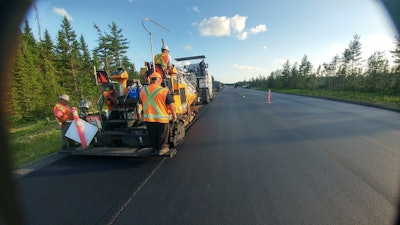
The temperature of the mix on the base after it has passed through the laydown machine – not the mix or manufacturing temperature -- is the most important factor in determining the available time for compaction. Hot mix asphalt pavement arrives at a project at temperatures between 275° F and 300° F and is installed on the existing base by mechanical methods (laydown machines).
If the air and base temperatures are colder than required or specified, the asphalt pavement will cool too fast causing it to set up and making it very difficult to obtain the required or specified compacted density.
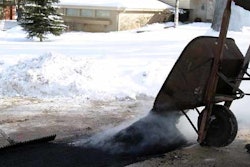
Thin pavement layers will cool quicker than thicker layers, and should the base or ambient temperature be low, the hot mix asphalt will cool quicker, density won’t be achieved and the patch will ravel and fall apart.
On paving and overlay projects, if the hot mix asphalt pavement cools too quickly, the entire surface will ravel leaving a rough, rocky surface in a short period of time. This not only results in a poor surface, it results in a surface that will retain water, reducing the life of the pavement or the patch by accelerating the raveling process.
This is why it's important to monitor all temperatures (ambient, base and hot mix asphalt) and wind velocity during the paving process.
Ambient Temperature
There are three basic steps to checking temperatures to assure a good and successful paving and patching project:
Monitoring the ambient temperature. Looking up the expected high and low temperatures for the day of paving, as well as monitoring the ambient temperature during the work hours, is very important to starting and maintaining a successful finished paving project. The normal requirement is that the ambient temperature should be 50°F and rising on a paving or patching project.
Find out the projected wind velocity for the day of paving. When there is wind, the temperature of the hot mix asphalt pavement will cool faster than normal. The higher the wind velocity the quicker the hot mix asphalt will cool.
Note any precipitation. This can reduce the temperature of the hot mix asphalt, which will hamper the efforts to achieve the required compaction.
Base Temperature
While ambient air temperature is a factor in cooling hot mix asphalt pavement, the base or ground temperature is even more critical. Monitoring the base (ground or existing pavement) temperatures can be accomplished with an infrared thermometer (purchased at an instrument outlet, Sears, Home Depot, etc.) to assure the base temperature is 50° F and rising.
HMA Temperature
The final step is checking the temperature of the hot mix asphalt prior to installing it on the base. This should be accomplished by taking the temperature of the pavement in the haul truck, at the front of the laydown machine and behind the screed (after the laydown machine has passed). Also, wind will cool the hot mix asphalt very rapidly after it has been placed on the base so caution should be taken when paving on windy days and break down rolling will need to be adjusted for the effects of wind velocity.
If the base or ambient temperature is not going to reach the minimum temperature requirement, you take the chance of having a failing end product where the pavement will ravel and fall apart. Similarly, cold-delivered asphalt mix will also cause the pavement to ravel and fall apart. Should the pavement cool too quickly and drop below 220° F prior to the initial or breakdown rolling, failure will occur because the hot mix asphalt has set and the required compaction (95% laboratory control) cannot be achieved.
Pavement temperature is very important to the roller operators to let them know when they need to do the initial or breakdown rolling. Monitoring temperatures and wind velocity are very important when installing a new surface or when patching (especially skin or surface patching) on an existing paved surface.
The University of Minnesota and the Minnesota Department of Transportation have developed a program named “Cool Pave” that can be used to determine the amount of time a contractor has to accomplish the break down rolling and achieve required density. Table A shows the time a contractor has to achieve initial density and compaction with ambient temperatures ranging from 50° F to 90° F, base temperatures ranging from 50° F to 80° F and mix temperatures of 300° F and 250° F. Also a wind velocity of 5 mph is figured into the compaction time.