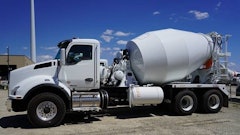
Tired of paying workers to stand around waiting for the ready-mix truck to bring your concrete? A volumetric mixer that lets you make concrete as needed on the jobsite might be the answer, particularly for contractors doing smaller jobs.
What is a volumetric mixer?
A volumetric mixer or mobile batch mixer is a machine that can be taken to jobsites and used to produce concrete or masonry grout. You might think of these mixers as mini-concrete plants. They are capable of making any type of concrete desired by adjusting the materials put in the mix. What is different in this approach compared to buying concrete from a ready mix plant is that the user buys the components needed to make concrete and mixes them himself on-site instead of buying premixed concrete.
There is almost no concrete waste with volumetric mixers because only the amount of concrete needed for the specific task is made. Dealing with leftover concrete has become an environmental issue because of the limited places for safe disposal, so there is value in avoiding excess concrete production.
Having a volumetric mixer eliminates concrete quality problems caused by traffic jams or ready-mix truck breakdowns.
"A drum truck has a limited amount of time for them to drop their load or it becomes what they call a hot load, and the only way they can make that usable is to add water and then your strength goes down," says Stan Horning, Global Mixers' sales director for the Midwest and West.
Using a volumetric mixer means the concrete is always fresh and the contractor pays only for what is produced. "It gives you the versatility to be able to create your own mix design and to mix on the jobsite as you need it," explains Dave Grant, vice president of sales for Elkin Manufacturing.
The voluminous materials move from the front to the rear of the truck and discharges into the mixer.
"Your material hopper has strike gates that control the volume of the sand and rock that enter the mix," says Horning. "Your cement has a constant flow and you change your mix design by the amount of sand, rock and water."
When the concrete comes out of the mixing auger it is ready to use. If different mix designs are required on the same job on the same day, they can be created easily by adjusting the gates. Depending on mixer capacity and mix design, these mixers can make up to 60 yds. of concrete per hour. Mixer sizes range from 2 to 10 cu. yds.
Elkin makes standard production machines or custom mobile mixers to specifications based on the needs of each customer. Patented special features include a cement metering wheel system which keeps close tolerances on cement delivery and an auger system where the auger boot and end bearings are adjustable to maintain concrete mix consistency as the auger wears.
Global uses a modular manufacturing process where all the major components are manufactured separately. "The steel is cut, fabricated, welded and painted before assembly," says Horning. "Ours is a bolt-on system. What that does not only aids in the anti-corrosive nature of the product, but everything is interchangeable." This feature makes repairs easy.
Silo mixers
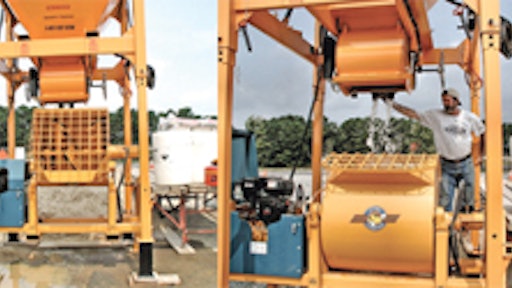
Another type of jobsite mixer is the silo mixer. Silo mixers are portable but not mobile because they have no wheels. They are sold separately from the silos that contain the concrete ingredients and are compatible with any brand of silo.
Silo mixers are transported to jobsites on pickup or flatbed trucks. Once at the jobsite, the silo mixer is placed beneath the silo by a rough terrain truck, which is a large forklift. The mixer is raised by the fork truck until it reaches the proper height under the silo.
"Our silo mixers have an A-frame and as you raise the mixer, the platform gets wider and is more stable as it gets higher," notes Ed Varel, engineering project manager for Stone Construction Equipment, Inc. The platform has fork pockets under it so it can be picked up from any side. The mixer's legs slide inside each other telescopically. Once the mixer is properly positioned, the operator removes the pins to drop the legs, which lock in place, and the fork truck is removed. The concrete mix will go directly from the silo into the mixer.
Silos do not have compartments, so they either come preloaded with the proper concrete mix or the user dumps bagged mix into them. Silos are typically loaned by the company providing the concrete mix. Bagged concrete mix can also be placed directly into the mixer without using a silo. To operate a silo mixer, the blades are engaged and the operator puts about half of the required water into the mixer before dumping in the concrete mix. More water is then added to get the right consistency. The process takes at most a few minutes before the concrete is ready to place.
Stone Equipment's silo mixers are hydraulic and come in 12- and 20-cu.-ft. capacities. These mixers have an offset or high dump, so the mixer can discharge to a pump, wheelbarrow or material placement system at heights up to 56 in.
Easy to learn and operate
Learning to make concrete with these mixers is fairly simple. "Normally when we sell a unit, we send a technician to spend a day or two to train them," Grant says. The operator needs to be able to recognize what good concrete looks like, although the only way to be certain the mix is right is to do lab-based strength tests.
Global uses a similar procedure, talking with customers in advance to find out what type of mixes they use so they have those mix designs prepared on the computer. The trainer calibrates the machine to determine the gate settings for the desired mix design, which takes about 90 minutes, and then does a yield test on 1 yd. of new concrete.
"We suggest that every new operator do a strength test so he has it on record," Horning says. The trainer then observes the customer doing a real job to be sure they are doing it correctly and in a manner appropriate for the conditions of the materials.
Stone supplies operator manuals in addition to having technical service and customer service departments. Its products are sold through authorized dealers who provide direct training to their customers.
Money savers
Portable ready-mix batch plants are another alternative to waiting for ready-mix deliveries, but they don't save as much money as volumetric mixers. "A mobile batch mixer makes concrete and delivers it, while a ready-mix batch plant requires both an operator and a driver, so a mobile batch mixer saves at least two jobs," points out Grant. He estimates that producing concrete with a mobile batch mixer costs about half the retail price of ready mix concrete in the local area.
"We at Global have always thought that rather than being competitive with regular drum trucks, our mixers should be complementary," Horning points out. "The drum truck is designed to dump 10 yds. as quickly as possible and they do a great job. The mobile mixer is designed for versatility and to address short loads. Generally speaking, a ready-mix contractor who does 20 percent of his business in short loads will make money with a mobile mixer."
"Where they save money is really in the time and the cost of the ready mix service," says Varel. "If you're going to use a whole truck, hands down, that's probably the way to go. But if you need a partial truck or have a specific time frame for doing the work, one of these mixers is better."
Rent or buy?
Mixers are often sold to customers other than contractors who then rent them out. Determining whether it is more cost-effective to rent or purchase a mobile mixer depends on how much it will be used.
"If a contractor is processing at least 3,000 yds. of concrete a year, the investment in one of these becomes very attractive," Horning says. He recommends that before a contractor buys a mobile mixer, they should make sure of the availability of materials and research what the cost of those materials will be compared to buying premade ready-mix.
Using volumetric mixers saves contractors money because they don't pay workers to wait for concrete and they can buy cement and other components in bulk, notes Grant.
"With volumetric mixers, contractors can control their own business schedule," Horning says. "They don't have to wait around. They can start working at any time. The machine is very versatile. It has a simplicity of operation. The concrete can be accurately metered. If you're comparing it to a large batch plant, it has a lower initial investment cost. Contractors will buy these things either to start a retail business for 3,000 yds. and up annually or if they are doing a lot of concrete work themselves. If they want to control their own destiny and put more money in their pockets, these mixers will make sense for them."













![Cemen Tech C60 5acd09ba7630e[1]](https://img.forconstructionpros.com/files/base/acbm/fcp/image/2022/03/Cemen_Tech_C60.5acd09ba7630e_1_.623c916eea2d7.png?auto=format%2Ccompress&fit=crop&h=135&q=70&rect=105%2C174%2C1725%2C969&w=240)