Motor graders have traditionally been the domain of only the most experienced equipment operators. The complexity of the controls and the finesse required to maintain precise grades have often necessitated an extensive learning curve — in some cases, years of regular use.
Most manufacturers are striving to reduce this learning curve via increased automation of machine functions. This automation can be largely attributed to advances in electronics — a byproduct of emissions control technology.
"Every engine manufacturer had to figure out a way to make their engines burn cleaner, yet still be very productive, capable engines," notes Howard Woolard, motor grader commercial manager, Caterpillar Motor Grader Product Group. "It stirred the creativity that led to electronic engine controls."
Electronic engine controls were initially introduced with Tier II designs. They not only delivered emissions compliance, they provided improved overall power management. "It allowed us to electronically control the engines and change the characteristics of how the engines performed based on what the customer was trying to do with the machine," says Woolard.
The electronics have since been married to other machine systems, serving as the "building blocks" for greater automation of key motor grader functions.
Mating electronics with hydraulics
Electronically-controlled hydraulic valves have enabled load-sensing hydraulics to become almost a "given" on today's motor graders.
"In LeeBoy models, this gives the operator better blade control through more accurate metering of cylinders," says Keith Lee, research and development at LeeBoy. "For the operator, the 'feel' while grading is better and blade movement is more constant and precise."
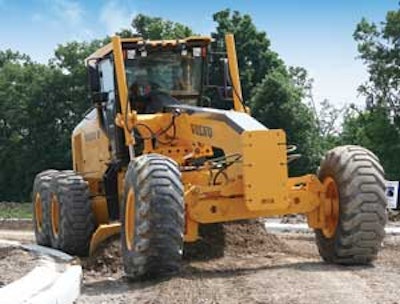
Electronic control of hydraulics has also produced improvements in all-wheel-drive systems. For example, both Volvo and Deere use a two-pump configuration to provide independent control of hydraulic flow to each front wheel hydrostatic motor.
Caterpillar also offers this feature on its M-Series models. "The dedicated pumps help us to control flow to the front wheels more than ever before," says Wade Porter, marketing supervisor, Caterpillar Motor Grader Product Group. "We've dramatically increased the overall torque by 52%, which has really helped us in terms of the tractive effort with the six-wheel drive."
It has also led to a hydrostatic-only mode (transmission neutralized) for the all-wheel-drive system. "This allows us to essentially dial down and precisely control our ground speed in certain applications, like cul de sac work where you already have your curb set and you don't want to damage it, for instance," says Porter. "Being able to dial that machine down below 1 mph and be able to just creep along for precision control is really essential."
Volvo includes an enhanced "Creep Mode" on its G900 Series motor graders, as well. When operating at speeds below 2.5 mph, this mode enables the operator to grade using only the hydrostatic front-wheel drive, while the rear tandems roll freely to minimize scuffing and rework. The result is smoother starts and stops and more precise passes.
A patent-pending automated steering compensation system is also featured on Caterpillar's M-Series. "Through the communication between the electronic control modules, we are automatically turning the outside tire 21% faster than the inside tire when we are in a six-wheel power turn," Porter explains. "That helps out in loose underfoot conditions where you really need your all-wheel-drive system working for you." It also cuts the turning radius by as much as 15 ft.
Controlled shifting
Electronics have played a significant role in recent enhancements to grader transmissions.
"We have an electronic shift management system for the transmission, for example," says Ed Samera, vice president, North America Heavy Products, Terex Construction Americas. "The operator can just put it in forward or reverse and it will shift multiple gears without having to do anything else. That is controlled electronically, coupled with the electronics of the engine to optimize fuel and meet emission requirements."
Communication between the engine and transmission further optimizes the shift points and prevents overspeeding the engine. "If the driver goes downhill, it's automatic. It will make sure he keeps [the machine] below the maximum engine speed so he doesn't have to worry about overspeeding," says Samera.
This communication has also enabled Deere to introduce Event Based Shifting on its D-Series. "Deere's transmission allows operators to shift from forward to reverse or reverse to forward without the operator needing to use the clutch," says Jeff Rowan, product marketing manager for motor graders at John Deere. "For example, if an operator is in reverse in sixth gear and wishes to shift forward to third, he or she only has to move the shift lever accordingly. The machine will smoothly slow down, reverse direction and accelerate into the desired forward gear. The transmission is always protected and the engine is automatically prevented from stalling."
On Volvo's G900 models, the electronic transmission provides a shuttle shift feature that enables simple straight-line forward to reverse shifts (and vice versa), without using the inching pedal or stopping first, and from any speed, notes Brian Lowe, product and communications manager, Volvo Motor Graders. "This reduces cycle times and operator fatigue by eliminating both inching pedal and brake use when changing directions," he explains.
"An operator can combine Volvo's exclusive memory feature with both the Autoshift and shuttle shift features," he adds. This enables easy cycling between forward and reverse gears without shifting or clutching. "The operator simply selects what gears best suit his application and the electronics look after the rest. You couldn't do that before."
Caterpillar has improved its electronically controlled ECPC transmission by electronically engaging and disengaging the clutches between gear shifts. "Prior to the M-Series, we only made changes between direction shifts," says Porter. "Now we're incorporating that technology between gear shifts, so it's going to give us a much smoother-shifting transmission than we've ever had before."
In addition, the company provides standard Variable Horsepower or optional Variable Horsepower Plus. Both deliver power in 5-hp increments as the transmission gear selection increases, and subtracts only 5 hp with each downshift. This ensures adequate power in each gear, says Dan Gillen, product support supervisor, Caterpillar Motor Grader Product Group.
"As you're upshifting, you can either continue to load the machine with more material or move the same load at a faster ground speed, which increases your productivity," he explains. "When you come into a steeper grade or you encounter heavier material and the transmission needs to downshift, you will have adequate power to hold the load or maintain desired ground speed, no matter what gear the transmission is shifting to."
Impact on in-cab controls
Advances in electronics have also permeated inside motor grader cabs.
The most visible example is the electrohydraulic joysticks introduced on Caterpillar's M-Series. This configuration eliminates the conventional control console and steering wheel, replacing them with a pair of three-axis joysticks that control all machine, drawbar, circle and moldboard functions. In addition, all auxiliary functions are controlled via electro hydraulics.
Caterpillar's patent-pending electro hydraulic joystick design also provides some automated functions. "For instance, once the operator has finished a turnaround, they simply push a button on the left joystick and that will return the articulation joint to the center position," says Porter. "The only way we're able to do that is through electrical communication with the hydraulics."
While other advancements may be less obvious, they have produced substantial benefits in machine controllability. Consider Volvo's Power/Speed Engine Mode Switch on the G900 models.
"The operator can switch at will between a 'Power' and a 'Speed' setting to actually change the engine's torque curve when it's running in either of its two lower horsepower ranges," says Lowe. When set to Power mode, the grader develops additional low-end torque, and engine speed is "capped" at 1,900 rpm in the low- and mid-range power setting for improved fuel economy. In the Speed setting, or automatically when a higher gear is selected, the engine changes its power curve for more efficient operation at higher ground speeds.
"By using a lower rpm and selecting a higher transmission gear, the high torque characteristics of the Volvo engine is fully utilized," Lowe explains. "You have the power you need to get the job done, but the economy of the slower engine speed when the power is not needed — all performed automatically and without operator input or sacrificing productivity. "
Cost vs. benefits
Advances in electronics have succeeded in making motor graders simpler to operate, while optimizing overall performance. However, this added sophistication does affect pricing.
"Obviously, as any motor grader manufacturer makes advancements in technology, that does come at a cost," says Porter. He emphasizes, however, that designing other areas of the machine more efficiently can help offset many additional feature costs.
Samera agrees, adding, "Better controls and advancements have impacted the cost of machines [overall]. Contractors often have a difficult time justifying such increases in investments. However, productivity gains play an important factor."
When considering today's more advanced motor grader designs, you need to weigh the higher price tag against the potential productivity gains, as well as any costs savings you may achieve due to improved control of key operating systems. Crunching the numbers will help you determine if a premium product can ultimately generate a premium return on your initial investment.