It is understandable that pavement maintenance on highways poses much different – and in most cases greater – risks than does work on parking lots, driveways and even secondary roadways.
The purpose of this writing is to address some of the more common highway maintenance hazards and to offer some practical tips that will hopefully help to reduce the chance of having an accident and therefore keep your insurance premiums from increasing.
After all, a large part of premium determination is predicated on prior loss history. This holds true for all lines of insurance. Insurance companies that write policies for businesses engaged in highway operations – whether it’s sweeping, cracksealing, or paving – require that there be a formal set of safety guidelines in place for this type of work.
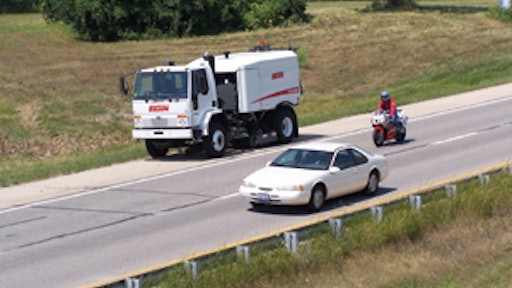
One of the main on-highway factors to be aware of is speed, primarily the speed of the traffic moving around your highway work zone. It should come as no surprise that research shows there is a direct relationship between the size, speed, and distance that an object travels at the point of impact and the resulting property damage and/or injury sustained as a result of this sometimes-deadly combination.
In addition other factors, such as the inability to control the driving habits of passing motorists, are probably the most frustrating. Factors such as driver fatigue, operating under the influence of alcohol and/or drugs, speeding, limited visibility during night operations or bad weather, volumes of large trucks and trailers, all are compounding issues.
Contractor safety actions
Unfortunately, highway work usually invites all of these components and could be ingredients for disaster.
What to do?
Outside of working on roadways that are closed to general traffic, which nowadays is rarely an option, the contractor must implement all of the necessary precautions he can to protect employees and equipment as well as others around the work crew.
So start with the things that are in your control. Insist on:
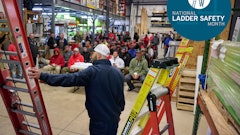
- Proper employee training
- Regular vehicle and equipment maintenance, and
- Effective night lighting.
Also, designate and train your on-site supervisor to be vigilant and to monitor the ever-changing conditions on the highway. Plus, authorize the on-site supervisor to direct the crew according to the conditions he sees.
These should be minimum in-house standards and are required by most insurance carriers.
Slowing drivers down
Now to address the larger problem: How to control the actions of passing motorists.
Accident investigations have traditionally determined that speed is the major cause of severe injury, property damage, and death.
Although it is next to impossible to control the personal habits of each motorist, you can at least attempt to control when, where, and how they pass your crew.
Because most pavement maintenance operations (sweeping, line striping, and repair) involve moving traffic patterns as opposed to fixed patterns for construction operations, the safety procedures can differ.
Depending on what entity owns and operates the highway, (state, local or federal DOTs) there are usually lane closure procedures included in scope of work specifications. These procedures can range from being very specific to very vague. But whatever procedures are specified, contractors should at the very least comply with the minimum requirements.
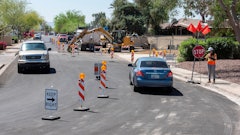
In addition, the contractor should implement other safeguards that will further protect his crew, equipment, and others. These additional procedures can include arrow boards, temporary lane closures, truck-mounted attenuators, and shadow vehicles. The easiest controls to implement are the use of arrow board, slow moving vehicle signs, and crash attenuator vehicles.
Each of these safety procedures provides another level of safety for your crew, protects your equipment, and also makes the jobsite safer for the driving public.
But it appears that the standard use of lane closure arrow boards and crash attenuator units, in most cases, are not enough to deter motorist who are intent on ignoring these devices and are selfish to their own desire to get from point A to point B the fastest way possible, regardless of who or what is in between.
Therefore, what more can be done?
Bring police to the jobsite
Research has proven that, by far, the most effective way to minimize "drive-by incidents" and slowing down passing traffic, is the use of police services situated well in advance of your pattern and in most cases in front of it. So one recommendation is to add police services to your highway safety plan.
It has been proven that when motorists view emergency vehicle lights in addition to safety vehicle lighting, there is greater initial reaction to slow down. Although there is usually an additional cost associated with the use of police services, it can speak volumes for the added safety value. However, the important part of this feature is to provide the necessary distance from where the police and other signal indicators are located in conjunction with the actual work crew.
This is critical in effectively and safely slowing traffic as it passes. This ultimately will allow your crew and motorists to have more time to react to any situation on the roadway.
Even though you do everything mentioned above and more, there will always be that inherent danger of working on the highway.
So never sacrifice dollars spent on safety for the lives of your workers and others.
A proper highway safety program can lead to profitability and reward you with lower insurance costs.
The implementation of formal highway safety procedures, not only minimizes your loss potential, but can have long-lasting positive impact on your insurance costs. Although most insurance carriers who write this type of business require that these procedures be in place, they can offer additional safety credits to your pricing upwards of 20%.
The long-term effect will be that with reduced loss activity, the insurance company can also apply experience rating credits upwards of 25%. This of course is relative to their various state allowable filings.
Scott Cerosky is president of Pavement Maintenance Insurance Agency, which provides insurance packages tailored to the street and parking area pavement maintenance industry. For more information call 800-656-391 or reach Scott via email at [email protected].