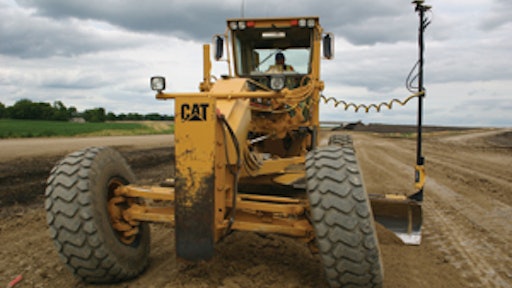
Investing in 3-D grade control technology can be an intimidating experience. The type of work will dictate the most appropriate system to use.
Today, you can select either GPS or ATS construction total station positioning technology. "GPS-based grade control systems are ideal for larger site projects and long-term, multi-phase projects," says Catherine Mansfield, Trimble Construction. "ATS construction total station-based grade control systems are ideal for contractors who need the flexibility to move from site to site frequently, work in confined spaces or perform high-precision grading with their dozer of motor grader."
ATS systems also offer a 3-D grading solution for jobs where GPS is not viable, such as in urban canyons, heavily forested areas or jobsites with numerous overhead obstructions, such as highway overpasses.
The best way to actually get started with 3-D technology is open for debate. Mansfield highly recommends buying the whole package, rather than start with a GPS or ATS-based rover system, then progress to a machine-mounted system.
"Whether you choose to invest in machine-mounted or rover systems first, both options allow you to get an understanding of using positioning technology for construction earthmoving," she states. "However, at a customer panel session at Trimble Dimensions 2005, a key message from all customers (small, medium and large contractors) was that if they had to do it over again, they would have started with more systems and not less. They believed they would have realized a much higher payback if they had invested in more systems up front.
"Additionally, it is important to note that if a contractor invests only in a machine-mounted system initially, they will need to hire services to come in and set up the control," she adds.
Rover as a first step
Other experts believe the rover provides a good introduction to 3-D before jumping into machine automation. "The best route to get into this is to probably start managing your software and a GPS rover, not necessarily jumping right into machine control," says Matt Kohler, sales manager for machine automation, Western U.S., Leica Geosystems. "Most people like to use those steps, manage their data, before they take that leap of faith. Having said that, you are going to start seeing a true payback once you really go to machine control because you are going to see that dramatic jump in productivity."
But there is a learning curve. "I have seen people be successful both ways," says Kohler. "But there are growing pains when you jump in and try to do it all at once." Data management is the key to the whole process "If you don't have the data, you are pretty much sunk." If the data is not prepared, the grader or dozer sits idle.
"Either implementation path can result in rapid payback if the contractor is savvy about bidding, job costing and project management," says Richard Rybka, Topcon Positioning Systems. "Most contractors will still want to start with a GPS rover system for two reasons. Many contractors are intimidated by technology, especially satellite positioning products. Starting with a survey system helps them get acquainted with the technology and learn the operational requirements. Secondly, a GPS rover system is multi-functional and can be used for laying out features like storm sewer, verifying topos and tracking earthwork volumes, as well as checking grades.
"The next level of implementation would involve adding indicate systems on heavy scrapers and large dozers and excavators," says Rybka. "To reach the optimum level, fully automatic systems would be added to fine grading equipment like motor graders and dozers with six-way blades."
Ken Autry, president of Fayetteville, NC-based Autry Grading, currently has Topcon 3-D grade control installed on eight pieces of iron, including automatic systems on four Volvo motor graders, two automatic systems on dozers and two indicate systems on scrapers. "We started out with a rover system," notes Autry, "and as we saw what it could do for us, we started adding to it."
Prior to investigating 3-D, Autry was no stranger to grade control. "We have run laser automatics for 12 years," says Autry. The company spent three years exploring the capabilities of the rover system. "Then we went right on to the automatics."
Autry explains that the toughest part was learning the software and building the cards. "You are actually converting the plans from 2-D when they come from the engineer to 3-D, and building a card that fits into the hardware of the equipment itself," says Autry. "We do it all in-house. We have a person on our payroll who does nothing but these cards."
The rover itself has been useful for estimating. "When the card gets built, all of the information that you are putting in can be converted to the cubic yards of dirt that you have to move," says Autry.
The estimator does a topo of the jobsite with the rover and an ATV. "Then we will clear the dirt and go back and topo it again," says Autry. "That will tell us if we are accurate in the takeoff yardage that we had. It is verifying what the plans were telling us."
When used for estimating, the GPS rovers can significantly increase bid accuracy. You simply mount the rover to an ATV or pickup and drive to the site. "If you want to drive a 50-ft. grid, you are going to tighten up your bid substantially," says Autry.
Survey rovers also pay for themselves by eliminating outside staking services. "If you have someone on sight who is dedicated to putting wood in the ground, it is going to be cheaper and your machines are going to keep moving," says Kohler. "You are absolutely going to see reduced costs and greater savings if you just go to a GPS rover system. With a GPS rover on a pole, you should be within a few hundredths accuracy."
All these benefits can be had for the cost of a base and a rover — approximately $40,000 to $50,000 according to Kohler.
Machine control solutions
There are many 3-D solutions for machine control. "GPS-based indicate systems typically start at about $35,000," says Arthur Taylor, segment manager for 3-D grade control systems, Trimble Construction. "A fully automatic system can cost as much as $50,000 to $60,000. However, it is important to understand that there is a very wide range of variation in the costs of the different grade control systems and this is typically based on a number of factors — indicate vs. automatic, 1-D vs. 3-D, the technology (laser, sonic, rotation sensors, angle sensors, total station, GPS or some combination of these), software interface for the operator and the ability to do real-time two-way data transfer between the office and the field."
Let's say you don't have a system and you get a job that requires 3-D on your grader. The total cost will vary depending on whether you use GPS or a total station. Let's look at the GPS solution first. "With the base station, rover and machine, you are looking roughly anywhere from $100,000 to $110,000," says Kohler.
The total station solution is less expensive. "With a machine and a robotic total station you are in the $80,000 to $85,000 range," says Kohler. And you can achieve very tight tolerances. "Your differences in tolerance with a tight blade will be within two hundredths across the blade with a total station."
When trying to decide between the different systems available, user friendliness should be at the top of the list. "All of the systems we have seen that do basically all of the same functions are relatively close in cost," says Autry. "An owner/operator really needs to look at it in a sense of which one he thinks is easier for him to understand and operate."
Autry Grading is currently expanding its use of 3-D grade control systems. The goal is to ensure that all of the rough-in crews and grade crews have at least one piece of GPS equipment with them.
Autry emphasizes there is a payback with these systems. "It is hard to convince people that there is until they actually do it," he says. "The costs have come down some, but it is still pretty expensive."
Networks save cost
In some regions of the country, networks have been established that eliminate the need for a base station on the jobsite. You simply connect to the network for the necessary reference information. "A lot of areas are moving that direction," says Kohler. Northern California, Las Vegas, Colorado and Washington are just a few places in the West that already offer networks.
When working in these areas, you can save $20,000 since you don't need a base station. "Some people just buy a rover to go around jobs within the city," says Kohler. "If they have jobs outside the city, that's when they put up their base stations."
Not all metropolitan areas are on networks yet. "There is not a central base station here yet," says Autry. "We don't have networks. I wish we did. It will come in time."
In the meantime, Autry Grading needs to set up a base station at each of its jobs. "That adds to some of the expense," says Autry. "But we have to work with the systems that are offered to us."
Installation options
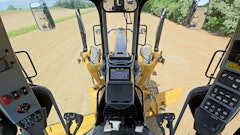
With many systems, it is possible to upgrade your current 2-D system to 3-D. This means you don't have to buy a completely new system when it is time to upgrade.
"Aftermarket installations of automatic 3-D grade control systems can be installed on most machines," notes Taylor. "Limitations depend on the machine type and the hydraulic system on the machine."
There are basically three kinds of activation for hydraulics, and each has an impact on installation. They include mechanical, pilot and electronic. "Machines with mechanical activation require the grade control system to be plumbed into the main hydraulic circuit of the machine," says Mansfield. "The larger the machine, the higher the installation cost."
Many equipment manufacturers have transitioned to pilot controls. "With this technology, the overall cost of the hydraulic installation is reduced, and the size of the machine does not significantly impact the cost for installation of the grade
control system," says Mansfield.
The latest development is electronic activation of hydraulic circuits. "With this technology, the overall cost of installation is further reduced and the size of the machine does not significantly impact the installation cost," says Mansfield. "In effect, these machines are all pre-plumbed."
Both pilot and electronic controls have greatly simplified installation. "With the recent trend toward pilot hydraulics and electronically controlled (E/H) valves, this is becoming easier and easier," says Taylor. "This move has meant the installation time for some models of machines has gone from 1.5 days down to 0.5 days."
"Some machine manufacturers today offer factory installations of grade control systems," says Taylor. "These systems typically cannot be moved from machine to machine as the overall machine design incorporates the grade control system, much like a car includes a stereo."
Autry Grading recently bought four new Volvo graders already set up with the hardware for grade control. This simplified installation of the 3-D systems. "The valves were put on here, but the hardware for bolting of the stuff was there from the factory," says Autry.
The future
As 3-D systems continue to evolve and more contractors discover the benefits, the technology is bound to spread rapidly. "I think we are at about a 10% or 15% saturation point in this market for 3-D," says Kohler. "There is still a lot of growth to occur."
Given the competitive nature of earthmoving, the rising costs of fuel and the tenuous availability of precious commodities such as earthmoving tires, this might by the right time to take the first steps toward 3-D grade control systems.