Digging requires horsepower. The faster, deeper and wider you want to dig, the more power you actually need. Ideally, you would like to get the job done as quickly as possible at the lowest possible cost. Yet, the cost portion of the equation means the solution isn't always the machine with the most horsepower.
Consider trencher selection. Mark Cooper, Vermeer, says you must compare the cost of operation and production in order to select the right machine for your operation. Machine size has the largest influence on these variables.
But it is a balancing act. "You should look at the job and determine how fast you need to get the trenching part done," says Brent Bolay, the Ditch Witch organization. "This helps you get into a size class of machine that will actually accomplish that."
Tires or tracks
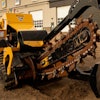
While size is the primary criteria that determines which trencher is right for your application, you may also have a choice between rubber tires or a tracked undercarriage. There are a few compact ride-on trenchers under 25 hp that are equipped with rubber tracks, but the majority of trenchers under 115 hp are on rubber tires. From 115 to 185 hp, you will find trenchers equipped with either tracks or tires; and above 185 hp, the trenchers are almost exclusively on steel tracks.
Rubber tracks on compact trenchers offer low ground pressure for soft soils and minimal ground disturbance. "Compact trenchers that can be equipped with rubber tracks can be used in residential areas because they can move over asphalt or concrete without damaging the surface," says Bob Wren, ASTEC. This leads to lower rehabilitation costs.
Machine life may also be affected. "I believe that rubber tracks increase the life of a compact trencher because the tracks absorb some of the shock load that goes into the chassis while digging in tough ground," says Wren.
In the mid-size trenchers, however, the rubber-tired units dominate the market. "There is more of a horsepower selection in the rubber-tire range, which allows the contractor to choose a size unit best suited for his or her particular application," says Wren.
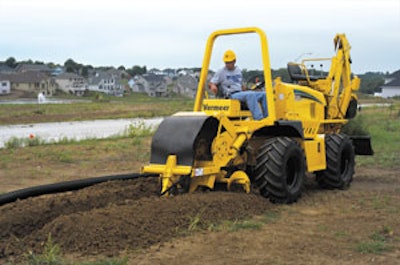
The benefits of rubber tires on mid-size machines are numerous, including the ability to handle curved trenching. "A rubber-tire trencher typically is more mobile; it has higher road speeds," says Cooper. "It is also easier on the ground, streets and grass."
The trencher turns by steering rather than skidding. "Rubber-tired machines can suit more applications without increasing the cost of restoration," says Wren.
Different tire sizes are available to suit specific applications. "At ASTEC, we offer a couple choices on some models, depending on whether the machine will be equipped with a trencher or a cable plow," notes Wren. "Those who are plowing cable usually want a larger footprint on the ground to increase tractive effort, and also improve flotation."
In some cases, suppliers offer a choice of tires or tracks in the same size machine. For example, Ditch Witch offers both the 115-hp rubber-tired RT115 and the HT115 on tracks. "In the case of the tracked model, you need to have an application that justifies the higher purchase price associated with a tracked unit," says Bolay.
Each option offers strengths and drawbacks. The tracked unit provides increased traction and flotation for cable plowing and straight line trenching. But the rubber-tired unit is more maneuverable for cutting curved trench, and it doesn't damage the surface as much, requiring less rehabilitation work.
"If you have a job that requires quite a bit of turning, a rubber-tire machine would be better because you would typically use the front axle, or steering axle, to guide the machine," says Bolay. "It is easier on the trencher [boom] with a rubber-tired machine than it would be with a track unit." When a tracked machine is turned, it tries to rotate the whole machine, similar to a skid-steer loader. "That forces the boom to move in the ground (against the side of the trench) faster than it really should."
Track trenchers can also create a challenge on rough terrain. "Because of the design of track trenchers, I would say they are more difficult to operate on rough terrain," says Wren. "They all have a rigid frame, which means the operator may be constantly raising and lowering the boom to maintain proper cover depth. Rubber-tired machines will have at least one axle that will oscillate to maintain ground contact."
Typically, the strength of tracked trenchers is straight line trenching for long runs. The low ground pressure of the tracks allows the trencher to traverse varying soil conditions.
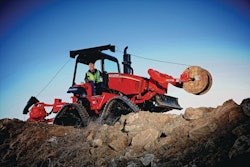
When trenchers reach a certain physical size, the tracks become necessary to provide adequate flotation. "When you get up to a 40,000-lb. machine, you just have to have a tracked undercarriage underneath it to handle that weight and still do the job," says Bolay.
"The bigger the trench and the harder the material lead you to track trenchers," says Cooper. For instance, consider trenching in rocky soils. "Typically, track trenchers are much larger and heavier, and are used to cut rock. This is because they are more stable — they do not bounce cutting rock. They also provide better flotation and traction."
Track machines can also be beneficial when trenching on slopes. When equipped with a tilt frame, they can make vertical cuts on sloped surfaces. "That is a feature we offer that lets you work in those areas a little easier by keeping the frame level," says Bolay. The Ditch Witch models typically tilt 7° left or right. "We put a little level up on the dash so it will give you some guidance as to where you are at."
Track trenchers tend to cost more to run over the life of the machine due to the expense of undercarriage components. But the low ground speed and minimal force generated while trenching translate into a long life expectancy. There is not a lot of pulling force exerted on the track. "The majority of the horsepower goes through the trencher chain," says Cooper. "The final drive has a pretty easy life. The biggest thing it has to handle is the static load."
Trenching vs. cable plowing
If you are going to use a machine for vibratory cable plowing, the selection criterion changes. Bolay explains that traction is actually a bigger issue when cable plowing than it is with trenching. The trencher chain cuts away the material before the machine really starts to pull. "It doesn't really require a lot of traction," he notes. "On the other hand, with the vibratory plow, since we are not removing that soil, it has to have enough traction to pull the plow blade through the ground."
Cable plowing is an application where tracks can be very beneficial. "In many applications, such as burying cable along side the right of way, a track cable plow will have more tractive effort and, at the same time, have less ground pressure per square inch on the ground," says Wren. "I would say there are more track machines equipped with cable plows than with trenchers."
Features add productivity
All of the manufacturers have developed features that will help you get the job done a little easier. For instance, Ditch Witch can provide the operator with a digital readout of trenching boom depth from the operator's seat. "He can take the digging boom down and have confidence of digging deep enough to have his cable or pipe placed at the right depth," says Bolay. If you are going over rough terrain, it will indicate whether the operator manually needs to raise or lower the boom.
Electronics have also made it possible to automate functions, such as with cruise control. "It allows an operator to set a ground speed while trenching, and then it maintains the engine speed to operate within a certain parameter," says Bolay. "It gives you optimum performance out of the engine by maintaining a constant speed. It maximizes your feet per minute — your production on any given job."