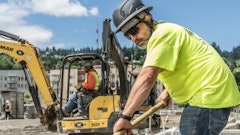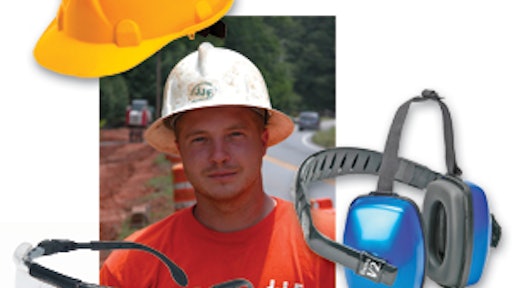
To an outsider, a hard hat and safety glasses may be nothing more than trademark symbols of those who work in construction. But to a worker, these items — as well as other personal protective equipment (PPE) — can provide security in an environment where potentially dangerous hazards, such as flying debris, falling objects and noisy equipment, are all part of a day's work.
"Hard hats and safety glasses are considered standard pieces of equipment for a construction worker," says Paul Satti, technical director for the Construction Safety Council. "They're accepted as being part of the job."
When it comes to protecting the head and face, there are a number of PPE items to consider. Hard hats and safety glasses are some of the most obvious. But employers should also consider hearing protection and face shields when appropriate.
Implement a PPE policy
To determine when and what PPE is needed, Satti suggests looking to job descriptions. "If properly written, they will identify your PPE needs," he says. "For example, if a worker is supposed to use a [circular] saw, you have identified an electric tool that might require eye and hearing protection. Based on that description, it's understood that the operator must be willing to wear PPE."
Satti also suggests drawing upon manufacturer recommendations, as well as accepted work practices established by the industry and its associations. Then incorporate information from your own hazard analysis based on personal incidents. "Go back and look at your past injuries and accidents," he advises. "If you determine that a high eye injury rate has been attributed to a particular task or tool, implement an eye safety program for that particular job."
It's important to use common sense when establishing a PPE policy. "OSHA won't tell you that your workers have to wear hard hats," Satti points out. "What it does tell you is that you should wear head protection if exposed to a hazard of getting hit in the head."
That may mean there are times when a worker will don some form of PPE when and where there is no perceived risk of danger. "But if you want to set a strong policy statement as to when, how and where to use PPE such as a hard hat, etc., you should have your workers wear them 100% of the time, because you can't follow them around and tell them when it's appropriate," Satti says. "They should wear PPE because it's policy."
Head protection
Wearing a hard hat offers a two-fold approach to protection, notes Jeanette Gaunce at Bullard. The shell protects from debris and objects that fall directly on the head, while the inner suspension — webbing, bands, etc. — absorbs the impact to protect the neck and spine.
Hard hats are categorized as Type I or Type II, with Type I most commonly used by contractors, Gaunce explains. A Type I hard hat offers top impact protection, while a Type II hat incorporates a foam liner that offers additional lateral (front, back and side) impact protection. With either type, look for one that meets current ANSI standards (Z89.1-2003 revision). That information will be printed on the label.
Even if a hat meets ANSI standards, other factors can hinder its effectiveness. "As manufacturers, we do a lot of design and testing to provide a helmet (hard hat) that keeps you safe," Gaunce says. "But sometimes, with or without knowing it, you can compromise the performance of the product."
Following are some guidelines for obtaining optimum performance from your hard hats:
- Personalization/decoration — Using a few stickers to personalize a hard hat would not be expected to negatively affect performance. However, too many stickers can prevent the user from properly inspecting the hard hat prior to use. If you wish to add an identifying logo, some manufacturers, such as Bullard, can pad print company logos and safety slogans, which are permanent and will not peel, crack or fade like a decal or sticker. Reflective striping can also be applied to increase worker visibility and allow for worker differentiation.
- Ventilation — Drilling holes to enhance ventilation sacrifices the integrity of the hard hat, Gaunce cautions. If ventilation is desired, choose a helmet specially designed for extra air flow. Be aware that these helmets are not approved for all uses.
- Usage — Some models of Type I hats can be worn backwards as long as the suspension is also reversed. Before wearing a hard hat in the reverse position, consult the hard hat manufacturer for recommendations.
Clearance between the hard hat shell and the wearer's head is required for the system to work properly. Placing items such as gloves in this space, or wearing baseball caps or insulated hats underneath, may limit the clearance and negatively affect hard hat performance.
- Care/maintenance — Even if they are used in an outdoor environment, avoid storing hard hats in direct sunlight, such as on the dashboard of a pickup truck.
Bullard also advises changing the hard hat suspension at least once a year, or more frequently if an inspection reveals cracks, frayed ribbon, etc. "And if an impact has occurred, remove the hat from service, even if there is no visible damage," says Gaunce.
The Construction Safety Council further suggests replacing a hard hat if the brim or shell is nicked, cracked, perforated, or deformed; there is a loss of surface gloss; there is chalking, fading or flaking of the surface; the shell is stiff or brittle; or it has made an electrical contact.
You can check the integrity of polyethylene shells by compressing the shell inward from the sides about 1 in. with both hands. Release the pressure without dropping the shell. It should return to its original shape. If it does not, replace it immediately.
In general, those within the industry recommend replacing hard hats every five years. You can check the "born-on" date underneath the bill to determine the age of existing hats used by your workers.
Eye protection
According to OSHA, about 1,000 eye injuries occur every day in the workplace at an annual cost of $300 million in lost production time, medical expenses and workers' compensation. It identifies two major reasons for eye injuries at work: not wearing eye protection, or wearing the wrong kind of protection for the job.
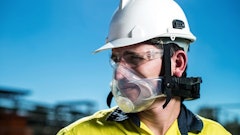
When selecting eye protection, determine what it needs to protect workers from. Safety glasses, goggles and face shields provide protection from impacts, heat, chemicals, dust and radiation. Safety glasses protect the eyes from impact hazards such as flying fragments, objects, large chips and particles. Those with side shields are required when a hazard from flying objects exists.
Goggles offer protection from impact hazards by forming a seal around the eye area to keep contaminants out. Ventilated goggles, both direct- and indirect — permit air circulation while protecting against airborne particles, dust, liquids or light. Non-ventilated goggles provide protection from chemical splashes.
Face shields protect the entire face or portions of it from impact hazards. Keep in mind that they are designed to be used in combination with safety glasses or goggles — they do not provide impact resistance when worn alone. Select a face shield window with the appropriate transparency and thickness for the specific task at hand. Windows and head gear devices are also available in various combinations.
If a worker wears prescription eyewear, ask an optometrist about prescription lenses and frames that meet ANSI Z87.1 standards. Or if you don't want to purchase another pair of glasses, the worker can use non-prescription safety glasses or goggles that fit over the prescription eyewear.
The Construction Safety Council suggests replacing protective eyewear when a lens is cracked or does not stay in the frame; when the frame is broken, bent or distorted; when an impact has occurred; and when the lenses are scratched to the point that vision is obscured.
Hearing protection
Hearing protection is moving beyond earplugs and passive earmuffs with the introduction of new technology such as electronic noise canceling (ENC) earmuffs from companies such as ProTech Communications, Inc. and Bacou-Dalloz.
"Historically, hearing protection had limitations in that products like traditional ear plugs and earmuffs don't offer much protection from low-frequency noise that comes from engines, fans, motors, etc. that are common on a jobsite," explains Joanna Lipper, vice president of marketing and communications at ProTech Communications. Low-frequency noise makes it difficult for a person to hear and comprehend speech and warning signals.
ProTech's NoiseBuster Electronic Noise Canceling (ENC) Safety Earmuff combines passive hearing protection for mid- and high-frequency noise with advanced ENC technology to help protect against low-frequency noise.
"It's the same technology that's used in more expensive noise canceling consumer audio headphones like those from Bose," she indicates. "But the NoiseBuster is much heavier-duty for industrial applications, and it costs half as much.
"The reality is that hearing loss is insidious," she continues. "You don't know that it's happening. The cilia in the ear are little hair-like cells that are susceptible to damage by exposure to noise. You don't know you're damaging your hearing because it doesn't physically hurt. It takes you by surprise — and it's irreversible."