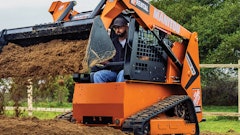
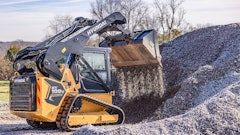
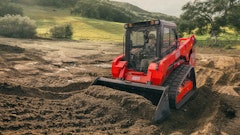
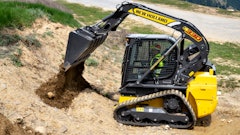
Ronnie Puckett estimates he has logged more than 25,000 hours operating a compact track loader for his Jefferson, GA, construction business. Currently, he's running his fourth machine — a Takeuchi TL140. He also has a larger TL150. Both are used to move dirt associated with residential construction.
For Dorian Boreman, the addition of a compact track loader came just eight months ago, when his employer, Commercial Fence, in Pasadena, TX, purchased a Mustang MTL16 track loader. The MTL16 was acquired to assist in the installation of chain-link fence primarily for petrochemical companies in the Texas, Oklahoma and Louisiana areas. Just a month later, Commercial Fence added another machine to complement its existing fleet of wheeled skid-steer loaders.
For these contractors, compact track loaders translate into extra productivity — from a variety of avenues.
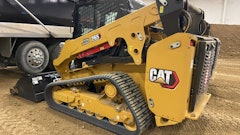
For one, rubber tracks provide flotation and traction in less than ideal conditions. That's important for Puckett, who has been able to continue moving dirt in spite of this winter's excessively wet weather.
"These tracks have been a real advantage this year because it's been so wet," Puckett relates. "The amount of rain we have had has really caused some problems. Without these machines, I'd be sitting in my house. But since they can work in wet conditions, I'm able to continue working when other contractors can't."
Boreman also appreciates the extra buoyancy a compact track loader provides. "We bought the first machine for a job upgrading the perimeter for the Port of Houston," he explains. "These machines can work in a harsher environment than our wheeled machines, although it does not dictate that we have all track machines. We see the biggest need for rubber tracks in low-lying areas and where rain and drainage are a problem."
Boreman recalls a recent job that required the installation of 60,000 ft. of fence. About 20,000 ft. was located in an area where it was difficult to mobilize because of pipelines and soft ground conditions. "If we got down there and got any sort of rain, we would have gotten stuck without the tracks," he says. "It made sense to use the track machines in this job and they performed very well."
A match for specialty attachments
According to suppliers, compact track loaders translate into enhanced productivity, and are a good match when using specific types of attachments, especially ground-engaging tools such as dozer blades and box blades, as well as pallet forks and tree spades.
Puckett uses a dozer blade to level residential housing pads, in addition to 76- and 80-in. buckets with a tilt attach for working on slopes around foundations.
"With dozer attachments, such as a six-way adjustable blade, the tractive effort of a compact track loader can put more power and traction to the ground to do an amazing amount of work," says Kelly Moore, Mustang. "Productivity in this situation will just be better with a track loader. You can certainly do the job with a wheeled machine, but you can just do it better with rubber tracks."
Mike Fitzgerald, product representative at Bobcat agrees. "We sell compact track loaders to many of the same customers into the same applications as a skid-steer loader. But rubber tracks will enhance what those customers can do on a particular jobsite," he says. "While the applications aren't significantly different, the productivity and ability to extend work days in changing weather conditions help justify compact track loaders."
A compact track loader is a good choice when pushing power is required because you have more rubber on the ground. It's a similar concept to laying down plywood to maneuver a wheeled skid steer in less than ideal conditions, explains Brad Lemke, director of product development at ASV. "With a track machine, you get the entire length and width of the track on the ground," he says. "That translates to traction. On a skid steer, dozing power doesn't come from the engine — it comes from contact with the ground. When wheels spin, you just can't get enough traction. But with a track machine you can."
Extra rubber on the ground is also a benefit when using attachments such as pallet forks, which Boreman uses for moving cumbersome chain-link fencing. "No one wants to ‘schlep' around a roll of 50-ft. chain-link fence," he notes. "It's not practical. The forks allow us to move material without manually manipulating it.
"Everything we do has to fall into the guidelines of productivity and safety," he continues. "Using the track loader allows us to do that. Work that was traditionally done by hand or with smaller, hand-held machines can now be done with the loader."
The loader function gained with a track loader is certainly a benefit, adds Mike Ross, national product and training manager at Takeuchi. "Contractors can use a dozer blade to sculpt the land, then use pallet forks to carry stone or block for a retaining wall, all with the same machine. With the rubber tracks on the ground and the good traction between the track and the ground, you're able to get the functionality of a dozer combined with loader functions for lifting material. A compact track loader is really a multi-functional piece of equipment."
Justifying the cost
Because of their versatility, compact track loader sales have grown tremendously in the last few years. This year, there continues to be new competitors and more models.
While no accurate numbers exist, some within the industry estimate that compact track loader sales accounted for as much as 25% of skid loader sales last year. That's in spite of their increased cost compared to a wheeled machine. "A tracked machine will cost more," indicates Moore. "But the extra productivity gained in the right application can certainly justify the extra cost."
According to Ross, some contractors he's worked with claim their compact track loaders outwork their skids steers at a ratio of two to one. "While it is more expensive, when you compare the purchase price of the machine to the productivity gained," he adds, "being able to work in all conditions outweighs the additional cost of the machine."
Fitzgerald reiterates this line of thinking. "One contractor told me that even though compact track loaders cost more to purchase, and cost more per hour to run, he gets more work done with them and the operators prefer to run these machines," he comments. "So as he needs to replace machines, he'll replace them with a tracked unit."
Puckett sums up the additional cash outlay rather simply: "I'm working when others aren't."
Boreman can also validate the premium cost, though he indicates there's still a place for wheeled machines. "I would recommend that anyone interested in a track loader do his research," he says. "For us, we needed a fleet of versatile equipment. The track loader fits into that well because it can be used in so many different environments."
In addition to wet, low-lying areas, Boreman also uses the machines in dry conditions where he wants to minimize rutting, such as on college ball fields. "There just isn't any footprint with the tracks," he says. "They eliminate any deep ruts that will eventually cost you money because you'll have to go back and fix them."
That lighter footprint is because the weight of the unit is dispersed over a wider area, explains Lemke. Ground pressure of ASV's machines are as low as 2.5 psi, compared to about 35 psi for a wheeled machine and 5 psi for a person. "These machines can realistically get into areas where you can't even walk," he says. "There are just certain jobs that a wheeled machine physically can't do. In applications where extra traction is needed, a tracked machine will be a better choice."
Lemke feels the same is true when using attachments. "Attachment manufacturers love to demonstrate their attachments on a track vehicle because it makes their attachment shine," he says. "A lot of attachment performance is limited by what the host machine can do. With a track machine, you reduce those limitations."
See more compact track loaders in the Equipment Gallery.