The ability to work in tight spaces is an ever-growing concern for many contractors. Yards are becoming increasingly smaller, lot lines are moving closer together and gates and fences prohibit access to larger, more traditionally-sized construction equipment.
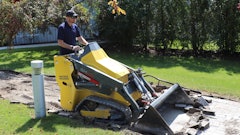
Luckily, there are a growing number of options for maneuvering in and around confined areas and through narrow gates. These include mini skid-steer loaders (also known as compact utility loaders) and compact skid-steer loaders under 1,000-lb. rated operating capacity. Both can minimize the amount of manual labor required on a jobsite by replacing wheelbarrows and shovels with machines.
Admittedly, a mini skid steer and a compact skid steer can do essentially the same tasks. They can both dig a hole and move dirt, and they can both auger and trench.
"We offer three machines 'two minis and one compact' that do basically the same job, and cost about the same amount of money," says Gerald Zastrow, mini loader product specialist at Bobcat. "But each machine has its specialty, so you need to ask yourself what you are trying to accomplish to determine which machine is best for you."
Attachment and size advantages
Start by evaluating the application. Do you do more digging or more attachment work?
Virtually any attachment available for traditional-size skid-steer loaders is also available in a smaller size for these more petite machines. But while both can utilize a large variety of attachments, mini skid steers are designed to be attachment carriers, says Zastrow. "Because hydraulic flow rates are greater, you will get a little bit better attachment performance from a mini skid steer, especially when using auger and trencher attachments," he says.
For example, the hydraulic flow rate of Bobcat's 463 compact skid steer is 10 gpm, whereas the flow rate for its MT52 and MT55 mini skid steers is 12 gpm.
"With the higher flow rates of a mini skid steer, available power on some of our units can run up to about 25 hp, which is about the same as you might see in a larger lift capacity skid steer," notes Mike Lumbers, senior product manager at the Ditch Witch organization. "So for contractors who require auxiliary power, they can dig deeper and auger and till faster with a mini skid steer. That's one reason why the mini is so popular. In some cases, you can have the same power in a smaller package."
If you're using a lot of different attachments, a mini skid steer may also be a better choice. "It can be more cumbersome to change attachments with a compact," says Jon Kuyers, compact solutions manager at Vermeer. "With a mini skid steer'either a walk--behind model or one with a stand-on platform'you can hop on and off quickly. With a compact, you have to crawl in and out of a cab every time you want to change attachments."
Because mini skid steers are smaller than a compact skid steer, they can fit into those especially tight areas where only wheelbarrows and shovels could previously go. "Generally, most of these smaller machines'minis and compacts'can fit through a 36-in. gate," says Kuyers. "But compacts are a little wider and heavier to maneuver in those really confined spaces."
"Plus, with a mini you don't have to worry as much about running into anything," adds Lumbers. "With a compact, visibility is reduced because the machine has a cab and is bigger, bulkier and taller."
The smaller size is one reason Chris Nash, owner of Northwest Arbor-Culture, Inc. and Northwest Arbor--Care, Inc. in Newberg, OR, purchased a Vermeer S600 mini skid steer a few years ago. The S600 replaces a lot of manual labor involved with Nash's landscape and tree care businesses. "We can get into places with this mini skid steer where we just couldn't get with mid-level equipment," he says.
Equipped with attachments that include a roto-tiller, trencher, grader, bucket, auger and pallet forks, the S600 can do a number of tasks, including minor grading, trenching, tilling and material handling. Nash also hopes to add a cement mixer in the near future.
"This machine helps improve efficiency for many tasks and it minimizes much of the back breaking work," he says. "It has really been a good investment. And it meets my requirements for being a safe machine that, for the most part, makes the operation more efficient."
Big benefits in a small package
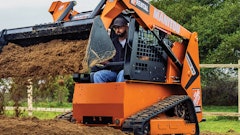
While minis may have the upper hand in tasks involving frequent attachment changes or very confined jobsites, the extra size and therefore weight of a compact skid steer gives it an advantage over a mini skid steer when it comes to frequent digging and material-handling applications. That added weight enables it to handle heavier loads that can typically be lifted to higher heights.
"With its physical size being smaller, a mini just doesn't have the lift capacity of a compact," says Lumbers. And because it is lighter, a mini may have some limitations when it comes to supporting heavier attachments.
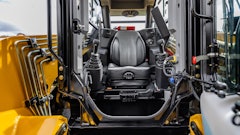
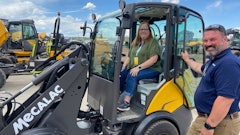
A compact skid steer also has an enclosed cab with ROPS protection, which provides several benefits related to operator safety and comfort. For loader work, the cab shields the operator from any debris that may fall from the bucket as it's being lifted above his head.
In the area of operator comfort, an enclosed cab with climate control makes it possible to continue to work even when Jack Frost and Old Man Winter come knocking.
"In the winter, a fully enclosed cab with heat is certainly a benefit," says Zastrow. "And the fact that you sit down in a cab for the duration of a job'rather than walk behind or stand on a platform'is less fatiguing physically, especially if you're operating the loader for an extended period of time."
Mini skid steers are controlled solely with the hands, and most within the industry agree that they are easier for first-time operators to use. Controls are more consolidated and most functions can be controlled with one hand.
However, some end users prefer the traditional feel of a skid steer. Trey Philstiker, owner of Rain Dance, a landscape company in Phoenix, AZ, indicates that his workers appreciate the familiarity the compact skid steer controls provide. Philstiker and his crews provide new landscape and backyard upgrades to just over 4,000 homes a year with the contractor's 20-plus Bobcat 463 compact skid steers.
Rain Dance began using compact skid steers about 15 years ago. But Philstiker eventually abandoned them in lieu of larger skid-steer loaders because of the smaller machine's limitations in hydraulic flow rates for trencher attachments. In places where the larger machines couldn't fit, he turned to manual labor. And for digging irrigation lines, he relied on walk-behind trenchers.
Then about five years ago, Rain Dance returned to the smaller units when flow rates increased enough to accommodate trencher attachments.
"With the smaller machine, we can get through some tight access areas in backyards," Philstiker says. "Now we can run them in the backyard without taking down walls. And with the trencher attachment and the versatility of the other attachments we can use, we have been able to streamline our operation. We can trench and set grades as well as boulders with these small machines. We don't have to have guys doing manual labor."
Rain Dance also relies on buckets and forks during the course of a day on the job. Workers might begin the morning by grading, switch to pallet forks to unload sod, then move to the trencher attachments to dig irrigation mainline laterals for sprinkler systems.
"Then, with the weight of the machine, we can compact and settle the trench lines," Philstiker adds. "We've been very happy with these machines and we're beginning to see a lot more contractors use them, in part because of the labor costs they can save by going to machinery. For us, we've been able to reduce crew size from six to three workers with these machines."