There was a time when, if you wanted to keep your dog in the yard, you had to tie him up or, if you could afford it, you fenced in the entire yard. Fence installations provide some revenue opportunities for rental centers, but after all, lots of people lack either the will or the wherewithal to fence in their entire property.
Then, several years ago, invisible fencing was introduced. The dog wears a collar which generates a mild shock when it crosses a predetermined line, which is the perimeter of buried wire.
Suddenly, everyone wanted it, and as municipalities accepted it as in compliance with leach laws, the rush was on. Of course, there were homeowners who wanted to install it themselves, as well as contractors, a customer base we all know well.
Today, many of these customers enter your rental center and rent a regular lawn edger to install invisible fencing, and although this is possible, so is cutting down a redwood with a pocketknife. A much better use of your equipment dollars - and your customers' time - is to invest in the right tool for the job.
There are dedicated machines on the market today for installing dog fence and other underground cabling chores, but if you want the most versatility for your equipment dollar, you might want to consider the mini-trencher.
Mini-trenchers are just what they sound like: a trencher smaller than what you usually rent, but a trencher, nonetheless. These smaller machines can be just the ticket for increasing customer satisfaction, as well as return on investment.
Making the right choice
The first thing to consider before you select a mini-trencher for your inventory is what they will (and won't) do.
The fact is, mini-trenchers can be used for a wide variety of tasks, not just the ubiquitous dog fencing job. According to Ed Carlson, president of Ground Hog Inc. "You can install low-voltage lighting, drain lines and irrigation lines with a mini-trencher, just be sure to check local code first," he says. He also points out that the frost line could be a limiting factor. Mini-trenchers cut anywhere from seven- to 18-inch-deep trenches, which is deep enough in many areas of the country, but not others. So, jobs that require a deeper trench than say, 18 inches, will necessitate the use of a larger machine.
Monty Porter, technical support manager at EZ Trench, says, "Our particular machines range from small trenchers that cut seven inches deep to a larger machine that cuts 13 inches deep. Speed of cut depends on soil conditions." A fact that needs to be mentioned to your customers at point of rental is that the machine won't trench as fast in hard clay as it does in topsoil. (It should go without saying that trenching in concrete is, of course, out of the question, but it pays to cover all the bases with some first-time users.)
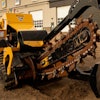
Now there are three basic types of machine on the market today: the disc-type machine, which uses a large wheel with teeth mounted on it to cut the trench; the chain-type machine, which has a digging chain with replaceable teeth much like its larger kin; and the blade-, or rotor-type, which uses, as you might expect, a replaceable blade to do the work.
Barreto Mfg. is entering the mini trencher market this year with the introduction of a new all-hydraulic, chain-type, mini-trencher.
"A lot of the mini-trenchers on the market are not self-propelled and require quite a bit of effort on the part of the operator to pull or push them along as they trench, especially in roots, clay or rocky ground," says Greg Barreto, president of Barreto Mfg. "Barreto has a fully hydrostatic, variable-speed ground drive which alleviates operator strain and adjusts ground speed to soil conditions."
>Different types of attachments/teeth or blades are available for different depths, soil conditions and width of trench desired.
All three of these machines have their uses, and before deciding which type you'll add to your inventory, you might want to try out each one.
There are other things to consider before buying a trencher. According to Porter, first among them should be "What is the quality of the machine? Is it user friendly for the customer?"
Carlson points out that heavy-duty features are something to be looked at as well. Make sure you're looking at a rental-duty machine.
Weight is also a factor in the decision, but as Carlson points out, "You really can't get too much weight in a trencher. After all, you want it to stay in the ground." This brings up another point - you'll likely need some sort of small trailer to haul these machines with. Weight is great for keeping the blades in the ground, but not for loading and unloading.
Simplicity of controls is another facet to consider. "Simple-to-understand controls lead to simple operation, leading to safety which leads to a satisfied customer who doesn't mind paying for a piece of equipment that made his job easier," notes Barreto.
"When considering the purchase of a trencher, one of the primary objectives is a machine that gives the rental customer a positive rental experience that will bring him back or make him recommend the product to others," Barreto says. "Safety, simplicity, durability, ease of operation and low maintenance should, if possible, be built into every piece of rental equipment."
Mini-trencher maintenance
Once you've added a mini trencher to your fleet, there is the question of maintenance. While the three types of mini-trenchers mentioned here do have different designs, they all require periodic maintenance. Lee Campbell, marketing manager at Trench Master, advises, "After each rental, check the belt tension and condition, clean the machine and check the spindle (the part on which the blade mounts) for wire, string or other debris." He points out that if a customer has been less than careful about where he uses the machine, this is where the debris can gather. If left alone, it can lead to bearing failure.
Carlson at Groundhog recommends proper tensioning of the chain, as well as greasing all fittings after each rental. He also offers a precaution: "I see a lot of failures in the rental industry caused by high-pressure washers. We recommend caution on our units to avoid bearing damage from spraying high-pressure water directly at a bearing." This is a precaution that applies to all sorts of machinery, not just trenchers.
Porter recommends regular maintenance as well. "Check blade condition and belt tension," he says. "Proper tension on the belts will keep the correct amount of power to the blade and prevent the belts from burning or wearing pulleys."
Of course, engine maintenance takes on a special significance on a piece of equipment that lives its life in the dirt. Proper care of air filters and frequent oil changes are part of life for equipment that digs for a living.
Just like any other piece of powered equipment, you'll need to add this one to your maintenance schedule, and make sure the manufacturers' recommended procedures are followed. With proper care you'll find that mini-trenchers might be small in size, but can be mighty in utility and profits.