Compaction at the screed using a European-sourced paver, and use of new oscillation vibration for compaction, were key to successful placement of a new hot mix asphalt (HMA) pavement at Indianapolis Motor Speedway this summer.
Vigorous compaction at the screed via tamper and pressure bars was paramount for application of the stone matrix asphalt (SMA) pavement, selected by the track and its consultant for its durability, strength and impermeability under the punishment of professional race cars and tires, and weathering.
The screed was achieving 89 to 90 percent compaction as the material exited, followed by breakdown rolling in static mode, then unique oscillation compaction to 95.5 percent density, and finish rolling in static mode.
SMA is a gap-graded (low medium-sized aggregate and fines) hot mix asphalt design which brings together robust, coarse aggregate and as much as 6 to 8 percent liquid asphalt. Its lack of medium-sized aggregate — and fines percentage less than 15 percent of the aggregate weight — results in a strong mix with a rut-resistant, stone-on-stone structure that develops internal friction and resistance to shear.
But because the gap-graded SMA emphasizes large aggregate, the low-penetration grade asphalt conventionally used can drain out of the coarse aggregate structure. To keep the asphalt in place, cellulose fibers or other asphalt modifiers are added at the plant to keep the binder in place.
Approximately 19,000 tons of SMA were being placed in two lifts, each lift approximately 1.6 million square feet in size.
Time to repave track
Track management did not wait until pavement failure before launching this reconstruction. "Racetracks are probably the most critical placements of asphalt that you can put down," says Kevin Forbes, P.E., director of engineering, Indianapolis Motor Speedway. "We look at an aging racetrack as a potential problem, and we don't wait for it to become a problem. From all points of view, there probably was nothing wrong conventionally with this racetrack. But it was getting to the point at which it was not worthy to run race cars on."
Heritage Research Group of Indianapolis designed and produced the new mix, and is overseeing placement and production operations.
Ultrasmooth surface required
For a high-profile track like Indy, smoothness considerations are elevated above standard highway benchmarks. "Our smoothness is hard to define, using the standard California Profilograph, even with zero blanking band," Forbes says. "Our issue is with deviations which occur over 100 feet, which are significant to race car drivers. The typical Profilograph measures every 30 feet, so it won't even pick our standard up."
Because the mat had cracked, though, discontinuities were present in the pavement. "The cracked sections started to curl up between sections, and they would create a very high frequency, but low amplitude, shudder to the drivers, as opposed to definable dips or bumps," Forbes says. "And that cracking allowed so much water into the mat that we decided it was time to start over."
Reconstruction begins
Reconstruction of the track began as contractors took from August 9 to 12 to meticulously remove the 36-inch strip of 1909-vintage bricks, known as the "Yard of Bricks," at the Speedway's start-finish line. The bricks eventually will be cut into smaller pieces and sold to the general public.
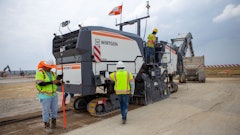
On August 16, a ceremonial "first cold milling" took place, with renowned professional racer Al Unser Sr., riding a Wirtgen W 2200 with 14-foot drum, owned by Javelina Construction, Fishers, IN, as subcontractor to McCrite Milling & Construction Co., Inc., New Albany, IN.
The 14-foot-wide mill wasn't used just for speed of removal, but to help maintain smoothness in the final product. "As we try to maintain a very uniform plane on this racetrack, we felt that averaging across a 50-foot-diameter surface with a 14-foot head is better than averaging with a 6-foot-8 or 7-foot head," says Forbes. The track had a very smooth surface to begin with, and little correction to be done after the milling machine removed the 2 1/2 inches.
The task of removing 4,399 square yards of asphalt from the 2.5-mile track required equal care, but the milling process was ahead of schedule only a few hours into the project, with the machine chewing up asphalt at the rate of 45 feet per minute.
That's approximately half the speed at which construction crews perform the same task on a highway project. The slower speeds simply reflect the need to create a surface capable of safely accommodating 220-mph race cars upon the project's conclusion.
"We don't want to take anything away from state highways because they are very well constructed," Forbes says. "But it's a different application of forces, and it's different speeds. It becomes very, very critical that we give the drivers the smoothest, flattest, most predictable surface we can. If the drivers know the surface underneath them is very uniform, very reliable and very consistent, that will allow them to pull out all the stops in terms of their ability to drive their race car."
Some 19,000 tons of asphalt was milled from the track, 1 in. surface, and 1 1/2 inches of intermediate course.
SMA spec'd for track
Heritage recommended SMA for this critical application. "A lot of people look at SMA for its stability and strength, but it's also the most durable mix that we can build," says Bill Pine, P.E. of Heritage. "We chose to go to two SMA lifts, for strength, durability and impermeability. We're putting a very dense mix in place of the open-graded mix to keep water out of the pavement entirely. Our goal is to get 95.5 percent density with 4 1/2 percent in-place air voids."
The two lifts are slightly different in composition. "The bottom lift is 9.5 nominal size dolomite SMA with a dolomite coarse aggregate, with dolomite aglime and mineral filler," Pine says. "We're using 0.3 percent cellulose fibers and about 6.5 percent PG 76-28 polymer-modified asphalt binder."
"The 76 side will give us good stability, while the -28 side will do well for us in the wintertime," Forbes says. "We are using the SMA principally for its high film thickness around the individual aggregate, which will give us a 'rubber-band' effect that SMAs are so good for, that will help us fight that brittle cracking stress that occurs in winter."
The aglime and mineral filler together work to control the density of the mastic [glue] between the aggregate particles. Aglime is 100 percent passing the 475 sieve, and 17 percent passing the 075, whereas the mineral filler is 100 percent passing the 150 sieve, and around 75 percent passing the 075. Mineral filler is basically dust, and aglime is a stone sand with a fair amount of dust in it.
A tack coat of AE90S emulsion was being placed on the milled surface by an Etnyre distributor truck, prior to placement of the intermediate base course, and a fog coat of lightly modified polymer tack will be placed between the intermediate and friction courses.
Steel slag in friction course
The friction or riding course will be a 4.75 nominal size steel slag SMA with the same aglime and mineral filler as the intermediate course, but with a blend of two different sizes of steel slag coarse aggregates, developed by Heritage Slag Company, Pine says.
The demands placed on racetrack asphalt are profoundly different from that of an interstate highway. "Compared to a conventional interstate mix, we're looking for more durability," Pine says. "We'll need strength in the apex of the turns, where the cars are focused in a line; outside of that, durability is by far the main characteristic that we must meet."
So on the banked curves, where specified, the asphalt binder will be switched from a PG 76-28 to a PG 82-22 to increase the stiffness of the mix in these areas.
On the first day of paving, SMA was being placed hotter than usual, at 365 degrees F, to make sure there was enough heat in the SMA to get compaction despite cooling with ambient temperatures in the low 60 degrees F.
"On a cloudy, windy day, if we're going to err on temperature, we want to err a little hot," Pine says. "We can always hold the rollers back, but if we get it too cold we'll have density problems. You've got to lean one way or the other, and we've chosen to lean toward the conservative side."
Later that day Forbes settled on 350 degrees F as the temperature at which the mix should leave the plant, but would revise that temp downward as summer like temperatures returned. "If we return to 90 degree temperatures with bright sun and no wind, the astute paving engineer will look at the exit temperature day by day, hour by hour," Forbes says. "We know from test strips that we were getting the required density behind the screed at about 270 degrees F."
New products seal long joint
New products developed by Heritage Research Group will be used on the track to seal the longitudinal joint from water penetration.
The first is J-Band, a kettle-extruded, modified liquid that will be placed 12 inches wide and 1/8-inches thick, centered beneath the longitudinal joint. "Its purpose is to melt and migrate up into the surface and make that area, left and right of the joint by 6 inches, absolutely impermeable," Pine says.
The second is another extruded product, XJB. "Between passes, we will paint the face of the joint with XJB — for extruded joint bond —which will improve the elasticity and compliance of the joint," Pine says. "So if those joints want to pull away from each other, the joint will stretch and not crack."
Placement and compaction
In September, the first full pass of intermediate course was being placed. This followed over 300 tons of test strips.
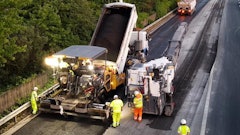
Paving was being accomplished with a German-sourced Super 2100 paver from Vogele AG with 12 1/2-foot compacting screed distributed by Wirtgen America Inc. Initial breakdown rolling was being done by two 30,644-pound HD 130 rollers in static mode, from Hamm Compaction Division of Wirtgen. Active compaction was achieved by two Hamm 20,062-pound HD O90V oscillation compactors in oscillation mode exclusively, followed by a single HD 130 finish roller in static mode.
Liquid dish detergent was added to the roller water system to ensure that the SMA would not stick to drums.
"We're pretty confident that we're seeing 89 to 90 percent compaction behind the paver screed, the breakdown rollers are getting us 93 to 93.5, and the HD O90Vs in oscillatory mode are getting us to 95.5, 96 percent compaction," Forbes notes.
The Super 2100 was chosen for its better handling of the SMA. "The three keys to density of SMA in our mind here are temperature, temperature, temperature," Forbes says. "Getting that initial density is a very good thing in case we have issues with mat temperature later on. And getting 89 to 90 percent density at the screed means that the heat we have in the mat will be retained for a much longer time. It means we will have more flexibility in rolling patterns behind the paver."
"I give credit for equipment selection to paving contractor Grady Brothers Inc., especially the paver," Pine says. "Without a doubt we are getting much higher in-place density behind the screed than what we'd get with a normal paver, because of the tamper bar in front of the main screed and the two pressure bars behind.
"We're running in the high-80s in back of the screed, and that does a couple of things," he adds. "We don't have to put as much effort into compaction with the rollers to get up to the same density, and it helps us maintain temperature for a greater length of time, because the more dense the mat is behind the paver when the first rollers get on it, there will be less penetration of drum water into the mat and it won't cool down so rapidly."
Oscillation essential
On the first day of paving, the Super 2100 moved forward at 25 feet per minute, with rollers at a speed of 100 feet per minute. The two HD 130 breakdown rollers were being used as five pattern pass static, with a five pattern pass using the two HD O90V in oscillatory mode, and a final HD 130 finish roller in static mode. The Hamm roller's oscillation mode was essential in eliminating the risk of crushing the mix aggregate during compaction.
"We wanted to get the initial density with some kind of dynamic action, but were afraid of crushing the aggregate with the vibratory mode. Oscillation works perfectly," Forbes says.
Forbes had not used oscillation mode before, which might have been seen as a risk on such a high-profile, high-stakes project. "We'd never used them before, but our asphalt laboratory research facility, Heritage Research Group, has used them on state highway projects and found the numbers were quite a bit better when using oscillatory mode in conjunction with the static modes on SMA."
"We had used oscillation compaction on another project and knew how it would perform," Pine says. "The main advantage to oscillating and not vibrating the mix is the lack of degradation to the aggregate structure. There is no breakage of aggregate under the roller.
"It seems like a very good process, especially for a mix that may exhibit some tenderness at times," Pine says. "But for SMA, from what we've seen, it works best in an intermediate position for us to obtain density, because at that point, you generally couldn't vibrate with a conventional vibratory roller because the mat would be too cool and you would risk aggregate degradation in trying to get compaction."








![Screen Shot 2023 01 04 At 5 23 30 Pm[35]](https://img.forconstructionpros.com/files/base/acbm/fcp/image/2023/01/Screen_Shot_2023_01_04_at_5.23.30_PM_35_.63bc42696de27.png?auto=format%2Ccompress&fit=crop&h=135&q=70&w=240)


![Bm 2200 65 Cold Planer Release[17]](https://img.forconstructionpros.com/files/base/acbm/fcp/image/2023/06/BM_2200_65_Cold_Planer_release_17_.649359d81b660.png?auto=format%2Ccompress&fit=crop&h=135&q=70&w=240)