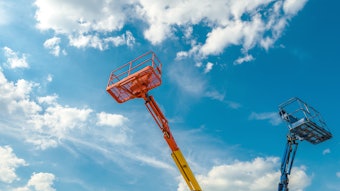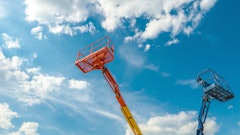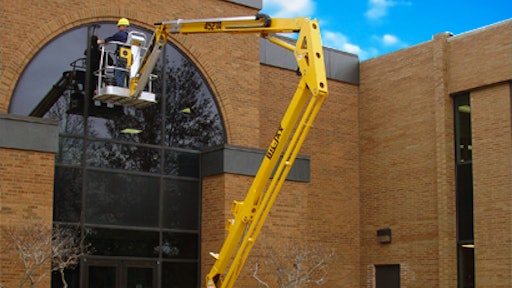
For a price tag that ranges from 30 to 50 percent less than a self-propelled boom lift, you can acquire a towable boom that rivals self-propelled models in terms of utility.
There are towable boom lifts in existence that can reach as high as 100 feet, but most available in the U.S. market range from 35 to 60 feet. They generally come in two types: articulated knuckle booms and telescopic booms. Knuckle booms are the most popular because they offer versatility in places they can reach. With a knuckle, the boom can get close to the structure and then reach over it, whereas telescopic booms are designed to simply reach up.
Towables are priced as low as $35,000, or about half the list price of an electric 40-ft. boom lift, making them an affordable option for those not prepared to make the significant investment a self-propelled lift requires.
"The savings don’t stop there,” says Tami Becher, marketing manager with Haulotte/Bil-Jax. “With the DC power and low ground pressure to access more applications, the return on investment will be realized sooner.”
Mike Northcott, associated product manager at Terex AWP, notes the attractive acquisition cost might not even be the best selling point. “More significantly, the rental rate on a trailer-mounted boom is about 80 percent of the rental rate of a same-height, full-sized electric boom lift," he says. "This indicates the high ROI that is currently attainable on towable booms for rental companies."
Northcott adds, “[Towables] provide excellent versatility for a variety of tasks. With non-marking outrigger pads and low ground pressure, they can be used on lawns, slate or gymnasium floors. Lightweight and maneuverable, they're ideal for congested jobsites and are frequently used for painting, pressure washing and tree work, as well as general maintenance tasks. In addition to construction sites, they can be frequently found in malls and schools.”
Some towables even feature the added versatility of being convertible to material handling equipment. Haulotte/Bil-jax, for example, features a material hook option on its machines, which include three models of articulating booms ranging from 35 to 55 feet of platform height, as well as the first machine developed in the Summit Series, a telescopic 36-ft. platform height model. "By removing the platform and installing the hook, operators can essentially change the machine into a 500-pound capacity material lift," says Marketing Manager Tami Becher.
She adds, "We also offer the X-Boom, a self-propelled version of the trailer mount using the same concept, yet on a different chassis. The machine is driven from the platform at stowed height, you just stop and deploy outriggers to extend the lift. This is a niche machine perfect when the trailer mount cannot be positioned (like on the back nine of a golf course) but low ground pressure is a requirement. The X-Boom series offers two articulating models with 45- and 55-foot platform heights."
Simple to move, easy to use
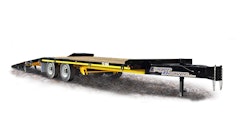
An important reason towable booms are so appealing is their ease of transport. No special carrier is required. Your customer's personal vehicle outfitted with a trailer hitch with a minimum towing capacity of 3,000 lbs. will get them on the road.
“When you need a boom lift but don’t have a flatbed, [towables are] ideal,” says Jeff Ford, global product director, JLG Industries Inc., which markets two models: the T350 and T500 with 35 and 50 ft. platform heights respectively, both with a 500-pound capacity. “All you need is a trailer hitch and you can take the towable boom lift where you need to work.”
Ford continues, “The ability to deliver a towable with a standard pickup truck, or have the customer pick up the machine without utilizing a trailer, makes delivery well-suited for rental.”
Becher at Haulotte/Bil-jax notes no CDL is required for towing, so the common rental customer can pick up and go. “The wide variety of uses and low entry cost into the aerial equipment market make these ideal for rental, and the machines are easy to use by the end user,” she says.
One aspect that makes towable booms easy to use are their simple controls. Fewer machine functions mean faster and easier training for new operators. “All operators require proper training, as defined in the manual,” Ford says, adding, “JLG controls are designed for one-hand operation for efficient and productive operation.”
For its part, Genie’s towables feature a pictograph system on both ground and platform controls to make it quick and easy to get right to work, Northcott says.
Some models are designed for the use of accessories in the basket and offer standard air and water lines in the boom. Some also feature an accessory tray for a generator, compressor or pressure washer usage.
Auto leveling is a popular feature on today's towable models and is offered by JLG, Genie and Haulotte/Bil-jax. "Genie’s patented automatic leveling system allows the operator to hydraulically deploy the outriggers and level the machine to one degree, in as little as 30 seconds," Northcott says of the TZ-34/20 and TZ-50 trailer-mounted articulating booms with working heights of 40 to over 55 feet. “Combined with the pictograph controls, the Genie TZ-Booms are intuitive to use. With some training, towables are within the capabilities of most novice users."
Quite simply, towable booms have the user in mind, with simple to understand controls and commonality with the platform and ground controls, Becher says. “A read-through of the operators' manual, decal review and short familiarization with the rental yard attendant will make a homeowner or novice comfortable with the controls," she says. "Our lifts feature 30-second outrigger deployment, so after you're positioned and unhitched from the tow vehicle, the auto level button and outrigger down button make the machine set-up very quick.”
Lightweight and level
While they're easy to transport, towable booms are not made to move around a jobsite with the boom extended. Most towables today offer a drive and set arrangement so the operator can walk behind or drive the machine from the platform in the stowed position.
Because they can't be driven with the boom extended, towables are not designed for every application. Towables are, however, ideal for applications where vehicle weight is a concern. The platform on towables is typically made of aluminum, whereas on self-propelled models, it's steel. This is done to keep the weight down.
In fact, a 40-foot self-propelled boom typically weighs somewhere in the neighborhood of 10,000 pounds. Towables, on the other hand, hover around the 3,000-pound mark, enabling them to work on the upper levels of structures where a lot of weight is undesirable. They are also less damaging to turf, so landscape professionals can operate them with less fear of disturbing lawns or flower beds.
One way that towables achieve a lighter weight is through the use of outriggers as opposed to counterweight, which provides self-propelled models with the stability necessary to rise to high heights. As a result, a towable's footprint is larger, usually about 14 feet across. Despite the wider wingspan when in use, towables can fold up to just 3 feet, 6 inches, making it possible for them to fit into tight spaces such as backyards and around buildings.
In addition, the outriggers offer a leveling capability and a firm lifting base of operations that is beneficial in areas of great land undulation. Some towables can level themselves on an 11° slope, while most self-propelled booms have a 2 1/2° slope capability.
A question of stability
If their light weight and leveling capability are defining characteristics of towable boom lifts, the next question to follow is often, "How stable are they?"
Experts agree that towables are just as stable as self-propelled boom lifts. They’re required to meet safety standards just like self-propelled models. It's the perception of stability that is sometimes in question. Keep in mind, when your customers are up in the air, they don't look down on a big base beneath them, but they do have a 14-foot spread from the outriggers.
Still, operators might notice a different "feel" when using a towable as opposed to a self-propelled unit. There's a bit more deflection, so the boom might feel a little softer, for example. This deflection, or slight movement of the boom when extended, is due to the use of lighter materials. Because self-propelled units are not restricted in terms of weight, the booms can be constructed to be a bit more stiff. This is sometimes perceived to be more stable, when in fact, there is no technical difference in stability.
What to look for in a towable
Towable boom lifts offer many of the same basic features, such as drive and set systems, auto-leveling hydraulic outriggers and towing speeds up to 65 mph. The main difference between brands is often after-sale support.
It's important to choose a reputable manufacturer that will support the product with training and parts supply. Other factors to consider include the design of the machine. Is it rugged enough to hold up to the rigors of over-the-road transport? How are the "feel" of the platform controls and the outrigger deployment system?
Power options are another area to think about when choosing a towable. Some models are electric, which makes them ideal for indoor use, and some are gasoline powered. There are also bi-energy models that combine the best of both worlds and make it possible to perform more applications with just one machine.