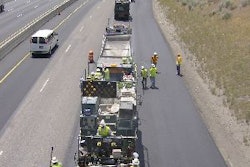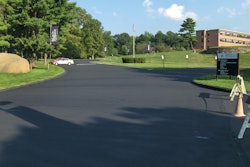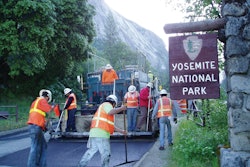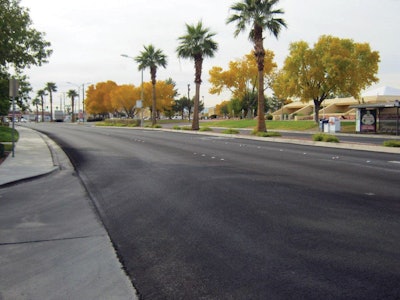
Located southeast of Las Vegas, the city of Henderson's 2011 pavement maintenance program covered several different streets all with different needs. The project was bid by American Pavement Preservation, Las Vegas, NV, in May 2011 and completed November 1, 2011. It used myriad pavement preservation techniques to solve myriad pavement problems on various types of streets.
"The project locations included many different types of surfaces with many different expected outcomes," says Eric M. Reimschiissel with American Pavement Preservation. "The project included collector streets at business and industrial areas as well as residential streets."
Various locations, various conditions
The Henderson, NV pavement maintenance program included numerous streets all with different problems.
College Parkway between Horizon Ridge and US 95. Sienna Heights from Eastern to Jefferies. East Gate and Parkson streets. "College was an average cracked surface with some alligator cracked areas, some large, wide cracks that were 1 to 2 inches wide," says Reimschiissel. "The surfaces were approximately 15 to 18 years old and never had any maintenance."
The Cape seal application was used to treat cracks and provide a new asphalt surface. "The application was completed at night due to the industrial areas, business office buildings, medical offices and the hospital emergency room entrances on Sienna Heights," says Reimschiissel.
Marks between Sunset Way and Warm Springs. "These streets had a good surface condition with cracking, so minimal asphalt patching was completed," he says. "Again, this surface never had any maintenance. A micro surfacing application was completed at night due to shopping center, casino, Wal-Mart and Lowes entrances."
Downtown streets. "These eight old streets were severely cracked, with uneven and raveled surfaces," says Reimschiissel. "A crack seal and micro surfacing application were completed to keep these serviceable for new construction. All the work was completed at night due to location of the city offices and all the casino buildings."
Sunset Way, Sunset Valley Verde, TV 5 Drive and Valle Verde. These surfaces were in average condition with cracking. "The surface was crack sealed and slurry sealed nine years ago," he says. "During this project, the surface was cape sealed to treat the block cracking and provide a new surface. All of the work was completed at night due to the business office parks, a private elementary school, and a college at the end of Sunset Way."
Twenty eight residential streets and eight collector streets. These surfaces all had higher-than-normal cracking and a surface with a 12-year-old slurry seal application. They were crack sealed and a Type 2 micro surfacing application was placed for maintenance. These streets were completed during day time hours.
Communication with community
Communication with the traveling public and surrounding community was key to a successful completion of the pavement maintenance project. There were several steps American Pavement Preservation took to effectively communicate traffic disruptions, says Reimschiissel.
All of the businesses were contacted in person and a list kept for the city to verify the notification time and date.Traffic control plans for each individual street and roadway were submitted and approved prior to the beginning of the work. Several meetings with the city Public Works and Traffic Engineer were held in regards to traffic control and work periods. Notifications were placed 7 days prior and 24 hours prior to any work activity. No Parking signs as well as advanced road construction signs were placed 24 hours prior to any applications.
Surface preparations
Because of so many different pavement surfaces and issues, there were many types of surface prep completed during the project.
Asphalt patching was completed on the very poor surface areas. Surface motor oil spots, heavy paint and pavement marking tape were ground off with a skid-steer loader rotomill head with 176 bits for a fine grind surface.
Creak sealing
Crack sealing was completed on all of the asphalt surfaces during the project. Due to dust regulations, the city of Henderson will not allow conventional methods of crack cleaning. Cracks were cleaned using a Crack-VAC, which uses compressed air blown through three nozzles. As the air is blowing the cracks clean, the blown dirty air is vacuumed into a holding tank on the unit then disposed. The Crack-Vac is PM 10-approved for air quality.
The crack sealing materials was applied with a wand. It was completed 20 days prior to the micro surfacing and cape seal applications by a six-person crew of Superior Asphalt, Salt Lake City, UT.
"The crack seal was a special hot rubberized crack sealant material designed for the hot Las Vegas climate," says Reimschiissel.
Micro surfacing
Henderson's pavement maintenance project included micro surfacing on residential, collector and arterial locations.
"The micro surfacing was completed on asphalt surfaces in good condition as a preventive application and asphalt surfaces in poor condition as a method of holding the pavement in a serviceable condition until funds are available for new asphalt or reconstruction," explains Reimschiissel.
Due to the locations of the major roads with businesses, casinos and shopping centers, the micro surfaced roads were done at night.
The micro surfacing was a Type 2 gradation application with 3% latex. Mix designs were completed for both day and night applications. A crew of 14 people using three micro surfacing machines was used to place the material.
During the micro surfacing process, day time temperatures reached 85 to 90 degrees while nighttime temperatures were approximately 65 to 75 degrees.
Cape seal
The cape seal consisted of a 3/8 chip seal using a PASS rejuvenation emulsion supplied by Western Emulsions. The chip seal was then covered by a Type 2 micro surfacing material.
"The Cape Seal application was placed on cracked asphalt surfaces to provide an application of rejuvenation and as a mass crack filler with a new micro surfacing type surface on the chip sealed surface," says Reimschiissel. "The PASS chip seal emulsion is a rejuvenation emulsion to aid in enhancing the life span of the older pavements."
The Cape seal was completed by Cactus Asphalt, Phoenix, AZ, with a crew of 16 people.
The cape seal locations were in industrial areas and on major roadways by casinos, shopping centers, a college and business office complexes. Due to the location of the work, the cape seal was placed at night between 9 p.m. to 6 a.m.
The chip seal was placed and allowed to set, then the micro surfacing was placed. Temporary floppy tabs and painted crosswalks were placed on the micro surfacing surface prior to opening the area to traffic. All of these work activities were to be completed and the road opened by 6 a.m.
"The challenge was to have the chip placed in time to set then the sweeping completed to allow time for the micro surfacing to be applied," says Reimschiissel.
Sweeping was completed by both vacuum and broom sweepers. The micro surfacing was placed over the cleaned chip surface, completed, set, pavement markings installed and ready for traffic.
Coordination brings it all together
There were over 35 people involved in all of the crews for the various work activities.
"Coordination between the traffic control crews, chip seal crew, sweepers, micro surfacing crew and the pavement marking crew was a challenge that required preparation and cooperation," says Reimschiissel.
The project was completed safely, on time, under budget, and with a happy customer, he notes. "The City of Henderson is very happy with the project and has added another location for a micro surfacing application in the spring of 2012."