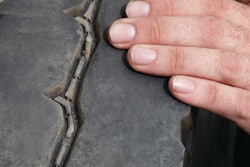
A cracked or broken wheel rim, elongated stud and bolt holes on wheels, and loose or missing wheel fasteners are all potential violations under the driver safety measurement system within the 2010 Compliance, Safety, Accountability (CSA) program. Generally, CSA affects carriers subject to the Federal Motor Carrier Safety Regulations (FMCSRs), carriers transporting passengers or cargo in interstate commerce, and carriers of hazardous materials in intrastate commerce. It may also impact carriers whose states require that they obtain a U.S. Department of Transportation number.
If carriers meet those criteria, CSA requires contractors and their drivers to inspect their trucks periodically, note any deficiencies, and address them quickly. Plus, under CSA, vehicle inspections by federal and state highway officials place different priorities on components based on the probability that those components are likely to cause crashes or other safety problems. The federal agency determines those probabilities using statistical data gathered and analyzed from crash reports.
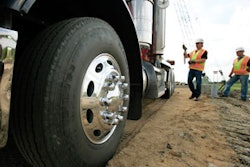
Even if they don’t fall subject to the CSA program, contractors should consider the physical size of wheel ends. A car tire and wheel assembly weighs about 90 pounds (for a big SUV); a big rig wheel assembly can weigh over 200 pounds. Obviously, it is important to put into place a solid maintenance program to ensure your wheels stay intact and you don’t risk violations under CSA. It seems simple and straightforward, and it is, if you follow these steps.
Get the Facts – Know Torque Values, Don’t Guess
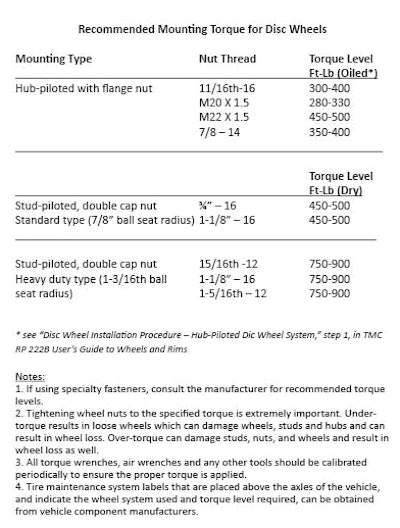
The proper torque for wheels is actually a function of the mounting type and lug nut thread. If you under-torque, the result can be loose wheels and possible wheel loss. If you over-toque, you can damage studs, nuts and wheels and the result can be wheel loss as well. Wheel manufacturers typically provide the following table (see Image 1: "Recommended Mounting Torque for Disc Wheels" chart) in TMC RP 237 to find the torque required. It covers the majority of wheels on the road today.
For special situations, go to the manufacturer's website or contact them for information on the recommended torque values for particular wheels or rims.
Proper Torquing and Re-Torquing
When you buy a new truck, or install a new tire and wheel assembly, it’s not a simple matter of “get up and go.” After careful study, TMC consensus says it’s critical to recheck the torque level after five to 100 miles. That’s because there is a “settling in” period, during which nuts and stud threads move, due to wheel paint, dirt, dust and perhaps rust and corrosion. Any of these factors can mean loss of clamping force.
You should then re-check again at 10,000-mile intervals. If you’re a TMC member, review TMC RP237. It is a great source of information on torquing and retorquing wheels.
Pay Attention to Your Studs and Wheels
Believe it or not, the stud on your wheel system acts like a spring that is stretched when torqued properly. The tension produces the clamp load to hold the wheel in place. Over-torquing stretches the stud and, in turn, will make it lose its tension. That means you can’t get a proper clamp load, and, worse yet, you could break or snap the stud. That’s another reason why proper torquing is so important.
It’s also important to clean and maintain your studs. Rust and corrosion should be removed, as well as any burrs around the bolt holes and center holes. If you have a hub-piloted wheel system, you should use a little lubrication – SAE 30 weight or equivalent – on the outer two threads of the stud, and a drop between the nut body and flange. On a stud-piloted system, TMC says no lubrication is needed.
But, if you run aluminum wheels and your procedures call for lubrication of the stud, you must reduce the torque by 100 ft/lbs to avoid over torque.
Now, if you ever face a broken stud, one becomes two. You must also replace the stud on the other side of the broken one. If you have two or more studs that are broken, then all the studs need to be replaced.
Paint and Repaint
On steel wheels, paint is important to keep wheels firmly attached to trucks. But too much paint around the area where the lug nut contacts the wheel or on the back side of the wheel where it is in contact with the spindle can create a problem. This typically happens when wheels are repainted. If the thickness of the paint exceeds 3.5 mils, about the thickness of a sheet of paper, it can wear away and a lug nut that was once properly tightened can become loose.
Rust
On the other end of the scale is no paint at all. No paint on a steel wheel eventually leads to rust. Rust not only looks bad, but rust under a lug nut can also cause looseness and loss of clamping power.
Tools to make the job easier
There are now pneumatic torque wrenches on the market, and while more expensive than the old mechanical torque wrenches, they certainly are simple and easy to use. Simply set the torque value at the desired number and tighten the lug nuts.
If you’re still old school, there are several other types of torque wrenches:
* Beam Torque Wrench: TMC says this is the most accurate wrench (+-2%) and it needs little calibration. The wrench measures the deflection of the beam of a known length to determine the amount of torque.
* Dial Torque Wrench: About a +-3% accuracy range, these wrenches are easy to use. The torque value is set on the wrench, and the technician tightens the lug nut until the indicator light illuminates to set the desired torque.
* Ratcheting (Clicker) Torque Wrench: When the target torque level is hit, an audible clicking is heard, which means you’re at your mark. But, if the actual torque of the nut is higher than what the wrench is set for, you must increase the setting of the wrench until movement is noticed.
* Break Handle or “Breakaway” Wrench: A very simple wrench with a degree of accuracy (+-5%), this wrench is pre-set for a certain torque level. Once it’s met, the handle “breaks,” indicating you’re at your torque level.
Once finished with your torquing wrench, return the torque level to its lowest setting and be sure to calibrate periodically (how often depends on the type of wrench, so check your manual).
Wheel bearings
Another source of potential wheel end issues are the wheel bearings. You should check bearing looseness to help prevent premature tire wear and lubricate your bearings per the manufacturer’s recommendations to ensure long bearing life and cool running.
Special thanks to Dave Walters from ALCOA for providing much of the information found in this article.