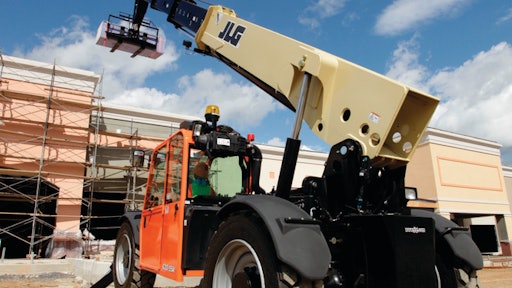
Telescopic handlers are a commonly rented item on construction sites, so it might lead some to assume that any equipment operator can jump in the cab and start moving material. Yet, the opposite is true.
“Telehandlers should only be used by properly trained, qualified operators, using the machine’s operator’s manual and other safety information supplied with the machine,” says Rick Curtin, director of product safety, Terex Corp. “Operators must be trained and capable of properly using features provided on telehandlers that are essential for safe use, such as control features and functions, load charts, boom and chassis angle indicators and boom extension indicators.”
Operator training, in conjunction with the operator’s manual, serves as the basis for qualified operators to assess and plan to transport and lift loads. “This includes proper machine setup and leveling, knowing the weight and center of the load and assessing whether ground conditions are appropriate for supporting the weight of the machine and the load,” says Curtin.
Assess the Site
Prior to using a telehandler to move materials, assess conditions around the jobsite and identify any obstacles, obstructions or personnel in your path.
“Always check jobsite terrain hazards, including but not limited to obstructions, undulations, adequate load bearing, puddles or other conditions which comprise knowing the surface conditions where the machine will operate,” advises Brian Rabe, manager, product development, Manitou Americas, Inc. “Knowing the condition of the terrain and under-surface conditions required to support the machine cannot be overemphasized.”
Rough-terrain variable-reach telehandlers are designed specifically for use in challenging underfoot conditions. “There are a number of features which help today’s machines navigate the terrain, including excellent visibility, ground clearance, tire type/size, fenders, chassis leveling and differential lock systems,” says Curtin.
While such terrainability features can provide specific benefits, they are only effective if used properly. “It’s important that operators receive complete and thorough training on the specific machine they will be using so that they understand the capabilities and limitations of the machine,” Curtin states. “If the jobsite conditions exceed the capabilities of the telehandler, do not use the telehandler unless the conditions have improved.”
Tips for Transport
Before picking up a load for transport, make sure you have the correct carriage and forks for the material being handled, and for jobsite conditions.
“Generally speaking, the forks should be positioned as wide as possible to adequately support and retain the load,” says Rabe. “Make sure the load is balanced laterally on the forks; the forks completely support the material; and the load is organized and retained if needed by straps or a weighted object like a sand bag.”
“When picking palletized loads, adjust the spacing of the forks so they engage the pallet or load at maximum width,” adds Brian Boeckman, global product director, telehandlers, JLG Industries, Inc. “Engage the load, rest it against the backrest and tilt it back slightly.”
As you transport the materials, keep the boom and attachment as low as possible, and maintain visibility via the mirrors and line of sight, Boeckman advises. Use a spotter if you don’t have a clear view of the work area. “The operator must check boom clearances before driving underneath overhead obstructions,” he adds.
“Maintain proper travel paths and minimize having to move loads over objects,” Rabe says. “Never elevate loads over personnel or allow personnel to move under an elevated boom/load.”
When traveling on uneven or muddy terrain, limit travel speed to maintain machine and load stability. During travel, keep the boom fully retracted and as low to the ground as possible.
“Only travel with the boom and load in the lowest possible position,” says Curtin. “Properly centering and cradling can also help stabilize the load during transport.”
Avoid raising or dropping the boom suddenly, which could compromise load retention or machine stability.
Take Your Position
Be sure to do your homework prior to lifting and placing/retrieving materials at heights.
“Study and apply load charts carefully. Do not exceed maximum capacity within each respective load range,” Rabe emphasizes. “Utilize the load chart to make sure the machine is within range to place or retrieve a load consistent with the weight of the load and distance required. Use stabilizers (outriggers) if needed.”
Once at the lift site, check to ensure the ground will have adequate strength to support the weight of both the machine and the load throughout the lift. Then, position the telehandler to allow you to place or retrieve the load without moving or repositioning the machine.
Park the telehandler on a level surface, or level out the machine. “Position the machine to lift the load, and level the machine from side to side by using the frame level function and the level indicator,” says Boeckman. The boom and attachment should not be raised more than 4 ft. unless the telehandler is level.
A trained operator should be able to recognize whether visibility may be compromised during picking or placement of the load at maximum lift heights. “If so, then use of a spotter with standard hand signals or alternative communication tools such as a two-way radio should be considered to communicate to the operator the placement of the load and/or attachment,” Curtin states.
Slow the movements of the attachment and load when operating at maximum heights, he continues. Hydraulically piloted controls, such as those found on Genie telehandlers, can help to ensure smooth operation at maximum lift heights.
Other features also make it easier to properly position loads at higher lift heights. “Floating shaft-mounted forks allow some additional freedom to reduce load bearing when disengaging/engaging loads,” Rabe points out. “Powered carriages (side tilt, side swing), combined with modulating hydraulic control, provide operators additional control capabilities to position loads accurately and allow improved fork disengagement from the load.”
If Lifting Personnel is Required
OSHA guidelines state that a telehandler should only be used to lift personnel if no other means is available. “Additionally, the telehandler manufacturer may not allow use of a work platform on their machine,” Curtin comments.
If the manufacturer does permit the telehandler to be equipped with a work platform, he adds, then the employer, operator and platform occupants should refer to the operating instructions provided by the work platform manufacturer, telehandler manufacturer, governing U.S. telehandler standard and any applicable jobsite, local or state rules or regulations. ANSI/ITSDF B56.6 section 5.15 provides specific instructions for the operator and the platform occupants regarding the use of a work platform on a telehandler. Additional operator requirements can be found in the operator’s manual.
“Operators elevating personnel must be properly trained compliant to OSHA regulation 1910.178,” Rabe adds.
Personnel in a telehandler platform are also required to wear appropriate personal fall protection at all times.
Approved work platforms will have been tested by the manufacturer to assess whether they can be safely used within the applicable load charts for the machine. Some telehandler manufacturers take this a step further by stipulating the specific platform that can be used with their machines.
“Manitou only allows elevating personnel if the applicable machine is fitted with the exclusive Personnel Work Platform specifically designed compliant to ANSI/ITSDF B56.6-2011 Safety Standard for Rough Terrain Fork Trucks,” says Rabe. “This unique system is specially designed to eliminate or reduce some hazards created when work platforms are used non-compliantly.”
Once an approved work platform is identified, ensure that it is properly secured to the machine. “The telehandler must be on a firm surface and level prior to elevating the personnel work platform,” says Boeckman. “The parking brake needs to be engaged and the platform must be leveled both side to side and front to back.”
Check that the area under the platform is free of personnel. “When individuals are in the platform, the operator must remain seated in the cab with the platform personnel in direct line of sight,” Boeckman stresses. “The telehandler must not be driven when individuals are in the personnel work platform.”
Make sure the operator and the personnel in the platform are in constant communication via hand signals and/or use radio communication. And as with any lift, make sure that the combination of the work platform, personnel and any tools or materials in the platform fall within allowable load limits specified for the machine.