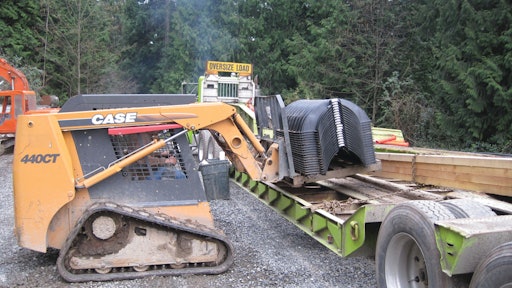
Biodiesel is quickly becoming more than a fad as contractors discover the benefits and develop experience with this alternative fuel source. Snohomish, Washington-based Earthwise Excavation has been an innovator in the use of biodiesel. This commercial and residential excavation company has been powering its entire fleet — including excavators, mini-excavators, skid-steer loaders, a dozer, a dump truck and a lowboy truck — with biodiesel since the 1990s.
“Ultimately, I was the big push for biodiesel because I like to try things out,” says Albert Postema, owner. “It’s one of the steps of our corporate responsibility program. If you want to look at the environmental impact your company has, look at the money you are spending on fuel.”
Earthwise Excavation runs B99 (99% biodiesel) throughout most of the year, with no retrofits or modifications required. In the winter, it switches to B50 (50% biodiesel).
The company has learned through experience. “Since we started, we have used a quarter million gallons of biodiesel,” says Postema. Initially, there were hurdles. “Quality of fuel and consistency of availability were tough issues in the beginning.”
The company even resorted to producing some of its own biofuel. But since that time, an ASTM standard has been developed and larger companies have stepped up production. “They have ironed out a lot of the issues,” Postema states. “If you are buying from the bigger outfits, they all meet the ASTM standards and they pass it through a fine micron filter. We don’t see issues these days.”
Green practices net benefits
The business case for biodiesel encompasses much more than the price per gallon. Postema reports that in the past, B99 cost almost $1 more per gallon, sometimes more and sometimes less. “It goes directly toward supporting what we thought was a good cause — using recycled fuel and helping out the farmers,” he says. “When you are paying $6,000 every time to fill your tank, it is much nicer knowing it is not going across the ocean.”
The use of biodiesel, along with environmentally aware hydraulic fluids and other sustainable practices, also positioned Earthwise Excavation to play a key role in the emerging sustainable building market that was gaining traction in the region.
During the recent downturn much of the conventional work dried up. “Before the crash, the sustainable building industry was about 25% of our work,” says Postema. “When the collapse happened, the sustainable portion of our business grew.” Now, it represents 60% to 70% of our company’s work. Sustainable builders work with me because they appreciate the extra steps we are taking toward sustainability. I credit a big part of our survival to the point that we have been sustainable and run the biodiesel.”
Given the current prices of diesel, the tables have also turned. “For low bid, we are currently cheaper than regular diesel,” says Postema.
There are health benefits associated with biodiesel, as well. “Using even a B20 really drops off the major carcinogens,” Postema points out. “So there is a little self-preservation. If you work around it and you are going to spend the rest of your life working around it, you can call it part of your health insurance.”
Operators experience a noticeable difference. “Our operators really like when we go back to B99,” says Postema. “They have fewer headaches, especially working in enclosed areas. If you have been exposed to diesel exhaust and you have been exposed to pure biodiesel, it is a night and day difference.”
The high concentration of biodiesel used by Earthwise Excavation can create a few unique challenges. It is not a problem for the vast majority of engines on the market, but there have been a couple of isolated fuel system issues.
“Biodiesel and straight rubber don’t mix,” says Postema. As a result, several off-brand engines in the fleet suffered injector issues after a few years. “Some of the rubber seals inside disintegrated. We had to rebuild the injector.” But these were isolated cases. “We know it doesn’t affect all of our injectors because we have trucks and equipment that we have run over a decade [on B99].” In fact, other than these isolated fuel system issues, the company has not had any engine-related problems.
In lower concentrations, biodiesel can actually be beneficial to fuel injection systems due to the dry nature of ultra-low-sulfur diesel fuels.
As a precaution, Postema recommends that contractors who switch to biodiesel keep extra filters on hand. “It definitely cleans the gunk out of a system. Just have some filters on hand and when it starts missing, change that filter out,” he advises. One of the machines in the Earthwise fleet went through a couple of filters after the initial switch, and now runs better than it did before.
A more conventional approach
Iowa-based Manatt’s Inc. is a road construction, ready-mix concrete and concrete and asphalt paving contractor. More than 600 people are employed under the Manatt name, and the company operates 300+ heavy trucks. Other equipment includes pavers, trimmers, motor graders, loaders, dozers, scrapers, excavators, crushing equipment and milling machines.
The company has been using biodiesel for approximately 10 years. “We run anywhere from 2% to 20%,” says Curt Manatt, Vice President. “We typically drop back to 5% in the winter months. Based on what we hear about lubricity, we never go below 2%. We think we need a minimum of 2% to add some lubricity to the fuel.”
This summer, the company plans to use B20. “By going with B20, we are saving $.04 a gallon at this point in time,” says Manatt. “It all adds up. When you buy it by the transport load, it is all money worth saving. As long as it is equal or less, we will burn 20%. If we start paying too much of a premium, we will cut back a little.” It is important to note that most manufacturers’ warranties will allow the use of up to B20 fuel.
“It has been a good fuel,” says Manatt. “It is a cost savings, and it is good for the environment and good for the economy with benefits to the farmers. Biodiesel has become more plentiful and it is more acceptable. Here in Des Moines, we buy ours from Diamond Oil.”
Manatt suggests looking at the economics. “Sometimes the price is up and sometimes it is down based on supply,” he comments. “Recently, it seems like the biodiesel is a better price. That is what determines our percentage. As long as it makes economic sense, we burn it all the time. Whatever the price, we always burn at least 2%.”
Manatt has also been investigating future use of compressed natural gas (CNG). At CONEXPO-CON/AGG, he was interested in a CNG-powered ready-mix truck on display by McNeilus. “They had to haul the truck to us on a lowboy last summer because they couldn’t find fueling stations on the way,” he notes. The first public CNG station has just opened in Iowa, so availability is still a major factor.
In addition, previous CNG trucks were a little down on horsepower. “That is supposed to be taken care of soon, and we will be changing things around a little as it becomes more popular,” Manatt says. “It is just a matter of time before it hits the market. These are pretty exciting times.”
In the meantime, Manatt is investigating dual-fuel options to address the interim while the CNG infrastructure is being built. “If you run out of natural gas, it runs on straight diesel,” he says.
Make your own
Alabama-based McInnis Construction is a family-owned general construction business that has been building bridges, grading roads and building pads, driving piles, pouring concrete and constructing buildings for more than 40 years. It has completed projects in Alabama, Mississippi, Louisiana, Florida and Georgia.
Clayton McInnis, vice president of business development, was able to expand the company’s environmental initiatives through college studies. “When I went to college, I wrote a business plan for my degree,” he recalls. “It was to make our own biodiesel. I partnered with a company out of Chico, California, called Springboard Biodiesel. I became the Alabama dealer rep for the equipment.”
McInnis used one of these systems to manufacture biodiesel for its own use and began blending it into the fuel supply.
“We run anywhere from B10 to B20 in our off-road equipment,” he says. This offers a pricing advantage. “We make it for around $1.20 a gallon,” says McInnis. But no corners are cut on quality. “It conforms to ASTM standards. If biodiesel is handled correctly, it is a really good, quality fuel.”
Yet, many contractors ignore the possibilities. “There is still this adverse reaction to it where people turn a blind eye because they don’t want to consider anything different,” says McInnis. “And we must. We must have other options that are compatible, not only for the economy, but for environmental and social reasons. The problem is not so much about the fuel and compatibility with the machinery; it is more a lack of education and a lack of awareness.”
Biodiesel is user-friendly. “The biodiesel itself is less toxic than table salt and more biodegradable than sugar,” explains McInnis. “When diesel engines were first invented by Rudolf Diesel, they were actually built to run on peanut oil.” Later, they were modified to run on petroleum diesel for economic purposes. “It is coming around 360 degrees.”
McInnis explains that economics favor a decentralized approach to biodiesel production, since it costs quite a bit to truck in feedstocks to manufacture the fuel and then transport it to its final destination. “Our equipment allows us to have smaller scale production in communities,” he says. Cutting the external costs associated with the logistics makes it more viable.
“In the South, we don’t have the luxury of being next to a large plant,” says McInnis. “We are the only contractor in this area I know of that makes a portion of its own fuel. You can’t go to a gas station down here and get B20. It isn’t retailed.”
Making biodiesel with the Springboard Biodiesel system has proven simple. “The machines we have are all stainless steel and very durable,” says McInnis.
There are different-size systems depending upon how aggressive you are at making fuel. “Our systems are heavily automated. For 100 gallons of fuel, theoretically, it would only take you one and a half to two hours of human involvement. The machine does the rest,” McInnis indicates. “You can make 100 gallons in 16 hours, but you have to be there only two of those hours.”
This is the third year McInnis Construction has used biodiesel. “It averages out over the years at B20,” says McInnis. “We are not seeing any significant problems. The biodiesel is more lubricated than petroleum diesel. It keeps everything lubricated. It runs slightly better and quieter.” Low-sulfur diesel is dry and hard on the engines.
“If you complement it with a 20% biodiesel blend, it works well because you have a lubricated fuel and a nonlubricated fuel that are blended together.
“I know that contractors are really watching their budgets, but it is a good long-term investment and it is something that adds a little more stability to the business model,” he asserts. “It goes beyond the day to day. It is important to think a few years ahead and get that return on investment if you are planning on staying in the industry. Government contracts really like to see that you are thinking outside of the box.”
To read the full story, click here to download the Fall 2012 issue of Sustainable Construction.


![Img 1707[56]](https://img.forconstructionpros.com/files/base/acbm/fcp/image/2023/04/IMG_1707_56_.6437076c97961.png?auto=format%2Ccompress&fit=crop&h=191&q=70&rect=0%2C462%2C1920%2C1080&w=340)











![Glp Porsche 072723 465 64ee42287c29e[1]](https://img.forconstructionpros.com/files/base/acbm/fcp/image/2024/03/GLP_PORSCHE_072723_465.64ee42287c29e_1_.65e88b8589b9c.png?auto=format%2Ccompress&fit=crop&h=135&q=70&rect=0%2C520%2C2250%2C1266&w=240)