Articulated dump truck/excavator earthmoving systems are a popular choice, especially in less than desirable underfoot conditions or where longer haul routes may be involved. But setting up an efficient earthmoving system doesn't happen by accident. It takes careful planning, expertise and the flexibility to change with jobsite conditions.
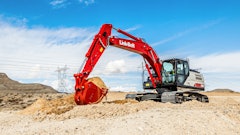
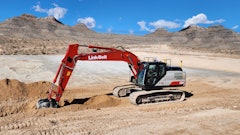
The place to start is with the excavator. "The loading tool is usually established first and then the number of trucks can be determined," says Steve Moore, Komatsu.
When choosing the excavator, consider not only the physical size of the machine, but also the bucket. "Matching the correct size articulated dump truck to the excavator is really going to affect your bottom line. But equally important is having the right size bucket on your excavator," says Chris Giorgianni, general manager of product marketing, JCB. "The general rule of thumb is with the right bucket and excavator, you should have a full dump truck in four to six passes."
"There are a number of factors that can limit the number of passes per load, such as the compaction of the material or the material itself," notes Doug Phillips, construction segment manager, Volvo Construction Equipment. "When possible, we try not to go over seven passes per load." Yet, this isn't always possible. "This all depends on the density of the material (or weight per cubic yard). The size bucket on the machine must match the breakout and lifting capacity of the excavator."
Advantages of ADTs
Articulated dump trucks are available in a variety of sizes from 14 to over 40 tons. "Most manufacturers focus on the 25-ton and above range," says Giorgianni.
This size range not only allows the flexibility to match up with a variety of excavator sizes, it offers solutions for varying jobsite sizes and underfoot conditions. Bigger articulated trucks can increase productivity on larger jobsites with good underfoot conditions, while smaller articulated trucks are more maneuverable and exert lower ground pressure.
"JCB's range really starts below [25 tons] and goes down to 14 tons," says Giorgianni. "The key attribute for our customers is to be able to negotiate soft ground conditions and tight jobsites that you might not be able to access with larger haul trucks."
The advantage of an articulated dump truck is that it can negotiate a variety of terrain. This can reduce the need to spend a lot of time preparing a well-groomed haul road. "With the flotation of the JCB trucks, you may be able to minimize the amount of work you put into the haul route up front," says Giorgianni. "You may not be as efficient from Point A to Point B, but you are not investing the money up front."
That said, a smooth haul road can be substantially more productive, even with articulated trucks. "Maintaining the haul roads can produce consistent cycle times by reducing wait times for the loading tool, and help the haul truck operator maintain a safe speed on the road," says Phillips. "A well-maintained haul road will also reduce damage to the trucks and fuel consumption."
"Not being able to get from point A to Point B at top speed is going to slow down the operation," Giorgianni agrees. "You are going to have to introduce more trucks into the process, which [impacts] the bottom line. So the more you can eliminate that, the better off you are."
Factors affecting cycle times
Travel and unloading times are key variables in determining the number of trucks needed for your earthmoving system.
Moore recommends dividing the truck cycle time by the time needed to load it to get a general idea how many vehicles you will require. However, he cautions that the cycle time can vary throughout the course of a project. "Truck cycle time will vary more than the loading tool, so you will have to consider the variance in truck cycle times before you decide on the final number of trucks," he states.
Material density, haul conditions and haul road length all have a direct impact on cycle times. Even the maximum dump angle of the articulated truck can impact productivity. With some materials, such as pea gravel, the dump angle may not be a significant factor.
"But if you have a sticky material, you want to be able to evacuate the dump bed as quickly as possible in a production environment," says Giorgianni. "A high dump angle is going to allow you to do that."
Obstacles and grades are another factor. "Grades often slow down the cycle times of the haul trucks because of the additional rimpull and horsepower required to move the load up a slope," says Phillips. "Grades and curves require the operator to manage the speed the trucks can safely navigate the curves and downhill grades."
Ground conditions, dump site location, operator efficiency and site prep planning play a role, as well. "At the end of the day, anything that affects truck cycle times has to be considered if you are going to meet your production goals," Moore states. "The two tools you will need to make sure you meet your goals are a stop watch and a dump counter on the truck."
Adding or subtracting equipment to accommodate conditions will ensure peak efficiency. "The number of loading tools or trucks can be adjusted, but usually it's the number of trucks that gets adjusted first," says Moore.
It's a careful balancing act. "The ideal match is to maximize utilization of the loading tool (or excavator) and minimize the wait time for the articulated trucks," says Phillips. "It is directly related to the haul route, distance, rolling resistance, grades, ground structure and curve angles occurring in the route."
Haul route design
Doing your homework up front will pay off later. "Haul road planning is extremely important," says Giorgianni. "A longer route than necessary, or trucks having to cross paths, can hurt efficiency and productivity. Fuel consumption can increase if grades and curves are unnecessarily a part of the haul route. If a shorter route is possible, the number of articulated dump trucks may even be able to be reduced."
"Optimizing a jobsite can definitely reduce the amount of haul units," agrees Phillips. "If the haul route is a limiting factor in production, it needs to be addressed and repaired if this route will be used for any extended amount of time. It can make an extreme impact on the profitability of the job. If you can reduce the fleet by one truck, [you can save on] fuel, initial purchase, operator wage and benefit, repair and maintenance costs. So it is substantial."
Consider seeking outside expertise. "To get accurate information concerning the site conditions and limitations of the haul road, a visit to the site by a trained specialist must be conducted," Phillips asserts.
Software is also available to assist in haul route design. "Volvo has production tool calculation software (Site SIM) that can be used to simulate the work required to move a predetermined amount of material," says Phillips. "Different loading tools and haul trucks can be optimized to estimate the most efficient way to move the material. With this tool, we can see the bottlenecks and remove them from the process to optimize the operation."
The software can also account for changing site conditions. "We have the ability to add limiting factors into the study based on scheduled work days and changes in conditions," says Phillips. "We try to give real numbers by doing the calculations at average yearly conditions - not the best and not the worst - so production can be seen for an extended amount of time and weather conditions.
"On larger jobsites, we can optimize the different segments of the project and predetermine the limits of where additional equipment is required to meet the production requirements," he continues. "We call this an incremental study. As the loading site gets longer as the job progresses, we can give the customer this information with our software."
Of course, in reality, you have to make compromises. "On actual jobs... you often have to use what is available," says Moore. "The most important fact you need to know is how much material needs to be moved by the end of the day to meet the job completion production goals. This number will determine [loading tool] size and the number of trucks needed to meet that goal. You usually never have the optimum size or number of equipment, and this is where the compromises start."
Minimize bottlenecks
Bottlenecks are a fact of life. You resolve one bottleneck and it will often expose another. "You will always encounter bottlenecks, so you need to estimate the best and worst conditions and make your plans for the average," says Moore.
For example, weather is an uncontrollable variable that can quickly throw off production cycles. "Travel times for articulated dump trucks will vary under different weather conditions. While this should be kept in mind when planning the number of trucks necessary, you have to be flexible on the jobsite," says Giorgianni. "If you end up with an excavator sitting idle waiting on trucks to get through sloppy conditions, trucks may need to be moved in to increase efficiency."
The key is to work through bottlenecks one at a time. "Find all of the bottlenecks in the operation and remove them, starting with the cheapest fixes first, and working toward the more expensive ones once you realize the profits from the previous repairs," says Phillips. He believes the whole operation needs to be considered. "Blasting, crushing, screening and loading all play their parts. You are only as fast as the slowest participant in your process."
Giorgianni adds, "You would love for one truck to be pulling off with a full load as another one pulls up ready to go, but a jobsite is evolving and bottlenecks will occur throughout the day. Travel times may increase or decrease as the excavator repositions along the jobsite, or the haul road deteriorates because of weather. Planning ahead by picking the right equipment and correct quantity, along with the best haul route, will help you avoid these bottlenecks."
Tips to Maximize Production
Steve Moore, Komatsu, offers the following advice for contractors using excavator/articulated truck earthmoving systems:
1. Try for the best match between the loading tool and the truck.
2. Minimize the loading tool cycle time. Keep excavator swing angles to 45° and bench load where possible.
3. Design your haul roads to minimize truck cycle times.
4. Set your production targets and make a good plan, taking into account all the variables. Stay on top of the job and don't be afraid to make adjustments to meet your goals.