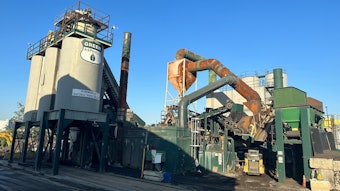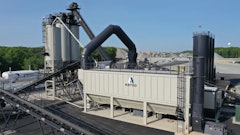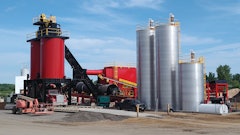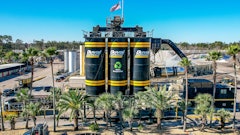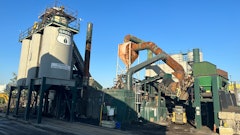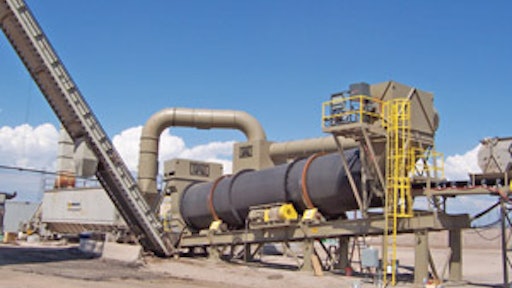
When you've been an asphalt plant operator for 35 years, running a plant that produces quality mix without a lot of maintenance downtime is about all it takes to keep you happy. For Edward Cox, operator of Vulcan Materials' Peoria plant in Arizona, the recent drum upgrade has been keeping the veteran asphalt producer happy ever since the new Maxam SOLO drum was fired up last summer.
The folks at the Vulcan operation basically wanted to upgrade the 1986 400-tph CMI parallel-flow drum mixer with a new counterflow system, with the following general parameters:
- 350- to 400-tph production capability
- Maintain a 320 degree F mix temperature
- Equip with a heavy oil (waste oil) burner
- Efficiently process aggregate containing an average moisture content of 3.5 percent
- Operate efficiently at the site's location, which is 1,000 feet above sea level
- Be compatible with the plant's existing 46,000-cfm baghouse
The solution
Vulcan's research and analysis led to a new Maxam SOLO counterflow drum shell with frame extension. The SOLO technology separates the control of the exhaust stack temperature from the control of the mix temperature, and provides a means to directly heat RAP without superheating the virgin aggregate and without producing blue smoke.
For the Vulcan installation, the RAP advantage did not play a critical role in the selection process, because the plant has no request for RAP mix designs.
The drum is equipped with Maxam's MAXAMizer Heat Recovery System, where the stack temperature is automatically maintained at the minimum acceptable level for the baghouse (typically 225 degrees F). With the MAXAMizer Heat Recovery Unit mounted at the exhaust gas plenum of the drum, stack temperatures never exceed 250 degrees.
All the excess heat that normally escapes the stack goes right into the material, and the technology's resulting low stack temperature means air (CFM) and fuel (BTU) requirements are reduced, increasing production by up to 20 percent and reducing fuel costs by as much as five to 10 percent per ton. Less fuel consumption also results in low emissions, and the lower temperatures mean less stress on the bags, flights and drum shell.
The system ensures the lowest possible baghouse temperature, but always above dew point and maintaining that temperature is automatically controlled. The MAXAMizer Heat Recovery System prevents moisture condensation and build-up of mud on the filter bags, which can cause them to blind and require replacement.
The Vulcan replacement
According to Cox, the conversion at the plant took less than a week, and the transformation included:
- An 8-foot 4-inch diameter by 42-foot 6-inch long SOLO counterflow drum shell constructed of 3/8-inch INX50 steel
- A skid mount frame with supports to grade
- Maxam Energy Efficient Flighting System - using short flights that allow more staggers, which in turn provide a more uniform veil across the entire drum cross section
- One-piece AISI 1045 forged steel tires - leaf spring style mounting system allows for expansion and contraction without cracked or fractured welds
- MAXAMizer Heat Recovery System firing #2 oil (diesel)
- Burner/material discharge housing with high temperature seals
- Exhaust housing with high temperature seal
- 125-hp wrap chain drive
- Maxam's exclusive Troo-Track Self-Aligning Trunnions
- Reversible slinger conveyor with 7.5-hp drive
- Dust injection screw
- Thrust roller with rail car style bearing and structural support
- 9' x 9' knockout box, tip valve, discharge chute and structural to grade
- 3/16-inch-thick ductwork from new drum to knockout box and from knockout box to existing baghouse
- A Hauck StarJet 580 Extended Burner fired by waste oil
The SOLO advantage
According to Ron Murphy, general manager for Maxam, the primary benefit of the SOLO technology is that it provides more drying in a shorter veiling environment due to the staggered, closely configured drum flights. For the Vulcan installation, the design was well suited considering the low moisture content of the aggregate being processed, and the installation of a shorter drum allowed the producer to retrofit its existing plant without any significant modifications.
"When we were called in to evaluate their drum requirements, they told us they wanted more production out of their plant by converting to a counterflow system, but they wanted to accomplish that objective without making a lot of major changes to their existing plant," Murphy notes. "Other drum designs have flight zones that are 4-foot 8-inch to 5-foot long and our design has flight zones that are 2.5-foot long due to the shorter rows and staggering of the flights.
"The design produces better veiling, more uniform veiling of the material during the drying process, which allows the material to dry in a shorter distance as it travels down the drum," he says.
The other advantage results from the MAXAMizer Heat Recovery System, which reduces the air and fuel required to dry the material being processed. That allows for increased production at a lower cost per ton.
Operator's perspective
According to Cox, the 320-tph Maxam drum system fits the bill for the plant's production needs.
"The installation really went well and the production capacity is all we need to serve our customers," Cox says. "We generally operate year-round, six days a week, and we don't run any RAP (reclaimed asphalt pavement) in our mix designs because Arizona (Department of Transportation) doesn't spec RAP into projects.
"The new drum system is easy to operate and maintain, and the electrical system required to install and operate the new drum is very simple and straightforward," he adds.
The Vulcan plant serves a variety of customer needs from residential mix requirements to DOT Superpave designs.
"Everybody wants more production out of their plants, but we just want to produce the quality mix our customers demand and do so in the most cost-effective manner possible," Cox says. "We went with the waste oil burner for efficiency and we went with the heat recovery system for efficiency and to reduce unnecessary emissions."
The other significant benefit of the new Maxam drum that Cox really likes is the self-aligning trunnions.
"We never have to worry about making adjustments to the trunnions because they're free-floating, and that minimizes the wear and maintenance concerns you have with other systems," Cox says. "On average, we're operating this plant at about 90 percent capacity. So, we know we have the capacity to meet the needs of our customers and we know we can operate without worrying about some of the usual maintenance items you have to address on other systems."
Cox also notes that the flights inside the drum are easy to maintain and the close spacing that produces a uniform veil during the mixing process helps produce the quality mix he wants to turn out.
"We have two 200-ton silos at this facility, and with this new drum, we know we can keep up with the various mixes our customers require, and we can do it in an economical and productive manner," Cox says. "We're a grocery store operation, stopping and starting all day. We have to produce three or four different mix designs each day, and the new system allows us to do that without a lot of wasted product and minimal disruption to our production.
"We also had a stack test (for emissions) shortly after installing the new system and the output was well below that of our old parallel-flow drum system," he adds. "That's another significant benefit for the community we serve."
So for Cox and the Vulcan operation, the drum upgrade has given the old plant a new lease on life and has allowed the asphalt produce to increase production, cut its production costs, and lower emissions in the process.