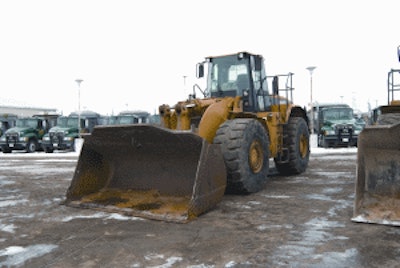
At first glance, it's a simple tale of a proactive company helping a customer save money and increase productivity.
But the story of how Patten Cat worked with Plote Construction to repower three of its aging Cat 980G wheel loaders is much more than that. It's about how these private companies - working with federal and state agencies and using Caterpillar engineering expertise - could save jobs, improve efficiencies and contribute to a cleaner environment. It's about partnerships.
The process
A big part of Bill Bayne's job is keeping track of environmental laws and how they impact Patten customers. Bayne, Patten's environmental health and safety manager, ensures customers know when new regulations are coming and what steps they can take to meet them.
"We've been talking emissions for about two years now, to help our customers comply with the upcoming regulations from Cook County, the Illinois Tollway, the state of Illinois" and other entities, Bayne said. "A lot of people weren't aware of the options they had."
Diesel engines often have long service lives and can be rebuilt. Many engines are still in use that were certified to less stringent emission standards in effect at the time of their manufacture and lack the advanced emission controls in existence today.
Engines manufactured as recently as 1996 and those built during the 1990s do not have the most advanced technologies to reduce emissions as new machines. Patten and Caterpillar offer Repower and Retrofit technologies designed to reduce the emissions of existing diesel vehicles. A few of these after-market equipment options are also designed to reduce fuel consumption and to improve operational efficiencies.
Replacing entire fleets of viable, working machines with new models is not an option for most customers - especially in tough economic times. Retrofitting with cleaner emissions technologies is a cost-effective and sustainable solution. And, fortunately, state and federal agencies have been offering grants to help fund those solutions.
Finding those grants and helping customers apply for them is another big part of Bayne's job.
"Many contractors and business owners weren't aware that stimulus money was available for upgrading their heavy equipment," Bayne said. "We're here to help them find that money and apply for it."
Plote Construction is one such customer. Plote is a family-owned business with more than 45 years experience in heavy highway contracting. Projects include roads, highways, airports, lifestyle centers and housing developments, Dan Plote, President of Plote Construction, said. And Plote has been a partner with Patten Cat since Dan Plote's dad, Ray, started the company in 1965.
"We've been doing business with them for that long for a reason," Dan Plote said. "They help us get our work done, whether it's through parts and support services, or new equipment or help like they gave us on the repower project."
Because Plote and Patten work closely, it made sense for Plote to ask for suggestions on what to do with the three aging 980G wheel loaders. The machines were nearing 20,000 hours of operation each and were put in the field long before current emission standards.
"We're always buying new equipment, but we saw the economic slowdown coming and wanted to be extra careful," Plote said. "So we went to Patten and asked, 'What are our options?'"
Patten was aware that federal money from the American Recovery and Reinvestment Act was earmarked for state programs to help upgrade older, less efficient diesel engines. Those programs - similar to "cash for clunkers" for big machines - could be tapped to help solve Plote's dilemma, Baynes suggested.
The Illinois EPA, in cooperation with its partners in the Illinois Clean Diesel Workgroup, administers various grant programs through the "Illinois Clean Diesel Grant Program" and the existing "Illinois Clean School Bus Program." The Illinois EPA received $4.2 million in stimulus funding for clean diesel programs.
Projects that are part of the grant program include the installation of diesel oxidation catalysts, closed crankcase ventilation systems, particulate filters, the purchase of diesel hybrid vehicles, engine repowers and equipment to reduce or eliminate idling, such as direct-fired heaters and auxiliary power units, said Darwin Burkhart, manager of Clean Air Programs for the Illinois EPA.
"Our goal is to help school districts, local governments, businesses, and truck owners and operators find ways to reduce diesel emissions," Burkhart said.
The target vehicles include school buses, shuttle buses, off-road equipment and other diesel vehicles that operate in urban and residential areas. Burkhart said the program would also focus on projects located in the Chicago and Metro-East nonattainment areas in reducing ozone precursor emissions and particulate matter.
"The diesel engine and off-road equipment industries are very important to the state's economy," Burkhart said. "This grant program will assist these manufacturers and the local equipment distributors in Illinois by helping to increase their revenues through the sale of clean diesel products and, in the process, retain or create new jobs."
The Plote project fits perfectly with the goals of the program and was approved within two weeks of the application last fall, Bayne said. The clean diesel program will pay half of the total project cost. Plote will pay the rest.
Getting the grant approved was just the first step. Patten had to line up the engines and needed parts, and put together a detailed timeline for project completion. In addition, the agreement came with a deadline: By May 31, 2009, all the work had to be done, bills had to be paid and grant money had to be awarded.
The new engines will result in a 50 percent reduction in NOX emissions and a 54 percent reduction in particulate matter (PM). Horsepower will go up as well, from 300 to 318.
"Another good thing for everybody is that rather than dumping these machines in a landfill, they will be upgraded for a second life with the possibility of even a third life," Plote said. "These machines will essentially be brand new."
Details of the repowering
Despite the many challenges in the economy, Caterpillar's commitment to sustainability has not wavered. In fact, the economic downturn has helped secure sustainability's place at the core of the company's strategy.
"Even tighter emissions regulations and rapidly increasing customer focus on sustainable business practices are boosting the demand for the retrofitting of new emissions technologies on working diesel engines," said Paul Cook, Emissions Territory Manager for Caterpillar Emissions Solutions.
During 2009, Cat Emissions Solutions has accelerated the development of emissions retrofit products to meet the growing customer demand for lower emissions from their older equipment.
Plote's 980G wheel loaders are a good example of that trend, Cook said. Caterpillar didn't have an emissions solution developed for the 980G model yet. The Plote machines will be a pilot project.
During the repower, each of the wheel loaders will receive a new ACERTTM engine, rebuilt torque converters, axles, differentials, brakes, radiators and any other improvements made to the wheel loaders since the machines were manufactured.
Approximately 200 tests and inspections of power train components are performed, and approximately 3,000 parts are replaced or reconditioned, including power train electrical switches, sensors, sending units, electronic control modules, engine wiring harnesses, bearings, gaskets, seals and coolant hoses. The power train is rebuilt with critical engineering improvements and updates.
Once the machines are in the field again, the solution will be rolled out to other dealers across the nation.
"What's also unusual about this upgrade is just how far it goes. These machines are going from tier 0, or unregulated engines, to a tier III, which is the cleanest engine available on the market. That's pretty significant. You don't see that a lot," Cook said. "In the Midwest, you'll see machines go from unregulated to a Tier I, but in this configuration, they're jumping all the way from unregulated to a Tier III, which is why this is such a significant project."
Working for the future
"Helping customers find innovative and economical ways to keep machines working isn't just good business," said Larry O'Neill, Patten's general manager. "It's part of Patten's DNA as a company. Helping to keep the environment clean is also part of Patten's mission.
"We realize we need to be stewards ourselves: our children and our grandchildren need to have clean air to breathe in the future," O'Neill said. "It's great to sell a machine and the parts and service, but if we're not a proactive partner then we're really not doing what's needed today and in the future.
"Patten increased its efforts to help customers deal with changing emissions standards about two years ago," O'Neill said. "The move reflected a core Patten philosophy: The dealership doesn't consider itself strictly as a vendor, but as a partner."
As such, Patten strives to identify possible challenges and outline solutions for its customers.
Much of Patten's staff time is spent making sure customers are aware of the emissions changes that are either coming or being contemplated and what those mean to their businesses.
"If you're aware of it, and it's part of your planning, when anything does occur in regulations, our customers are going to be well prepared and educated about their options and opportunities," O'Neill said. "When you look at problems and challenges, you usually see opportunities at the same time. You just have to have a positive attitude that there's something good in everything that occurs."
Garrett Patten, dealer principal and general manager of construction products, agreed with O'Neill believing "we're all aboard the same ship here and we're trying to navigate the economic waters that are pretty rough right now. We keep asking ourselves, 'Where can we make a difference for our customers?'"
Both men considered the government funding a "win-win-win" situation for everyone: It helps the customer update their fleet, helps the dealership keep its staff working and it's helping improve air quality in the region.
"If we look at the fact that during these economically challenging times, we're taking three unregulated machines, bringing them up to Tier III standards - and at the same time we also have 10 more technicians in our shops that have jobs - that's a real bonus," Patten said. "For Dan Plote, these wheel loaders will run cleaner and run better. Plus, the rest of each machine will be rebuilt to the point that these machines will be virtually new."
One study estimated that the stimulus funding aimed at diesel retrofits would likely generate approximately $6 of increased economic output for every $1 of federal funding. This economic impact is likely to be greatest in the auto parts manufacturing and heavy-duty truck manufacturing sectors, which have sustained job losses more than seven times the national rate.
"The funding has been a huge success for Chicagoland and we hope we see more of it in the future," Patten said. "We're thrilled that we can keep our technicians working and at the same time they're working on projects that have a positive effect on the environment, while also reducing the costs of our customers, which allows them to be more competitive in the marketplace."