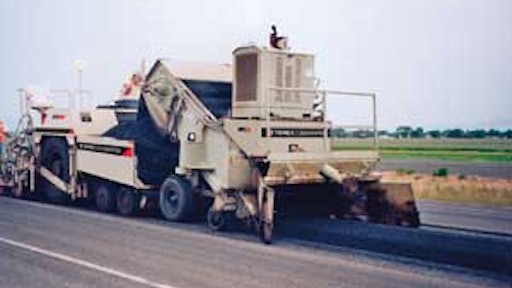
Paving in today's climate is a balancing act. Contractors have a desire to lay high tonnages of material per day. Yet with current mix designs like Superpave and SMA (Stone Matrix Asphalt), there's a tipping point between paving speed and quality. Whether dictated by spec or company pride or policy, sometimes the paving crew must slow down to deliver the desired mat quality.
For contractors who want to lay more tons of material in a day, there is a right way and a wrong way to deliver high mat quality. High speeds using only a paver can create a hurry-up and wait paving sequence as the paver runs out of asphalt before the next truck arrives. "This makes it difficult to maintain a constant head of material at the screed, so smoothness suffers," says Mark Hunt, general manager of Terex Roadbuilding's Asphalt Group.
Establishing a continuous paving process will deliver a smoother mat, but it takes a great deal of planning and coordination between plant production, trucking needs and the paving train's speed. Sometimes it's difficult to continuously lay material with a paver alone, as truck exchanges are slow and hopper capacity is limited. "It's not recommended for the paving crew to run the hopper dry as this can lead to truck-end segregation," says Bill Rieken, paver application specialist for Terex Roadbuilding. "So this limits the surge capacity of the hopper and the distance that can be paved before the next truck arrives."
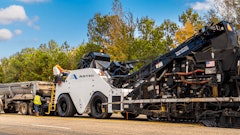
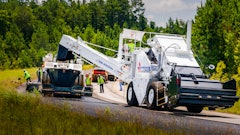
A number of machines are available to help bridge this gap and deliver more paving time between truck exchanges. Material transfer devices (MTDs), like windrow and mat smoothness machines, and material transfer vehicles (MTVs) deliver the additional surge capacity to help contractors better establish a continuous paving process to produce a higher quality, smoother mat.
Selecting the right machine for the paving train depends on a number of factors from production goals and mix designs to truck availability and state specifications.
Pick it up!
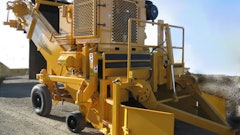
One of the most mature technologies for material transfer is the windrow machine, also known as a pick-up machine. The first windrow machines were developed in the 1970s, and their design has remained relatively the same over the years. Its simple, low-cost design allows contractors to pave more tons in a single day.
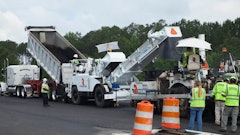
With this machine, material is laid in windrows in front of the paver by belly-dump trucks. The windrow machine attaches to and is maneuvered by the paver as it transfers material from the ground to the paver's hopper. "As long as the crew has a steady stream of trucks, a windrow machine will deliver considerably higher production than paving with a paver alone," says Rieken.
However it's not all about production when using a pick-up machine. "Contractors have told me the use of belly-dump trucks with the windrow paving process saves them about $1 per ton compared to using end-dump trucks," he adds.
Windrow paving is practiced more west of the Mississippi and in western Canada. It is also popular in areas with a shortage of trucks. Because belly-dump trucks carry more material than end-dump trucks and can quickly drop their load, this process uses fewer trucks.
There are some challenges associated with this process that crews must be aware of to be successful. Using experienced paving crews is helpful, and a good dump man is critical in windrow paving. The right size and amount of material must be laid in the windrow, or it could easily starve the hopper or overflow the paver with material.
Crews also have to be cognizant of potential temperature differentials from the truck exchange. These differentials can make the mat more difficult to compact to spec densities. Overlapping the windrows will help prevent temperature differential issues.
Since the material is laid on the ground in front of the paver, ground and ambient temperatures as well as the weather are also factors that can limit when the crew can pave with this process. Additionally, the required trucks are more specialized for this process than end-dump trucks, and not all markets will have an abundance of belly-dump trucks available.
Mat smoothness
Mat smoothness machines were also designed around the concept of allowing contractors to take advantage of continuous paving benefits. The first designs appeared in the late 1980s, about the same time as the first MTVs. They were developed for contractors who did not use belly-dump trucks and for sites where there is not enough room to efficiently use the longer trucks.
The mat smoothness machine can be considered a type of hybrid between a windrow machine and an MTV. It attaches to the paver like a pick-up machine. Therefore, it eliminates the need for an additional operator and offers about the same low operating, maintenance and fuel costs. "Operating costs for an MTD are dramatically lower than an MTV," says Rieken. Also its compact design, similar to the windrow machine, means the mat smoothness machine is easily transported without permits from site to site.
Like an MTV, mat smoothness machines have a receiving hopper, allowing end-dump trucks to be used with this continuous paving process. By employing large-diameter, ribbon-style augers, these machines help to solve truck-end segregation issues by reblending the material before it is conveyed to the paver's hopper. Shock-absorbing push rollers help the paver to pick up the truck without bumping, which results in smooth mats. High transfer rates reaching 1,200 tons per hour allow the truck to quickly unload and make way for the next truck, allowing the paving train to move at a steady pace.
Since this type of machine is connected to the paver, truck operators must be educated not to back into the mat smoothness machine. Rather, similar to dumping directly into the paver's hopper, the truck should wait for the train to receive it, so the shock-absorbing push rollers can smoothly pick up the truck.
Although mat smoothness machines offer the additional surge capacity for continuous paving, they do not offer as much storage as with MTVs. Additionally, there are some state specifications that require "non-contact" paving, which a mat smoothness machine will not meet.
Transfer vehicles
The first MTVs were also developed in the late 1980s, which corresponded with a change in mix designs to a larger aggregate. "Large aggregate mixtures were used at the turn of the century under the Warren Brothers patent. A lawsuit in Kansas in the 1920s basically said that mixes with smaller maximum aggregate size did not infringe on the patent, so producers went to smaller aggregate and got comfortable with it," explains David Newcomb, vice president, research and technology for NAPA.
However, as traffic volume and wheel loads increased, the smaller aggregate did not adequately withstand the punishment. "Larger size aggregate mixtures had a resurgence in the late 1980s, mostly as heavy-duty type mixes," he adds. The change to a larger aggregate increased the occurrences of segregation, especially between truck exchanges.
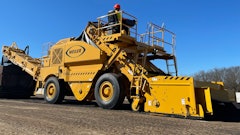
MTVs were initially created solely for the purpose of continuous paving. "The first MTVs featured large storage bins to allow extra paving time in between truck exchanges," mentions Rieken. These MTV designs did not feature reblending capabilities.
It was not until the mid 1990s — coinciding with the advent of the Superpave System — that MTVs were equipped with some type of reblending system. During this same time period, studies were also being conducted on the affects of material segregation. These studies also concluded that thermal segregation can be just as detrimental to the life of the road.
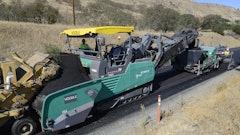
By offering reblending capabilities, MTVs can deliver a more homogeneous mix to the paver to improve mat quality. These machines can better handle extreme segregation issues than windrow and mat smoothness machines. This is due to the vehicles' auger reblending systems, which remix the material prior to delivering it to the paver's hopper.
MTVs allow for offset paving, which comes in handy for special applications like paving superelevated bank turns on racetracks. They also offer non-contact paving, which is required by some states specifications.
These vehicles also offer large storage capacities to give contractors the necessary material surge to pave continuously at higher speeds, allowing more tons to be laid. Upper and lower paver hopper inserts can be used in conjunction with MTVs, offering more mix storage for the paving train.
Since these vehicles are powered independently of the paver, however, they will have a higher initial purchase price than the MTDs. Crews will need a second operator for the MTV and there are more moving parts than with an MTD, so operating costs will be higher as well.
The large storage capacity helps with continuous paving, but it makes the vehicle heavier. Some MTVs have wheel loads in excess of 100 psi, so they will not be used on all paving lifts, only the top lifts. Due to the higher wheel loads, some state specifications, such as Georgia's, require MTVs to be empty before crossing bridges, while MTV usage in Iowa is dependent upon approval of the project's engineer.
One additional challenge when using some MTVs is adjusting to temperature loss. Longer dwell times in storage bins can result in up to a 60 degree F (33 degree C) temperature loss the first couple of loads, which could drop the mix below specified minimum paving temperatures.
A cure-all?
Material transfer devices and vehicles have allowed contractors to make great strides in improving mat quality, while increasing the amount of mix being laid daily. These machines combat segregation and establish continuous paving, which results in smoother mats.
However, adding one of these machines to the paving train does not guarantee a quality final product. "The equipment does not eliminate the need for crews to follow proper paving techniques," offers Rieken. Newcomb agrees, adding, "Segregation with larger aggregate mixes has always been a problem when they are handled improperly."
If the crews are properly trained on the equipment they operate, don't outrun the plant's production capacities and follow quality paving practices, they can achieve bonus-level mat quality more efficiently through the addition of an MTV or MTD.
Information provided by Terex Roadbuilding.







![[Video] Vögele MT 3000-2i Material Transfer Vehicle in Action](https://img.forconstructionpros.com/files/base/acbm/fcp/image/2016/08/default.57b205a972422.png?auto=format%2Ccompress&fit=crop&h=135&q=70&w=240)