Technology is forever evolving, so at what point do you decide to jump in and invest in a new mid-size (8- to 10-ft.) asphalt paver?
Most purchase decisions are based on your own personal business plan — i.e., you have a particular trade-in schedule, you want to enhance or change your company's direction, a piece of equipment breaks down, etc. However, you should consider the affects some of the newest technologies can have on your operators, the environment and your pocketbook as it relates to improved productivity.
"It's important to understand your business and where you want to grow," says Scott Wiley, marketing manager for large paving products at Ingersoll Rand. "Evaluate what equipment you have and what's available in the marketplace. Then keep it clean and well serviced and it will serve you well."
Focus on operator and environment
In the area of operator enhancements, Caterpillar has improved visibility by creating an operator station that pivots outward. "Good visibility is very important so operators can more readily see trucks and crews working around them," says Brian Moriarty, engineering manager.
Steering wheels and electric controls (toggle switches) are also making machines easier to use. "Electric toggle switches are more ergonomic and give us a chance to build a machine without cables," says Mark Bolick, LeeBoy. "Instead of two levers, now there is one joystick. And the steering wheel is more comfortable for the operators to use so they aren't as tired at the end of the day."
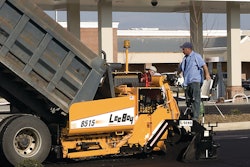
Operators at Precision Paving, Hickory, NC, welcome the steering wheel in the 8515 LeeBoy paver purchased last year.
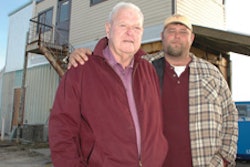
"There is less physical resistance," says Bruce Godfrey, president. "It doesn't work the arms as much. With the older pavers, it was difficult to push the levers forward if a truck was up against the machine. The steering wheel just makes it easier to operate."
Quick, uniform heat
The debut of Tier III engines provides multiple benefits. Not only do they provide lower emissions, they allow for improved fuel efficiency and reduced noise to the operator.
Another feature of today's pavers — and one of the newest technologies to change the way asphalt is laid — is the introduction of electric screeds. "Contractors who don't have them now will likely give a lot of thought to this technology when they purchase a new paver," says Bill Rieken, application specialist for Terex Roadbuilding, manufacturers of Terex/Cedarapids paving equipment.
According to Rieken, Terex/Cedarapids dabbled in electric screeds a number of years ago. Yet, it's only been within the last few years that the technology has taken off — so much so, that currently more than 90% of all new Terex/Cedarapids pavers leave the factory with this option.
Electric screeds have become popular because they heat up quickly and more uniformly over the entire width and length of the screed, improving screed performance and enhancing mat quality. They also produce a better joint because of the more uniform heating, adds Rieken.
"Electric screeds are the way of the future," Wiley asserts. "By maintaining even heat across the screed, you reduce the likelihood of hot spots, which can warp screeds and negatively impact mat performance. Plus, they eliminate fumes generated from diesel firing so operators have a cleaner work environment."
The move to electricity as a heat source is a definite enhancement. "The old diesel-fired screed is a simple system, but it's high maintenance to keep the burners lit. And it's not a very pleasant work environment for the operator," Rieken explains. "It puts out a lot of BTUs, but it's not very even heat. So you have to cycle heaters on and off, which brings the human element into the equation."
While this new technology offers inarguable benefits, it does come at a higher initial cost. When Stephen Macanga purchased four new Ingersoll Rand pavers last year, only one of them featured an electric screed. "We're getting away from the oil-fired screeds," he says. "But the electric screeds are more expensive, so I wanted to work into them more slowly."
Macanga focuses on commercial paving, including airports and parking lots near his home in Westchester, PA. He upgrades to new machines about every five to eight years, depending on associated maintenance costs. With his recent purchases, he's positioned to take advantage of increased speed, as well as electronics and lasers for grading and paving.
Lay asphalt faster
Several features of the newest models boost productivity to allow operators to lay more asphalt faster.
For instance, LeeBoy introduced a 12-in. auger (vs. a 9 in.) to move material to the end of the gates more quickly. "Some of these changes give contractors the ability to use mid-size pavers for bigger jobs — ones that only larger pavers could do previously," says Bolick. "These smaller machines are also handier for getting around intersections and cul-de-sacs.
ontractors used to go in with large pavers, then do a lot of hand work. But these commercial-class pavers eliminate a lot of that hand work, so you're able to lay more asphalt in a day."
Rubber tracks can also improve maneuverability. "Rubber tracks don't harm the sidewalks and existing streets when you cross them," says Bolick. "Contractors are able to unload on a street and walk across a concrete sidewalk or apron and not do any physical damage."
Godfrey appreciates the rubber tracks on his new 8515 paver. Although this is his seventh tracked machine, it's the first one to ride on rubber. "They don't mark the parking lots or damage the asphalt if I have to walk across it to do repairs," he says. "And they have better traction with safer loading and unloading onto and off of the trailers."
The decision between tires or tracks really depends on the type of work you do. "For new road construction and development, you might want tracks because they have better tractive effort and do less damage to the surface area," notes Wiley. "If you do more overlay work, you may want tires because, for the most part, they will have a little less operating cost to maintain the undercarriage, and you don't have to worry about a loose base. Where you have a good, solid, milled surface to operate on, a tired machine will work well. But there has been a big move to rubber tracks because of their benefits of traction and flotation."
Smoother mats at a faster pace
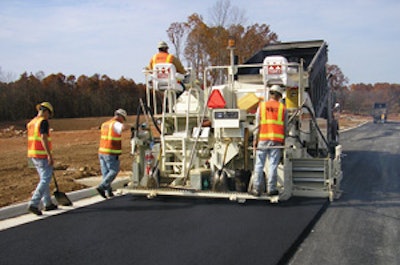
Overall, manufacturers indicate the ability to lay down increasingly smoother mats at a faster pace is the real benefit of today's modern pavers.
"The goal is to lay down as smooth a mat as possible with minimal or no defects so a road lasts longer," says Moriarty.
"Older machines simply don't have the precision controls of the newer models. More automated systems with grade and slope control give contractors the ability to achieve that smooth mat, which in some cases can garner bonuses. Smoothness in the end not only gives drivers a smoother ride, but helps minimize defects that can lead to premature failure in the road. It's all about the life of the road. The smoother it is, the longer it will last."
"With newer technology, contractors can also lay asphalt a lot quicker with a machine that is more efficient and maneuverable," adds Wiley. "It boils down to getting more asphalt laid in a day. Plus, with the added density of some of the newer screeds, contractors can, in some cases, reduce the effort required from an asphalt compactor because they might be able to achieve the required compaction with fewer passes. This cuts down the time on the job."