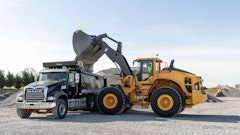
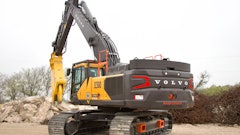
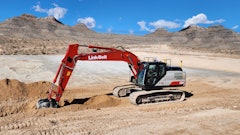
No one earthmoving system is optimal for every jobsite. Consider the dilemma of choosing between an articulated truck paired with an excavator or a wheel tractor scraper.
The unique cut and fill conditions of the jobsite determine which system actually provides a better solution.
"Conventional wisdom suggests that the haul distance is the principal criteria for the right choice of equipment on a given project," says Govi Kannan, Volvo Construction Equipment. "In addition to the haul distance, there are several application-related and economic-related factors which influence the decision on equipment selection." These include the material, space constraints, weather, operator skill and owning and operating costs.
"When I go out to the jobsite, there are five major questions that I ask," says Scott Knoblauch, industry application consultant, Caterpillar Inc. "What kind of material is being moved? What are the underfoot conditions? How much material do I have to move? How far do I have to move it?
How long am I going to be here?" The answers to these questions help determine the most appropriate earthmoving system.
Material type is top criteria
"The first thing that I look at is material type," says Knoblauch. Certain materials favor the use of either the scraper or an articulated truck.
"Under the right conditions, it is virtually impossible to beat the production of a wheel tractor scraper. For example, consider the Caterpillar 627 push-pull wheel tractor scrapers. The main advantage is that you have four engines worth of horsepower on a single cutting edge in a push-pull configuration," says Knoblauch. "We have a little over 1,100 hp on one single cutting edge when they are working together. So the advantages are quicker loading times and increased density in the bowl."
The ideal conditions for a scraper would be easy loading material that spreads nicely. "Scrapers are really great in sandy loam soil," says Fred Casten, product manager, trucks and scrapers, Terex Construction.
"There is no cheaper way to move dirt than with a scraper when the conditions are right," he adds. "You can load a scraper very quickly in good conditions."
But scrapers are not as tolerant of wet, sticky clay that is more difficult to load, and rocky soils dont allow the scrapers to pull through as smoothly, Casten points out.
The amount of rock that a scraper can handle really depends on the type of scraper and the size of the rock. "If you are using a paddle-type scraper, we basically say no rock at all because of the potential damage to the flights and the chain," says Knoblauch. "The auger scraper has a broader material appetite than what an elevator has with fewer moving parts and less operational cost. If we can fit the rock underneath the apron, we can load it in the bowl. Auger scrapers can handle a rock up to the size of an average office chair with little or no trouble."
But rocky soils are not the best application for a scraper. "If I am loading shot rock, a scraper may do it, but it is not the best tool to be using," says Knoblauch.
Articulated trucks are top loaded. "Thanks to this configuration, the articulated haulers are not constrained by the type of material that is loaded on them," says Kannan. "Sometimes it may also be possible to carry semi-liquid, sludge-like material through the use of a tailgate."
Knoblauch agrees, noting, "With an articulated truck, if we can load the material (within reason) in the back, we can haul it."
Dealing with changing weather
Weather changes can dramatically alter jobsite soil conditions. "Articulated trucks can work in all seasons, year round, where your scrapers are usually limited as weather conditions cause the job to become wet and sloppy," says Michael Kennamann, senior sales and marketing consultant for articulated trucks, Caterpillar Inc.
Flexibility of the equipment to adapt to changing conditions is also important. "Articulated haulers are economical for a wide range of applications," says Kannan. "Their flexibility and versatility are best exhibited under adverse and difficult conditions."
Articulated haulers excel in poor underfoot conditions where traction is limited. "Their ability to traverse poor underfoot conditions, as well as rough terrains, have earned them a reputation for accomplishing any difficult hauling task," says Kannan.
Horizontal vs. vertical cut
The length and depth of the cut has a major influence on whether a scraper or articulated truck is better suited for the application. "It takes 100 to 300 ft. to load a typical scraper," says Knoblauch. If the length of the cut is less than 100 ft., then it can be more difficult to load.
Articulated haulers, on the other hand, are not constrained by space. "Thanks to the top-loading methodology, the haulers can be ideally placed below an excavator in the most space-starved corners," says Kannan.
"If I am digging a borrow pit for an overpass on a road construction site, it may not be favorable for a wheel tractor scraper," says Knoblauch. An articulated truck is going to be the tool of choice. "But if I have to level 30 acres to put up a housing site or commercial development property, it is probably more conducive to using a scraper."
Casten also claims it takes more room for a scraper operation than it does for excavators and articulated trucks. Scrapers work best where there is room to lay out a circuit.
Haul roads influence choice
Casten reports that scrapers and articulated trucks perform equally on smooth haul roads. "I dont think mechanically one would have an advantage over the other," he says.
But fuel consumption can also become an issue if you are using twin-engine scrapers. "If you have a long, high-speed haul road and you are using a conventional twin-engine scraper, you may burn more fuel and it may become uneconomical to run it that long and hard," says Casten.
Rough haul roads favor the use of articulated trucks. "If you have rough and bouncy terrain, I think the scrapers tend to bounce the operators worse," says Casten. "The articulated trucks have a better ride."
The grade of the haul road can also influence your choice. Twin-engine scrapers and articulated trucks can both handle steep grades. "But if I am on a jobsite where we only have single-engine scrapers and articulated trucks out there and steep grades come into play, I am going to side with the articulated trucks," says Knoblauch.
"The single-engine scraper is just going to take too long to go up and down those steeper grades," Knoblauch adds. "I am going to increase my cycles per hour and lower my cycle times by using an articulated truck because it can handle the grades a lot better. If I have a twin-engine scraper, grade is not as important as material appetite and the cut conditions."
Casten favors the use of articulated trucks on steeper grades. "If there is any consideration of underfoot slippage or if it rains and you want to continue the operation, I think the articulated truck would be better for a hill," he states.
Operator skill requirements
It takes practice to become a good scraper operator. "One of the biggest complaints from scraper owners is the spinning of tires by inexperienced operators," says Kannan.
"The old-school scraper operators are few and far between anymore," says Casten. "It does take a lot of talent to run that scraper."
"There is no doubt that an articulated truck is a little easier to run than a scraper. But I am going to add to that by saying operator training is of essence with both systems," says Knoblauch. "There is a little more involved with the scraper."
Versatility favors trucks
"I believe the versatility of the articulated truck and excavator tandem makes it so much easier to own those pieces of machinery," says Casten.
"Scrapers can only scrape, load and dump.
"You can go to almost any jobsite and see an excavator there; people already own them," says Casten. "With the addition of some articulated trucks, they can move a heck of a lot of dirt as well."
Pull-type Scrapers Fill Niche
Pull-type scrapers have become increasingly popular because they are relatively inexpensive and offer an economical way to move earth in the proper applications. But there are a few limitations. "The material appetite is pretty much limited on a towed scraper," says Scott Knoblauch, Caterpillar Inc. They are well suited for light stripping of topsoil.
The wheel tractor scrapers excel in materials that require a high horsepower-to-weight ratio. "If we have some very hard clay that we are trying to move, the tractor scraper exerts about 85 psi of ground pressure to the tires," says Knoblauch. So we can get the horsepower to the ground."
Towed scrapers are not capable of producing this kind of ground pressure. You dont want to try to hog material with a towed scraper or your operational costs will go through the roof, claims Knoblauch. The ag tractors used in these applications also run 10 to 12 mph slower down the road, something to consider if you need to move a lot of material in a short time on a long haul road.
Jerry Foster Land Grading, Dexter, MO, has been in the land grading business for 40 years. He uses three rigs: two Case IH STX 450 tractors, each pulling two Reynolds scrapers (a 17 yd. on the front and a 16 yd. on the back), and a Case IH STX 375 pulling two 14-yd. Reynolds scrapers.
These units usually work in light clay, gumbo and sandy loam conditions. There is also some sand. "Of course, in some soils it works better, but all around they do real well," says Foster.
Haul distances vary from less than a quarter to half a mile. "Most of the time it is a quarter mile or less," says Foster.
This setup has proven very durable and efficient for Jerry Foster Land Grading. "The price and the maintenance, for what we do, they just work in our application," says Foster. Each rig costs approximately $317,000, which includes $195,000 for the tractor, $102,000 for the train of pull scrapers and $20,000 for laser equipment on the scrapers. This is less than the investment required for a wheel tractor scraper. "The upkeep and maintenance would be less, too," says Foster. "You dont have to have something pushing you. You can fill both buckets and it is just more efficient."
Equipment disposal is also greatly simplified with the pull-type scraper arrangement. "There is a bigger demand when you get rid of them because there are farmers who want a bucket to use around the farm," says Foster. "You can just sell the tractor separate. You have so many places to go with it."
Sevig Construction, Cedar Rapids, IA, performs residential and commercial site development work. Its fleet of equipment includes six pull-type scrapers. "We pull them in tandems, but of course you can pull a single if you want to," says Gordon Sevig, owner/president. "We have three 15-yd. Ashland scrapers and two 18-yd. Ashland scrapers. Then I have a Caterpillar 70, which is about a 14- or 15-yd. scraper."
The Caterpillar 70 is a four-wheel scraper while the Ashland scrapers are two-wheel drawbar hitch models. The Cat 70 is pulled behind one of the Ashland scrapers. These tandem setups are pulled by a Case IH 375 Quadtrac, a Case IH 425 Quadtrac and a Cat Challenger, which are all rubber-tracked tractors. Added together, these scrapers allow Sevig to move 66 yds. per pass. "To make a tandem scraper practical, you need to have a little space," says Sevig. "It takes a little while to load two of them. It takes some distance to get two of them loaded correctly."
When Sevig encounters a confined space, he simply unhooks one of the scrapers. "Right now, we are pulling just a single behind one of the tractors because we are in kind of a confined area," he notes. "The drawbar-hitch tandems can also be backed into tight spaces."
Sevig sticks with short hauls. "A quarter of a mile would be the maximum," he says. He claims he has never needed a truck. When conditions are too soft for scraper operations, he top loads them with an excavator. "If you load 36 yds. in the two 18-yd. scrapers, it takes a pretty big truck to match that."
One scraper rig is equipped with Trimble GPS. "It is accurate to within 1/10th ft. on a project," says Sevig. This keeps all of the scrapers on the job productive. "I have seen guys run around half empty because they didnt know where they were going or what they were going to do," says Sevig. "So they thought they were doing something if they just took half a load."
With GPS in the lead scraper and business band radios in all scrapers, productivity has been maximized. "The main operator can pretty much keep the other guys loaded and tell them where to unload all of the time," says Sevig.
"I spent about $75,000 on our GPS," he adds. "I move it between the scrapers and the motor grader. I dont know when you get your investment back, but once you have it, you would not operate without it."