Smartphones, 3G and 4G networks are everywhere, offering wireless subscribers virtually instant access to data and electronic communications from anywhere at any time.
Thanks to the scores of recently developed mobile devices and applications — as well as the introduction of new ones seemingly on a daily basis — the demand for mobile data is skyrocketing. One prominent wireless authority, RCR Wireless, projects that mobile data consumption will increase 700 percent by 2014. For their part, wireless service operators are upgrading existing infrastructure and adding new capacity to meet the current and future demands of a data-hungry world in which more and more subscribers are transferring their desktop broadband usage to mobile devices.
One of the underground utility companies helping the nation's communications leaders grow their mobile broadband capacity is the Fishel Company, based in Columbus, Ohio. The 75-year-old utility contractor specializes in water, sewer, gas, telephone and fiber optic installation. With 20 offices in 11 states, "Team Fishel" employs more than 1,000 teammates. And, like its communications partners, the Fishel team embraces new technologies in an effort to deliver the best value and on-time solutions to meet its customers' needs.
In an ongoing project to install conduit and fiber optic cable for distributed antenna systems in and around Scottsdale, Ariz., Team Fishel is utilizing the newest technology in microtrenching. And, according to Kwigs Bowen, area manager of Team Fishel's office in Chandler, Ariz., the Vermeer MTR12 microtrencher attachment enables the installation crew to place more conduit, faster and with less cost and less site disturbance than other methods.
Expanding bandwidth
According to Bowen, a distributed antenna system (DAS) is a hybrid of fiber optics and radio sites that allows radio frequency engineers to pinpoint signals in densely populated neighborhoods or in areas that are difficult to cover. In each DAS, low-profile antennas (AKA Nodes) are hidden on such objects as light poles or traffic signals and in Scottsdale, equipment was often placed inside artificial Saguaro Cacti no more than 24 feet (7.3 m) tall.
The fiber is fed into a box located next to the artificial cactus (or existing street light pole) and from there it connects to an jumper and optical transceiver and amplifier, which terminates at an antenna located inside the node. Like traditional cell sites, a resident makes a call transmitting to the node and then the signal is converted from RF Energy to a optical signal which is then fed to the fiber back bone and to the local service provider. DAS networks enable cell phones, laptops and other wireless devices to take advantage of increased bandwidth for faster Internet and streaming video.
Working for Crown Castle, which owns and manages large cell towers nationwide, Team Fishel is placing hundreds of miles of specially designed HDPE conduit and installing the fiber to feed a DAS network that improves the reception and bandwidth capacity of AT&T's 4G wireless network in the area. "We drill or trench, whichever method is needed to install the conduit, place the fiber and then splice the fiber to activate the antenna system," Bowen said.
Most of the work, which includes horizontal directional drilling and fiber splicing, has been in Scottsdale, where private home owner associations (HOAs) expect and demand as little disruption as possible to preserve the aesthetics of their neighborhoods.
Nearly invisible installation
Working in an upscale HOA called "Mirabel," a Team Fishel crew used the new microtrenching attachment for the first time to install about 4,000 feet (1219.2 m) of conduit between the curb and gutter, where the installation is virtually invisible. The installation "train" consisted of a McLaughlin V500LE vacuum unit out front, followed by a Vermeer RTX550 tractor and the Vermeer MTR12 microtrencher attachment with a conduit reel carrier mounted on the front of the tractor. The trenching crew laid the conduit in the trench after it was cut and vacuumed. Another crew backfilled the trench to complete the installation.
"On that curb and gutter, we cut our microtrench right at the lip of the curb, where the asphalt street butts up against the concrete gutter," explained Bowen. "We cut the trenches 1¼ to 1½ inches (3.1 to 3.8 cm) wide and about 8 inches (20.3 cm) deep, then we installed a conduit developed especially for this application. The conduit is oval in shape and about ½ to ¾ of an inch (12.7 to 19 mm) thick and has two ducts in it that can accommodate cable about the size of a No. 2 pencil lead that can contain up to 72 fibers each — it's pretty amazing really."
"We completed that installation in three days," Bowen noted. "If we had gone in there with a horizontal directional drill, we would have been there for a week at the very least, and that's if we didn't hit rock and everything went well. Not only did we install it in three days, but the average person who drives by or walks by wouldn't have known what we were doing because we weren't leaving a mess behind us. We had a truck pulling the vacuum excavator unit. Behind that, we had a Vermeer RTX550 tractor with the microtrenching attachment and a reel of duct on the carrier on the front end of the tractor."
Bowen likened the team's microtrenching to rocksawing that was so prevalent a couple of decades ago. "It's like rocksawing was back in the 1980's when they used rocksaws all over the country to install cable TV services," he said. "Microtrenching is kind of like a mini-rocksaw because we are cutting a small trench with the microtrencher cutter wheel, then installing a small duct product and putting a microfiber cable in that product. Microtrenching helps reduce initial capital costs of the construction and we can roll it out very quickly. Production has been faster than traditional construction so we can provide the service at a lower cost and with less disruption."
Quick learners
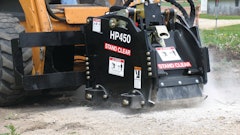
The Vermeer MTR12 and MTR16 microtrencher attachments offer maximum cutting depths of 12 and 16 inches (30.5 to 40.6 cm), respectively. They have an offset capability of up to 2 inches (5.1 cm) outside the right rear solid rubber tire. That allowed Team Fishel to cut the trench right next to the lip of the gutter. A two-stage lift and level design helps keep the attachment flush with the surface to maximize cutter wheel engagement and vacuum performance on uneven surfaces. Cutter wheels include a range of teeth types and widths to meet varying specifications.
"The learning curve for our operator was short and he had the hang of it within a few days," Bowen said. "Vermeer has been very good to work with and it's an excellent machine. It's a very productive and clean operation."
"We've had days where we've done 2,000 feet (609.6 m) with this system, but an average day is probably 1,500 feet (457.2 m)," said Bowen, as Team Fishel's work to install more fiber for distributed antenna systems in the area continues. "The way that Vermeer has designed their microtrencher, we can tuck it right up next to that concrete curb, without damaging the concrete and we think that's a very positive feature. In a week's time, we can install more than a mile of product, with little disruption and commotion in the neighborhood."
Team Fishel's work isn't done as the cactus antenna will be placed about every quarter of a mile (.4 km), meaning eight more systems will be installed in the Mirabel development. Upon completion of the overall upgrade project, up to 300 of the cactus antennae will be placed throughout the Phoenix area, enhancing bandwidth and allowing us to surf the Net and use our phone apps that much faster.
Click here to watch a Vermeer RTX550 with microtrencher in action.