
Often, one of the last and most critical steps in building roads is when compactors roll down that last mile. Accurate compaction can be overlooked in the rush to finish that last pass before the holidays, but it will be noticed by construction crews and commuters in upcoming seasons.
“Compaction isn’t just a final step, but the foundation for structural integrity, moisture resistance and long-term durability,” said Cody Wagner, paving technology product manager at RDO Equipment Co.
When crews don't achieve accurate compaction, the base layer under the pavement can be more susceptible to premature failure, requiring costly repairs and increased maintenance over time for the crew.
“It is so important for crews to achieve accurate compaction so rework isn’t required, and they can achieve the density required by the Department of Transportation (DOT),” Wagner said.
Wagner explains that, at its core, compaction is the process of reducing air voids in the material mix to achieve a specified density based on the environmental stressors the road will endure, such as freezing temperatures or snow plows clearing the roads.
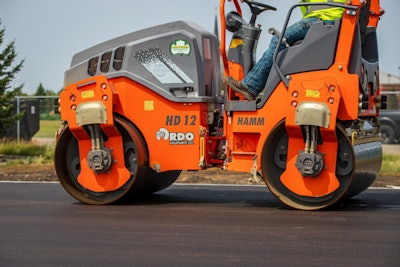
Many compactor machines, like HAMM rollers, now come equipped with sensors to deliver real-time density readings, so operators can proactively respond to potential issues and adjust force during subsequent passes. Project managers partner with the job site crew and equipment providers to select the right roller machine for the specific phase in the compaction process.
Compaction and HAMM’s Starring ‘Roll’
Accurately compacted material makes strong and smooth roads built for stability. When the asphalt or other road building materials are accurately compacted, it reduces soil settlement or the road’s permeability.
“While soil compaction focuses on load bearing and moisture control, asphalt compaction is all about achieving density and smoothness for performance and longevity,” Wagner said.
Environmental factors or road building material can affect a HAMM roller’s compaction force.
- Material type like soil, gravel, asphalt
- Moisture content of the material
- Layer thickness of the roadbuilding
Some rollers, like HAMM’s VIO-2, give operators flexibility to choose vibration, oscillation or a combination of both without sacrificing speed, Wagner explains. This ability can help the fleet manager reduce the number of rollers on the job site or change the compaction force when conditions require it. Fleet managers and operators rely on five primary compaction forces.
- Impact: Sudden force for deeper penetration
- Kneading: Pneumatic tires manipulate the mix
- Oscillation: Horizontal shifting for gentle compaction
- Static pressure: Weight of the roller compresses material
- Vibration: Vertical pounding to rearrange particles
“HAMM’s VIO-2 technology combines vibration and oscillation in one drum, giving operators flexibility to adapt to changing conditions without swapping machines,” Wagner said.
Sensors Detect Real-Time Density
To meet the generally accepted industry standard of 92% compaction, crews rely on a compaction train, such as a sequence of rollers, each with a specific role:
- Breakdown roller: Typically using a dual steel drum, this machine uses vibration (vertical pounding) or oscillation (horizontal shifting) to begin densifying the mix.
- Intermediate roller: Often a pneumatic tire roller, it kneads the mix and boosts density by 2-3%. Tire temperature must be carefully managed to avoid surface damage.
- Finish roller: A second steel drum roller, usually in static mode, smooths out imperfections. It may add 1–2% density, but its main job is to compact on a final pass and create a clean, uniform surface.
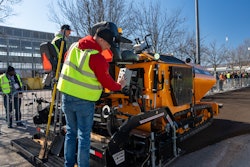
“When the mat is laid by a paver, timing and temperature matter,” Wagner said. “Usually, the material being laid cools quickly, so it’s important that a roller is ready to go with the right drum setting shortly after the paver.”
Asphalt is laid hot, between 260 to 320 degrees Fahrenheit, and cools quickly. According to Newton’s law of cooling, the hotter the material, the faster it can cool. Crews must compact while the binder is still workable to avoid the “tender mix zone,” where asphalt becomes fragile and prone to damage.
“Operators have to apply pressure to the road while the mix temperature allows it to still be mailable,” Wagner said. “Miss this window and the road is at risk for structural failure later.”
After the rollers complete several passes and the mat cools, crews or DOT officials check density by coring or gauging the mat.
Proper compaction extends pavement life, reduces water infiltration and improves resistance to rutting and cracking. HAMM rollers with Smart Compact technology provide real-time density measurements through sensors and automated machine control to adjust the roller’s drums.
“These sensors allow operators to actively practice intelligent compaction methods with DOT officials, quality control inspectors and fleet managers,” Wagner said.
Intelligent compaction (IC) is a construction process that uses GPS and integrated sensors on a roller to provide real-time data on a material's stiffness as it is being compacted.
“With HAMM’s Smart Compact Pro, operators have actionable insights from its ground penetrating radar to map density in real time, giving operators actionable insights based on temperature, stiffness and density,” Wagner said.
Smart Compact Pro helps crews:
· Reduce the number of passes
· Improve job site safety
· Minimize core sampling
“Smart Compact Pro has been a game changer for large-scale projects like resurfacing airport runway,” Wagner said. “Operators on that job site said their HAMM rollers’ spacious cabs, controls and in-cab displays helped them to see vital density information without getting out of the cab.”
From highways to housing developments, HAMM rollers adapt to a wide range of applications. Their compact design allows maneuverability in tight spaces, while their robust build ensures durability in tough conditions.
Whether you're stabilizing soil or laying down asphalt, HAMM rollers deliver consistent results.