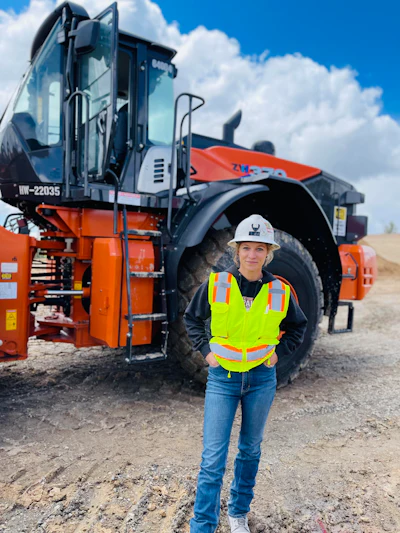
Mary Schwandt's career demonstrates that women can build successful, lucrative careers in construction, rising from entry-level positions to executive leadership while advocating for inclusive workplace cultures that support female workers in this traditionally male-dominated industry.
- Mary Schwandt started as a laborer at 17 and became COO of Acha Construction LLC, growing the company from 3 million to 10-plus million annually.
- Her military background as an Army truck driver taught her leadership, integrity, and responsibility that directly shaped her construction career.
- Women in construction face persistent messaging that they don't belong, requiring both personal resilience and company-wide cultural changes.
- Schwandt now serves as a FORCE Female Leader and industry ambassador, speaking publicly and using social media to show women construction offers viable career paths and financial independence.
- Creating inclusive workplace environments for entry-level workers, especially young women, is critical to retaining talent and building the industry's future workforce.
At 17, Mary Schwandt took a summer job with a local construction company in Nevada. She wasn’t necessarily looking for a lifelong career, but she was looking for work. More than 12 years later, that summer job has taken Schwandt from laborer and foreman to COO of Acha Construction LLC, president of Valor Traffic Control and vice president of Idaho Sheep Company. Along the way, the Army veteran has become a national speaker, writer and advocate for women in construction, using her own experience to show others what a career in construction can offer.
“I kind of just started a summer job and never left,” Schwandt says.
The company where she started exposed her to nearly every aspect of heavy civil construction, including asphalt paving, concrete paving, earthwork and utilities. Rather than becoming narrowly focused on one part of the industry, Schwandt learned by doing, building a foundation that would eventually prepare her to take on increasingly greater responsibilities.
 Mary Schwandt
“Being in an industry like that, you kind of learn everything along the way,” she says.
That willingness to learn has remained a defining part of Schwandt’s career. So has the influence of another formative experience: her time in the U.S. Army.
Lessons in Leadership
Schwandt joined the Army at 18 and spent more than six years in the military, serving as a truck driver. The experience taught her lessons in discipline, integrity, responsibility and teamwork that she would eventually carry into construction. At 19 and 20 years old, she was helping run missions where the stakes could be as high as getting her team home safely.
“It taught me a lot about, you know, leading,” she says. “The military teaches you a lot about integrity, responsibility, and that all does transform back to the construction industry.”
When she left the Army in 2021 and moved into full-time construction, Schwandt brought those lessons with her. She also brought an ambitious goal: to use what she had learned to help grow the business. The company went full union, expanded to more than 50 employees and grew exponentially.
“We went from 3 million to 10-plus million a year,” she says. “I think we took a lot of what we learned and made a construction company out of it.”
Making Room at the Table
Schwandt’s career has not been without obstacles, particularly as a woman working in a traditionally male-dominated industry. One of the most persistent challenges, she says, is the message — sometimes explicit and sometimes implied — that women do not belong in construction.
 Mary Schwandt
“I think a lot of women in the industry, especially a lot of young females, deal with the ‘you’re not good enough’ and ‘you don’t need to be here’ face value that men put out there,” Schwandt explains.
Overcoming that requires resilience, but Schwandt also believes companies have a responsibility to create cultures where employees can succeed. When she took over running Acha about two years ago, she says the company established clear expectations for how employees would treat one another.
“We don’t let the men treat women [disrespectfully]. We don’t let the women treat men [disrespectfully],” Schwandt says. “It’s hard when you don’t have a structured company that wants that. A safe environment for everybody.”
For Schwandt, that environment needs to especially extend to those workers who are just entering the industry. Not everyone arrives as a journeyman. A lot of young people are coming in directly out of high school, and their first experiences can have a lasting effect on whether they see construction as a career or decide it isn’t for them.
“Can you guys build an environment that allows kids and young females to come into the industry and want to stay into it?” she asks.
The question gets to the heart of what Schwandt sees as one of the industry’s biggest workforce challenges. Companies must create a space that give those employees a reason to stay.
Becoming the Person She Needed
Schwandt’s advocacy extends well beyond her own company. She has become a FORCE Female Leader in Pavement and an Asphalt Industry Ambassador, while also speaking at industry events and using social media to reach people who might not otherwise see themselves represented in construction.
She was among the early attendees of Ignite and has worked with industry leaders to promote opportunities for women. She also uses her voice to show the everyday realities of construction, from life on a job site to practical questions like picking the right work boots or what hairstyles work with a hard hat. The details may seem small, but they’re important for someone considering construction for the first time.
When Schwandt entered the industry, she says, she didn’t have someone to look up to or turn to with questions. As her career developed, she realized she wanted to become that person for someone else.
 Mary Schwandt
“I just don’t think there was enough when I came into the industry,” she says. “There wasn’t anybody talking about it. I didn’t have anybody to look up to and ask questions.”
Being visible has its challenges. Schwandt says she has received negative comments on social media, but she has learned to move past them and focus on the opportunities that come from having a platform.
Showing What’s Possible
One of the messages Schwandt most wants women to hear is that construction can be more than a job. It can provide a career, financial independence and a life for themselves and their families.
Her goal is to help the industry do a better job of showing the full range of careers available, from laborers and equipment operators to project managers and superintendents.
“We’re not just depending on men to go work construction anymore.”
For Schwandt, that message is rooted in her own experience. She started in construction as a laborer and steadily took on more responsibility, eventually reaching the executive level. She wants other women to see that same potential for themselves and understand that they don’t have to enter the industry already knowing exactly where their careers will take them.
A Legacy in the Making
Schwandt also sees an industry changing rapidly through technology, training, diversity and more. But for her, the future of the industry is ultimately about the people.
Her own career is evidence of what can happen when someone gets an opportunity and chooses to keep moving forward. She started as a laborer and now serves as a COO, helping lead a growing construction company while advocating for the people she hopes will follow.
Looking ahead, Schwandt knows what she wants her legacy to be.
“I hope that I get remembered for standing up for women in the industry and promoting the lifestyle you can have,” she says.
For Schwandt, paving the way is not just a metaphor. It is the work she has chosen to do — one job site, one conversation and one future construction worker at a time.