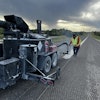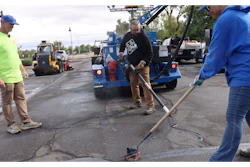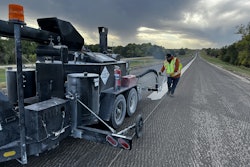

Nobody warned me that it rains in the desert. I flew out to Chandler, Arizona, to learn crack sealing alongside Robert Bonura and the crew at DeHart Asphalt, a family-run pavement maintenance company that has operated in the Southwest for more decades. The plan was straightforward: get hands-on experience with the two most common approaches to pavement crack repair, crack filler and mastics, and document the process for Season 3 of No Edge Lines.
Then the rain started....and it didn't let up.
Watch the full episode above.

Brandon 0:03
A come out to Phoenix. They said, learn how to crack seal. They said, you've never done that before. It'll make a great episode. They said, What was I supposed to do? They made a lot of good points, but just as soon as I got out here, what happened? It rained in the desert, not just a shower, mind you, like a lot of rain. It was at this moment, as we stood around making small talk beneath a gazebo in the park that I started to worry how we were gonna make a show
Robert Bonura 0:41
out of this one. We're built for this. And look at it. Now. It's raining, right?
Speaker 1 0:45
Arizona. This is crazy. This pond, this pond, rain level like, Dude, it cannot take any more water. I thought it was like tapering off for a second. I was excited. And then it
Brandon 1:01
like, right? Ducks are happy as can be though. Man living life,
Unknown Speaker 1:13
me all the way, right, all right. I've made a bit
Unknown Speaker 1:19
of a pool of myself. I it.
Unknown Speaker 1:23
I've been making plenty of
Robert Bonura 1:25
mistakes, so I knew you weren't gonna get it
Unknown Speaker 1:27
the first time. That would be insane. I should be looking better than this. The
Brandon 1:41
sponsor for today's episode is krafco, celebrating 50 Years of quality and innovation in the asphalt and pavement industry, hand built in the United States from crack seal application, mastic melters and seal coating equipment and supplies, krafco has everything contractors need when it comes to restore, protect and extend the life of your pavement surfaces. Click the link in the description for more as a lifelong born and raised east coaster the American West mostly conjures images from the broadly accepted pantheon of pop culture icons and film, television, in person. It kind of feels like stepping out onto an alien planet. But let's be honest, who looks out across a desert and says, why? Yes, let's go live there. I mean, who could be crazy enough to do such a thing? Well, one this guy, Robert benura, and not just him, but also his wife, his in laws and his children, who all make up almost the entire workforce behind DeHart asphalt, they invited me to come and learn how to do crack repairs in one of the harshest and most brutal environments for pavement where temperatures can get so high At certain times of the year that the asphalt actually softens, causing it to pull apart and deform. This exposes it to water intrusions, accelerating its deterioration and shortening its lifespan. I came here to learn the two most popular forms of crack repairs, crack filler, or crack sealing and mastics. But before we get into that, we hit a surprising roadblock. Pun intended on East Coast time. It's the only thing saving my ass
Speaker 2 3:28
right now. So what are you East Coast time? I don't know time. That's the nice thing about Arizona. We don't know.
Brandon 3:33
You don't care. Okay, so it's seven o'clock, so it's 10am for me, I'm good. I mean, I feel I sleep. I feel like I just pulled an all nighter, but like, it's middle of the day. You're past
Unknown Speaker 3:44
you're past it. Yeah, I did that Saturday. It's all good,
Brandon 3:47
you know, I'm running out of things to do. You know, this is, this is a real problem for the series, because I've started to learn a lot of the things now have
Unknown Speaker 3:57
our easy patcher. That's the
Brandon 3:59
thing you guys just came out with, like, in the last year and a half or so? Yeah, that launched at pave X, boom. That's called Brand synergy. Look it up.
Speaker 2 4:17
Kathy liked it. Kathy liked it. Kathy's nervous. She's like, Is Daniel miked up right now? That's okay, see the nervous Cathy. Don't worry about it. We can cut everything.
Brandon 4:32
You say, You're the little guy in this area. How long have you been at it?
Unknown Speaker 4:36
Well, 35 years.
Speaker 1 4:38
35 years. So when you started, you were how old? Well, me,
Robert Bonura 4:45
I was, I was 22 when I started. Okay, so my in laws here in Arizona, they started in 1980 Yeah, with Leonard's dad. It was called Western asphalt. They moved over from Michigan and and started.
Unknown Speaker 4:59
They're from my side. Side of the world, all
Robert Bonura 5:00
right, yeah. So they moved down from Michigan in 79 and started here in 80 krafco did a demo, or creating in like, the early 80s. His dad was actually a part of that, with krafko at the GM, proving rest if
Brandon 5:15
a crack is bigger than two inches, that's typically the like we should move from crack pillar to mastics, or is that
Robert Bonura 5:22
I've heard wrong? No, you've heard right, I would say. Because once you get below that two inches, the mastic won't fit in, right? It won't seal into it as well, because the mastic has aggregate in it, so and and it's it's there to the aggregate is with the mastic to create more of a structure and a stability in the crack
Brandon 5:43
filler, if it has aggregate in it. I mean, like, how different is it than just asphalt mix? Like, I haven't even seen it in person, like, so it's this rain would stop, then I could actually go and get to see it
Robert Bonura 5:55
with this, it actually is horrible, right? So it comes out hot, it comes out like crack, seal it, just in itself, levels, but it doesn't. You don't have to sit here and compact it, you don't have to rake it, you don't
Unknown Speaker 6:06
have to shovel it. It's much more fluid.
Robert Bonura 6:09
Yes, then great word for it is fluid. Okay, yeah, there's a lot of parking lots that the the ground. It ships, you know, the sub base shifts a lot just from what the native soil that it sat on. So you've got cracks that go, that turn into 345, inches wide. And so instead of having to mill and patch it out, you can put the mastic in there. And once it hardens, it's like asphalt.
Unknown Speaker 6:31
When you say self leveling, I mean
Robert Bonura 6:33
you pour it in and it literally will go to where it's like the the material just shifts itself. You just pour it in there and it'll it'll fill in that whole depression area. And you just have to be able to control it. You know? It reminds me of, what's that a What's that Olympic sport? When they throw the, oh, curling, curling,
Unknown Speaker 6:49
yeah, what you're doing, you're just
Brandon 6:51
controlling running across the thing. I've always imagined that asphalt workers would be great. They would at curl right, you know, you get your best glute man in front of that thing, you'd see those muscles just rippling. He's got all of the right technique. That might be, that might be a fun experiment
Robert Bonura 7:20
adopted by oh, I need that. I need that shirt.
Brandon 7:30
I want the guys at American asphalt to know, you know, we're coming for you. You might be raised on blacktop, but the adopted by asphalt family is growing. It is by leaps and bounds.
Robert Bonura 7:42
Yes, I joined it in 2005 I got adopted into the asphalt family.
Speaker 1 7:47
So that's right, I'm three years adopted. This
Unknown Speaker 8:00
is my father, in law. This is Leonard. Hi, Leonard.
Brandon 8:03
A lot of the contractors that I meet work with their families in one form or another. Their dad was in blacktop. Their granddad ran a crew, so that's not that unusual, but it was a little different this time, because the family here isn't just part of the business. Somehow they are the business, the whole business. I was curious to see just how that dynamic looked like in a practical day to day way. I couldn't work with my father in law. God bless him. I don't know that I could do. We love each other, but if I had to work with them every day.
Robert Bonura 8:41
We've had those days.
Brandon 8:47
You have it. You're silent the second half of the day, you're not talking to each other, and then it's like cold beer. Cold beer. All right, we're all good. Look at that. It's almost like magic. The rain is with dissipating. They've been actually
Robert Bonura 9:01
the big puddles that we got to dissipate.
Unknown Speaker 9:03
Now we can just put it down on top of this water, right?
Robert Bonura 9:05
Sure. Why not? No.
Unknown Speaker 9:07
What do you do?
Speaker 1 9:11
This situation called for the crack back. Did you just
Unknown Speaker 9:15
say crack back? Crack back. Crack that
Unknown Speaker 9:19
Baby Got Back.
Speaker 1 9:21
Okay, so not crack, not crack back, crack back back. So I'm assuming it vacuums the cracks. So listen, lowest hanging fruit here. That's all we do.
Speaker 2 9:36
Okay, so this is designed to clean out all of your cracks, clean out your cracks, clean out your cracks, but sometimes you have some large debris in your crack. So
Brandon 9:54
I'm a child. I'm a child. I'm sorry that it's just hitting me really funny to. When you say there's sometimes large debris in your crack, what happens? Am I allowed to clean the crack? So we have a slight issue. Okay, what's the issue? It's wet. So wait, I thought you were about to tell me that you can't clean a crack when
Unknown Speaker 10:15
it's wet. That is true. Whoa, yeah. Got a
Unknown Speaker 10:19
flame thrower. Yes.
Speaker 2 10:21
Holy. Like, first thing you said to me is, it's raining outside. I'm like, I know Leonard.
Unknown Speaker 10:25
Like, yeah, let me get that heat Lance.
Unknown Speaker 10:27
Really never rains in Arizona.
Speaker 1 10:29
So it's, you guys had to dust it off. Like, back east, it gets used all the Oh, I'm sure, I'm sure we got lots of wet cracks back East. You did it. All right. Things going good. Everything is going good. Everything is going wonderful. Everything is perfect. Here in Chandler, Arizona, oh, Leonard, now
Brandon 11:02
I get it. Now I know why you were excited. These are not my gloves. Even though we're using the heat Lance like this, they would not recommend applying crack filler in this scenario. In a normal circumstance, we're doing it special for me today. But this would not be ideal, even if you put the heat Lance on it. This is not going to give you the best result
Speaker 2 11:29
of that product, silty, some moisture inside there.
Speaker 3 11:33
All right. Here we go. I
Unknown Speaker 11:41
was like, I should come and help them, and then that's it, God, There you go. I'm helping getting in there.
Speaker 2 12:01
Okay, how'd I do? Oh, yeah, you're opening a nice reservoir for that material to flow inside and bond, you know, depending on the application, like some people do over band, some people do flush fill. Now, if you're doing an over band, you're having material here you have material all inside, and then over here you're you're bonding that material everywhere, so that way it makes it nice and weather tight, so no water is getting in there and getting down to the sub base. Because my first
Brandon 12:31
instinct is, why would I want to make this crack worse? Correct? But it's for a better purpose. It's going to give you overall better results than just leaving it as it is, that doesn't happen. Do you know how many times I've gotten it good on the first time? No times is the first time. It's kind of like a max learning ability of things happening in a short amount of time when they start to blur together for me. Do you want to see an example first? Or you just want to go for it. I want to go for it. It was becoming quite clear that we were fighting a losing battle against the weather, but I was still determined to at least get some basic experience. But before they would let me use the brand new easy patcher, I had to try my hand at applying mastics the old fashioned way,
Speaker 4 13:20
no boozing, okay, crack filling, just keeping it flat, all right. Boy, that bucket looks like it's from 1895 okay. Now just go, Yep, okay, just okay.
Unknown Speaker 13:35
So I didn't do as good on that. I did not as well.
Speaker 2 13:41
Yeah, you can actually see it right here. This is all part of the easy patcher. It's at you.
Brandon 13:48
This is where I get to tell you all the ways I'm already seeing how I can suck. Hey, perfect. Okay, if I lose track of how much material is in here, and this thing overfills, what's gonna happen?
Speaker 2 14:00
It's gonna overfill whatever. Happens then, like, what it's just gonna that's when spill out everywhere. Yeah, that's when Shawn and Devin, I come in with iron to
Brandon 14:08
fix it for that is the fear that I have, is that I'm gonna be thinking, I'm watching everything and all sudden, and now I've got a big mastic mess. This is what we call the hero shot ready? Oh,
okay, I'm about to learn one big, important fact about Robert's father in law, Leonard, and it explains two things about the heart asphalt, why they have all their practical equipment painted a custom shade of blue. And why, he just told me to push the button I absolutely wasn't supposed to press. Push the red button. I pushed it literally, Leonard says, and he's on Mike. Leonard says,
Unknown Speaker 14:57
See that red button? I go this way. He goes, Yeah,
Unknown Speaker 14:59
I'm. Red Button.
Robert Bonura 15:05
He only sees blue. That's why all of our stuff is blue. So now we're
Unknown Speaker 15:10
gonna go to dispense. All right? You can move it in small increments, or you can go full send and open up.
Speaker 1 15:16
This is gradual, yes, okay, here we go. He goes nothing,
Speaker 4 15:21
yeah, you're doing great. All right, playing a nice, nice, smooth seam over this crack, which is what we're looking for. You're you're driving at a good pace right now. You're doing great. Oh, I'm getting up. You're a little off, but you're good. Okay, perfect. Okay, we're good there.
Brandon 15:44
Nice work, dude. All right, I want you to compare the two ways I applied mastics here, both for the first time, the old way, with a colonial era bucket and a stick, which I utterly failed at, and the new easy patcher, which I pulled off well quite easily, having only even driven a skid steer one time. That's pretty crazy, unfortunately for this parking lot, despite my skillfully applied mastics, this is what it could look like if you don't take the time to properly clean or dry an area before treating now, if this
Speaker 2 16:20
was an actual job site. Now, if this was dry, and someone called us and have us come out look at it, we could see the dirt sticking to this.
Unknown Speaker 16:28
Yeah, it's not clean.
Speaker 2 16:30
Wasn't clean and it was, it was wet. So, you know, one of the things I talked about, I'm talking about today, surfaces had to be clean and dry. You know, you can't go in where there's a bunch of dirt, water, mud.
Brandon 16:43
It's gonna make this all useless. It just ruins it. It wasn't Leonard's fault at all. The first thing I noticed is that the camera was reversed. So when they were telling you to go left, the camera was going the opposite way. Wasn't the poor man's fault. He's so colorful. So colorful me turning off the machine is that that's on me.
Okay? Okay, the day's finally turned in our favor. Rubber. We have some sunshine. But I didn't get to be here for when you actually started this up. So I didn't get to see kind of like, what does it take when you come out on the day? You say, it's pretty automated. I usually
Robert Bonura 17:41
try to start it up about an hour and a half or so before we get to the job site.
Brandon 17:44
Okay, so I want to run. Proceeded to show me, step by step, how he gets his craft go super shot up and running every day. And he wasn't kidding. It's pretty automatic. And even as a total novice, I felt like after he was done, I could have handled the startup on my own, but getting a crack sealing machine started, and then actually doing crack sealing, I quickly discovered are very different things. I never want to say something is easy, because then inevitably it comes back to bite me, but it seems pretty simplified.
Robert Bonura 18:15
The thing that you run into is figuring out your timing, because if you've got a full tank of material that hose won't kick on until the materials at 300 degrees.
Brandon 18:24
I noticed you did say, when you kicked it on over there, you said a half
Robert Bonura 18:29
tank of material. Yeah, I usually run, I try to run a half tank to less.
Unknown Speaker 18:33
Okay. You don't like to get it because
Unknown Speaker 18:34
that's going to double the time, double the start time.
Robert Bonura 18:37
Okay, so that's and then at that point I put in the material that we need, and we build it from there. Because once it's hot and it's liquefied, you know, and it's just fluid, and you're dropping these bricks in here, they melt pretty quick. It's like an ice cube. Leonard likes to fill the tank all the way up. It's quite as high as possible.
Unknown Speaker 18:53
Leonard, why are you doing it? Come on.
Speaker 5 19:20
Came here left a big trying to keep that right. Use Yeah, you send me round to me upside down like a rush of blood to
Unknown Speaker 19:59
the head. Now, just
Robert Bonura 20:21
follow him and just Keep going. Him. You still make
Unknown Speaker 20:40
weekend,
Brandon 21:16
on my second day in Phoenix, krafko invited me to come take a tour of their factory, to see not only how their equipment gets made, but also the people who make it. When I got there, it made me start thinking about my own time working in a factory a lot like this one.
Unknown Speaker 21:37
Every factory sort of
Brandon 21:38
has that Mystique to it whenever you're new, is that there are like secrets of how it works that only the old timers know absolutely, at least that's the way it was where
Speaker 3 21:51
that's 100% true. So we've got about five to five and a half million dollars of inventory. I mean, it's everything from a one cent washer up to $20,000 engine, depending on what it is. Oh, our first two main areas here,
Brandon 22:04
I remember being new to the crew, and if that's ever been you, you know you're not just learning how you do your job, but how you fit in alongside everyone else trying to do theirs.
Unknown Speaker 22:21
Exactly. Yep,
Brandon 22:23
I say this all the time to people when they talk about the American worker, right? I think a lot of people say, like, where are all the robots? Are you guys got robots? Like, No, we got human beings picking up the tools, using them, and, you know, automation and stuff can help.
Speaker 3 22:41
But, yeah, it's real. People really do it absolutely. So we've got about 80 people in this building from production office staff. You know, engineering is all here in this one facility, and we produce everything in house yearly. We build about 450 to 500 machines a year. One of the most
Brandon 22:58
talked about things in America is that people are struggling to find qualified trades people. Yeah, and you have some certainly skilled tradesmen and women here. And I'm just curious, man like, Where, where are you
Speaker 3 23:12
finding it? Where? Multiple, multiple ways. Typically, we'll bring in most of our production staff as a temporary person, bring them in, try them out for a couple months, see how they fit with us, see how we fit with them. And if it's a good match, and they know what they're doing and they like working here, then we'll hire them on full time more
Brandon 23:28
than ever before. American manufacturers like krafco are desperate for the next generation of workers in an emerging world of artificial intelligence, automation and robotics, the nationwide need for skilled labor has only grown in value and importance. While that can mean an increase in uncertainty for a lot of job seekers, it can also mean being able to spot good opportunities when they arise, really quality, like steady, stable jobs for people
Speaker 3 24:06
who need it, the dollars stay here, they get spent here. They stay here.
Brandon 24:11
They're working here in this plant. Krafco is based here. So all of that, any economic investment in this type of manufacturing, has a direct and immediate impact on this community. Everybody in any form of manufacturing in this country has faced difficulties, challenges with material, pricing, availability, yep. How have you guys faced them and tried to overcome those challenges?
Speaker 3 24:35
Yeah. I mean, it's we kind of take it day by day. We just try to be creative. You know, everybody talks about the fancy like just in time and lean manufacturing, which all that stuff is really good, but if you run 100% lean, you're relying on your suppliers way more. So we're telling customers they're going to get a machine on such and such a date. If all those pieces don't fall into place correctly, then that date gets pushed out. And so we tried not to do that.
Brandon 25:00
So if I were entering the workforce today, one of the things that I would hope for is a co worker like Chris Roscoe. Chris, my name is Brandon. I worked in a factory much like this for about a decade and a half. How long have you been working like this?
Speaker 6 25:17
January would be 26 years. 26 years. I get my 25th anniversary award tomorrow, tomorrow.
Unknown Speaker 25:26
Congratulations, man.
Speaker 6 25:28
I've been starting the service department, and still here in the service department, my passion, it's what I do. What would you
Brandon 25:36
say to younger generation kids who are like, I don't know what I want to do and but I don't really feel like college is maybe my thing.
Speaker 6 25:47
This has been definitely good to me, because every day I get to come here and do what I do my passion, you know? So I would figure, if you're not happy where you're at and doing what you're doing, you need to really think about it and get somewhere, through the stepping stones to to get to where you want to be, and find your passion and then just stick with it, you know, better and better and better and better. I mean, you can flip flop and switch and change up. You become proficient, you know. And it's kind of the same way here every day
Brandon 26:22
that I don't go to this kind of job. There is something about it. I miss and I don't, I don't say that as like trying to patronize anyone. There is something about it, the simplicity of like knowing what I was going to do and being good at it, was a different kind of satisfaction, that nothing that I do now really is the same. Yeah, he reminded me so much of some of the guys I used to work with, who took me under their wing when I was young and quite honestly, had a terrible, terrible work ethic. But they helped me. Well, they helped me grow up. It's really because of my time there with them as my example that made me want to go out and start this show learning how to do the asphalt industry. In some ways, I could still hear their voices in my head telling me to get off my and get doing something, not for the boss, not for the money, but out of a sense of pride in what you do. You you.
Transcribed by https://otter.ai