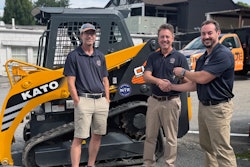

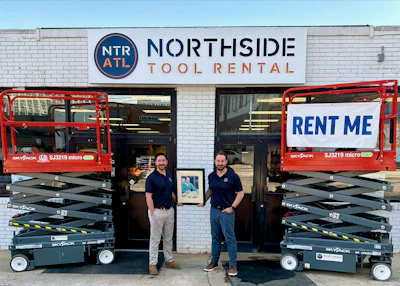
Northside Tool Rental is a family-owned equipment rental business located in Atlanta, Georgia. They brought on Josh Nickell at chief executive officer in 2024. Nickell has been a well-known figure in the equipment rental industry. His decades-long career includes the former vice president of the equipment segment, technology, and workforce development at the American Rental Association.
His family’s rental business, Nickell Rental, was recognized four times by Inc. Magazine as one of the fastest-growing companies in the country. The business was purchased by Sunbelt Rentals in 2018. Rental reconnected with Nickell in June 2026.
Rental: Having been in the equipment rental industry for as long as you have, in as many chapters as you have, do you have any retrospective thoughts about your career?
 Josh NickellNorthside Tool Rental
I worked at Nickell Rental at the time, and I understand a lot more now why they do that. It is an incredible experience to have to step outside of a role like that. To be the new person. to understand what it's like to not know the answers to simple questions as the new person. To understand what it's like to have a boss or bosses. To navigate those things in a different way. Even the simple things.
When I worked at Nickell Rental, my last name was on the sign. I was the CEO of the company. I knew people would do the things I ask them to do just because I asked. I had to be careful not to overstate my confidence in things because they wouldn't push back.
I didn't realize how strong that was until I was on the other side of it. I remember having conversations with peers where the CEO gave an offhanded opinion like, “I kind of like this” or “that might be interesting.” A week later I meet with people person to discuss what we wanted to do, and it was all booked exactly the way that that CEO had said. All they did was give their opinion. I'm like, wait a minute, it was just an opinion - it wasn't a directive.
You don't realize how powerful your words are until somebody else's words are that powerful.
You don't realize how powerful your words are until somebody else's words are that powerful.
You don't realize what it's like to be new. How difficult that is. How to support somebody through that. I definitely hired some people when I was younger who were absolute all-stars, and said, “here, just go, you're amazing.” It was true that they're amazing, but I needed to give them the “start here's.” I needed to give them the best practices. Sometimes, confining that is important, even for an all-star.
It's those experiences that I now look back on, and treasure more than I expected myself to. Sometimes you don't want to learn the hard way, but sometimes having to deal with being the odd person out is critical. Sometimes it's good to put yourself in places where you're uncomfortable to learn those lessons.
Rental: What was it like growing up in the equipment rental industry?
My grandfather was part of Taylor Rental. My dad ended up going Taylor Rental corporate after my grandfather sold his company and then eventually opened Nickell Rental in the 1990s. My dad had gone to college to be a dentist. He was 3 months from being “Dr. Nickell” and quit. He called his father-in-law and said, “Remember that time that you joked around about me working at the rental store with you? I'd like to take you up on that.”
It ended up working out really well for him. Because my dad went through that experience, he really pushed me to find work that you can be passionate about. There was never any pressure to get into the equipment rental space. I can talk about equipment well and I know a fair amount about it but I'm not super handy. I had said for many years I was not going to do it. I was a music major in college at first, [then] a business major, and almost went to be a magician. I did not expect to be an equipment rental guy. I like a challenge. I like complexity. That's something that the rental industry has in droves. It is a very complicated industry. It's a young industry where everything isn't figured out yet.
I believe that most of my job is to find the intersection of what people are passionate about and great at and give them the opportunity to do that every day.
I had an internship in college and worked for the CEO of a brokerage house. They said, “I could I could sell insurance, I could sell hot dogs, I could run equipment. I like running a business. I like the complexity. I just need a good product to do that.” That changed my whole trajectory. I don't have to be able to fix the equipment, I just have to be able to hire great mechanics. I came back into the industry with a different perspective: I can love the business; I can love the complexity; I don't necessarily have to love a particular skid steer or a diesel engine in the same way - I can hire people who love those.
I believe that most of my job is to find the intersection of what people are passionate about and great at and give them the opportunity to do that every day. We try and have check-ins weekly with everybody on my team to ask those questions to understand that. If you're passionate about it but not great at it, we call that a hobby. If you're great at it but not passionate about it, then you're going to burn out. But, if you're passionate about it and good at it, you're going to be better than a lot of people in the room at it. I don't need people who can just carry out my opinion. If I can find things that they're amazing at, give them the opportunity to do that, support, encourage, and build a team around that, then magic happens.
 The Nickell family in Ireland.Josh Nickell
Rental: What are some challenges that are happening at Northside Tool Rental? How are you handling them?
The consistent generational problems like difficulty of finding mechanics and drivers. Blue-collar work is not sexy anymore and less people are getting into that [but] they're critical and important roles. So, how do we find people who have that twinkle in their eyes? That person where you can see that hint that they like to work on equipment, that they like to work around equipment, that they've got a certain passion for that. We can build on that.
Finding those people, cultivating, and keeping those people in such a highly competitive market is a challenge that's not going to be fixed anytime soon. It'll take at least a generation to get enough of those people in the pipeline.
AI can help people skip some steps like an after-hours chatbot, or helping select the right equipment, but at the end of the day AI is very prescriptive.
When you talk about all the fascinating, interesting things happening with technology and AI, you don't see a whole lot of AI replacing mechanics or drivers. They talk about AI maybe driving cars for us but…a truck has to go off-road onto jobsites, load and unload complex things in unique environments. We could have predictive maintenance so that our mechanic time is more efficient but you're still going to have to get somebody hands-on fixing things, especially in a multi-manufacturer, multi-category product environment like we are.
People will continue to be the value proposition. There's so much that people bring to a relationship and that's important to contractors. AI can help people skip some steps like an after-hours chatbot, or helping select the right equipment, but at the end of the day AI is very prescriptive. The thing that it struggles to do is tell you the thing you didn't know to ask about. If you didn't prompt it for that, it doesn't tell you. It doesn't take you down the rabbit hole of the thing that you needed to know that you didn't know that you needed to know and didn't know to ask for.
One of the things we're working on right now is consult. When a customer calls us and says, “I want to run an aerator,” we don't just rent them an aerator; we try and help them get greener grass. I think that's something that is a little bit of the secret sauce that AI can't replace anytime soon. Can we speed up that process using AI to help fill in the contract, make sure that we have the right inventory in the right place, or price things properly? Sure. But that little extra conversation is going to be hard to replace. Leaning into that will help separate the service of different types of companies.
Rental: Northside Tool Rental has grown to now six locations. What’s a new goal for the company?
One of the mistakes that I used to make is not celebrating the wins – not taking a step back and enjoying that moment. You'd get the new branch, you'd get the award, you'd do the thing, and then it'd be like, alright, let's move on to the next thing.
Not only does too much big goal seeking wear people out, but celebrating the wins are the things that you remember when strategizing around a cup of coffee. If you rush that next thing too fast, you miss those small moments - the ones that you really enjoy and remember. Pause, to celebrate the wins.
One of the things that I learned having been acquired and going and working at different companies is that you can't hold too tightly to exactly what the future's going to look like.
On some level, I try and slow myself down and not say, “What's the next 30 stores look like.” It's more about, “How do we do these six stores great, and have a great time doing what we're doing today.” We want to continue to improve the customer experience. We want to continue to utilize new and different technology to serve customers. We want to cultivate a pipeline of people. If that opens the ability to add new markets and new locations, that'd be great and something that I would love to do.
We work hard on focusing on a few things at a time and making habits out of those things. We're relentless about executing those and creating those habits. When we do phone training with our team, which we do every two weeks, we work on one thing with them based on what that person is working on. Not the 20 things that we want to do when we're to the full level of excellence, but one thing. For the next two weeks, we work on that same thing until it becomes a habit.
We follow the same principle with our branch reviews. Our branch reviews are exhaustive, and we all do terribly. If we pass the branch review, then we have the best rental store in the country, because it must check every box. But we don't look at it as a failing grade, it's a highlight of the one to three things that we work on for the next quarter. We do the same thing with the individual team members. When we're doing our quarterly check-in, we're setting goals and breaking everything into small(er) pieces and make habits out of them to achieve excellence in those.
Try to have goals but not necessarily set goals to just set goals.
From there, being open to opportunity. One of the things that I learned having been acquired and going and working at different companies is that you can't hold too tightly to exactly what the future's going to look like. In the Christmas of 2017, I probably could have told you what I was going to do with the rest of my life and 5 days later, it was completely different.
That wasn't what I had planned. That wasn't what I expected to happen, and I was very attached to what I thought was going to happen. I look at it more like there's different paths that you could take on a hike - it's good to have that optionality to see all those different paths but you don't have to choose today. You don't have to know what that exact end goal is. It could be a number of different things. It could be that we have another store in the next three to six months, or not have another store for five years. Both might be okay, depending the situation.
Try to have goals but not necessarily set goals to just set goals. Set achievable goals, be open to opportunities and be ready. What are [your] opportunities? How do [you] prepare for when those opportunities come? How do [you] take advantage of those opportunities?
Some people say prepare yourself for luck - have an idea of what you can do and be ready.
Luck is what happens when preparation meets opportunity.”
—Lucius Annaeus Seneca
Rental: We spoke with you in 2021 and I wanted to revisit one of the questions. How has the rental industry changed since then?
I think in some ways, it doesn't move as fast as I always expect it to move.
Many of the same things that I talked about then are a lot of the same things that we're dealing with now. We were dealing with workforce then. We were dealing with technology. We weren't dealing with AI in the same way, but it was still technology, (but) at the time, it was just digitization of processes. Prior to 2020, about 30 percent of rental companies didn't use a modern rental software, or rental software at all. Now, you'd find that number is really small.
We've come a long way technologically, but now there's so much more that we can do. The rental industry gets to use proven technology, which means old technology, which means the other industries get to figure out how to solve for some of these problems, and then we get to adopt them.
We're going back to a more competitive traditional rental market.
We're watching things like driver assist. A lot of our equipment doesn't even have backup cameras on it, much less driverless features. How do we get the future of autopilots, cruise control, so you can set an excavator to do an excavation for you.
There are some really interesting things for operators at construction companies. They have a hard time finding operators, just like we have a hard time finding mechanics and drivers. Operating equipment is a lot like playing a video game - it's just that it's out on a hot, sticky, uncomfortable jobsite. What if that was sitting in a nice, air-conditioned room, and you could pop virtually into a jobsite and do some work and then set the autopilot to keep digging that trench? Then pop over to another piece of equipment and do the same thing? Now you've taken what feels like a blue-collar job and now you've made it a white-collar job that has an exponential increase in efficiency, because they can manage multiple jobsites and multiple pieces of equipment. I keep waiting for things like that to happen.
We had a real push for technology between 2020 and mid-2021, because everybody everywhere, in every industry, was thinking digitization. But then the equipment rental industry got hit with an equipment shortage. If you could get your hands on an asset — an excavator, a skid loader, a scissor lift — it was going to rent. And it was going to rent at higher utilization than you've ever had before. That lasted from 2021 through 2023 and early 2024. Some of the stuff that would have been an investment in technology, an investment in efficiency, took a little bit of a backseat to “can I get the asset.”
We're going back to a more competitive traditional rental market. Ordering equipment is at more normal levels. Now, we've got AI as a potential distraction, but AI is an efficiency tool. How do we build some of those things in? How do our partners in rental software build those things in?
Rental is an incredibly data-intensive business. I've got data on my equipment. I've got data on the team. I've got data on the trucks. There's so much data that's here and so much that has to be done through intuition or experience that something like AI could do really well or at least simplify.
For example, something that we're thinking about right now is missed rentals. Missed rentals is both really complicated and really simple. Simple in that if you miss enough of the right rentals, then you need to buy another piece of equipment because you'd be able to rent it. It's difficult because there's so many caveats. For something like a log splitter, the first cold weekend in fall every log splitter in the state of Georgia will go out, because everybody has the exact same idea. You might miss 10 log splitter rentals but if you bought one more log splitter, you're not going to get 10 more rentals out of it on that weekend — you can only rent it once to one of those 10 people. It's also very seasonal, so you have to look at the whole year, at how long that it lasts, at the length and term, and if you can win a customer back.
Tracking missed rentals is simple and critical to know when you need to buy new equipment. It’s something that we can do today, but how do we now simplify that so that it can push more toward “watch out for log splitters…if you push those rentals out by…or improving this sales technique….” You might be able to rent 3 more log splitters a year — the data's there. How do we train a system to do it in a way that takes 20 years of intuition to teach a person to do it?
Those are the kinds of things that will help simplify and then push things to us, such as “Consider a new log splitter, and why” or “Consider calling this customer, and why.” I think we're on the verge of some of that simplification.
The other problem that we see sometimes is that the technology folks will look at what we're doing in the equipment rental space and think that it will be easy to “Uberize” or solve this giant technology problem. But then it doesn’t get great adoption, it's a much smaller market than people feel like it is, or it's more complicated than people thought. They don't think about the complexity around it. They don't think about how many of the rental companies that exist today are still small businesses.
In a lot of ways, rental store owners are thinking about the customer experience and making it better for contractors and watching what other industries are doing. Then, once there’s a proven technology, the industry goes, “okay, I'll go do that now.”
Rental: What would your grandfather’s outlook be on today’s equipment rental industry, in regard to AI and digitalization?
In many ways, he would love it. He came from being an accountant at General Electric. He retired and started a rental company. So, he really had that accountant's mindset, which is why he liked rental.
Rental, on many levels, is an accounting problem. How much do I spend on assets? How much do those assets make? How often do they make that money? How do I make that profitable? It's an accounting exercise, especially back then.
Rental, on many levels, is an accounting problem.
He would be fascinated by the data systems and analytics that we have that he could utilize now that hadn't even been created back then. When he was still in the business, financial or dollar utilization wasn't defined. There was no equation for that. Physical utilization wasn't defined. There was no equation for physical utilization.
There were some metrics that we have now that we really depend on that nobody agreed on. There was no standard for. I think he'd find that fascinating.
One of the things that he would look at with a real skeptical eye is what AI can do well and what it can't do well. And him being an accountant at the end of the day, he'd probably test them a couple times. When it got 5 plus 5 wrong, he’d be like, “this thing's junk, I'm not trusting it ever again.” He would have a little bit of a trouble with that accountant's brain balancing the fuzzy things that it can solve really well really quickly with accepting that it's going to be wrong sometimes - but so do the people.
I think he'd be interested. I think he would be skeptical. I think he would be pretty excited to see the data and accounting that's been created in the industry over the decades.
Rental: You’ve mentioned that the rental industry waits for proven technologies. What technology are we using today do you think will influence the future of equipment rental?
We went through an ERP (enterprise resource planning) software transition this year. We wanted to utilize a modern tech stack that improved the employee and customer experience, but also a system that positioned us well for what's next in AI as those opportunities materialize.
One of the things that I've been thinking a lot about is storage is cheap. Collecting data is cheap. So, how do we collect all the data points today, now, so that in the future we can wonder how weather impacts business, how this type of economy, how the Dodge Momentum Index, unemployment rates — how different metrics impact me.
You might say that people do more stuff themselves when interest rates are higher, and they feel a little bit tighter or that when the economy is great and interest rates are low, people may hire someone. Having the data available is going to matter and data is cheap. How do we pick and point out all of these things and make sure that we're collecting all of the data in a really clean flat fashion, so that we've got a historical, starting place.  Self-proclaimed "Dance Dad," Josh Nickell and his daughter Charlotte. Josh Nickell
Rental: Finally, what's something that the rental industry doesn't know about Josh Nickell?
I don't really think that there is much that they don't know. I'm not super shy, and I'm not a closed book. I have a tendency to over-share more than under-share.
There's probably a lot of people that don't know how much I like to spend time with family and travel with family. One of my daughter's is an Irish dancer, another is a drummer, and my wife is a teacher. We do a lot of fun and interesting things around that. I'm an Irish-dance Dad and have a whole decked-out outfit full of plaid that is her school colors.
Share your story with fellow equipment rental businesses. Email us at [email protected]. Looking forward to hearing from you!