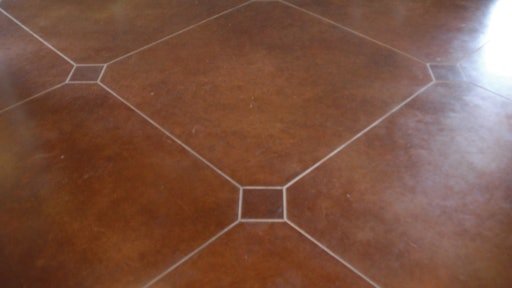
Decorative saw cutting, also referred to as scoring, offers contractors and customers a variety of options for giving concrete aesthetic value. Saw cut patterns can be as general as a geometric grid cut into the floor to very detailed, intricate work such as logos and images. But like any artistic challenge, decorative saw cutting requires the right tools, a commitment to excellence and knowledge of the market and cutting processes.
The tools
Investing in good saw cutting equipment is essential, says Shellie Rigsby of Decorative Construction Supply in Texas. "By using professional equipment it does make you look more professional and does make you stand out. But the most obvious benefit of professional equipment is that it makes it easier to do a good job," she says.
Dexter Phillips, vice president of Musselman and Hall Contractors, Kansas City, Mo., agrees. Good, dedicated equipment can help remove the human error factor of saw cutting, ensuring you can get the best cut possible, he says.
But how do you choose between all the concrete saws on the market? According to Rigsby, different concrete saws play different roles in decorative saw cutting. And the type of pattern you are cutting also dictates the size tools you will need. For example, more detailed designs require smaller, handheld tools. But even the geometric designs may call for different sized saws.
The largest walk-behind saws are used to cut control joints. Because of control joint requirements, these large concrete saws and blades cut a deeper line than typical scoring cuts. For that reason, Rigsby says these saws are not often used for decorative cuts. "Because these cuts are structural in nature they are not about precision; they are about performance," she explains.
Some smaller walk-behind saws can be equipped with blades that create a decorative, beveled look. Other smaller, walk-behind saws are designed specifically for decorative saw cutting with these types of blades already installed.
One option is the Husqvarna model 150D, says Andrew Nevener, senior territory and national training manager for Husqvarna. "The 150D is strictly used for cutting decorative joints," Nevener says. The 150D's blade cuts a beveled edge into existing saw cuts. "It's a user-friendly saw, too. It's got an outer rim of the blade to guide the saw and two brass bushings with guide wheels as well," he adds.
Phillips uses Husqvarna 150D as well as its model 150 walk-behind saw with Husqvarna's ProEdge beveled blades, which go through existing saw cuts and create a beveled look on the cuts' edges. "The majority of the decorative saw cuts we do are beveled saw cuts for decorative reasons as well as to protect the joints from raveling," he says.
Like Phillips, Concrete Illusion Inc.'s owner Joe Glogowski uses a small, walk-behind saw for decorative cutting - the Super Compact Cobra from Engrave-A-Crete. But Glogowski prefers using this saw for cutting circular patterns rather than straight lines.
The next smaller sized saws contractors can use are circular saws, Rigsby says. When using a circular saw, however, there are no guides to keep the cut straight, so Rigsby says contractors need to use a straight edge to keep the saw moving and cutting in a straight line.
Another handheld saw option is one designed specifically for decorative concrete scoring. There are multiple options available on the market, and Rigsby suggests testing the waters before choosing. "Go to different manufacturer workshops or training facilities where you can try out saws and get a feel for them," she says.
Other features to look for and questions Rigsby suggests asking include: does the saw offer the precision features you need for cutting; is it made of a good, heavy metal so the saw will travel well along the floor; do the wheels move easily; and does the saw have support material if you need help?
Another saw Phillips uses is the Mongoose from Engrave-A-Crete. He uses this saw for both radial and straight line cuts. But the Mongoose is just one option of saws designed specifically for decorative cutting.
Another option is the Sawtec Dekrasaw from Blastrac. According to Blastrac's Inside Sales and National Training Manager Jonn Rippman, "The Dekrasaw is a good saw for any novice. It has adjustable guides for different operator positions and you can make all the cutting depth adjustments," he says.
These adjustable guides are a major benefit of professional decorative cutting saws. Unlike a common circular saw, handheld saws designed specifically for decorative cuts usually have wheels or built-in guides to help contractors keep their lines straight and decrease the chance of human error. The Dekrasaw, Husqvarna 150D and the Mongoose all have wheels or pins to guide the contractor during sawing.
A smaller option still is an angle grinder. "Cutting from an angle grinder is more advanced and an artistic technique," Rigsby says. "It's not what I'd want an entry level person to use for cutting straight lines because they will have a difficult time accomplishing that."
Phillips used to use angle grinders for saw cutting but has since replaced them with professional decorative handheld saws. "We don't use them anymore because with the grinder's guard it's hard to see what you are doing, you don't have any attachments to get a perfect circle cut and they typically don't have good methods for dust collection," he says.
Glogowski, on the other hand, does use an angle grinder, but only for touch ups or small freehand work. "The angle grinder is used in a small proximity. You're not going to run it 20 feet across a driveway because you could wobble," he says. "It's just not practical for long cuts." For those longer lines Glogowski uses his Mongoose.
Because precision cutting is so important in this process, Rigsby points out that no matter what saw a contractor decides to use, small blades are a must. "The saws that get you down to a 7¼-inch blade or smaller are going to do a much better job for precision," she says. "The smaller blades are better for intricate designs; they can turn better and create a smoother line."
Some geometric saw cut patterns will require contractors to cut circles into the concrete. For this, some contractors may prefer to use chalk lines and freehand these circles. Other saws offer an attachment to make circular cutting easier. For example, the Dekrasaw attaches to a pole and weighted base to turn circular cutting into a one-person job. Engrave-A-Crete's Mongoose saw also has a center pivot attachment for cutting circles.
Whether decorative saw cutting is being done indoors or outdoors, one essential piece of equipment all saws need is a dust control mechanism. Most professional equipment will have something for dust control, Rigsby says. And if it doesn't, you should keep looking, she adds.
The Dekrasaw has a dust shroud built around the blade, Rippman says. A vacuum can also be hooked up to the saw. The shroud contains the dust and debris and then the vacuum sucks it up. "Concrete dust is an extremely fine particulate so make sure you have a vacuum with at least 175 cfm and 70 inches of static lift," Rippman says.
The Husqvarna models also have a blade block, says Nevener. This enclosure collects the majority of the dust, and what isn't caught in the blade block can be sucked up by attaching a shopvac or larger vacuum to the saw. Glogowski and Phillips both attach dust extraction vacuums to their Mongoose saws to keep dust under control.
Dust masks and safety goggles are added protection that all contractors should wear, especially when cutting indoors.
The process
Before any cuts are made, a contractor must first define the design and finalize the layout, Rigsby says. She then suggests chalking the design on the concrete. Avoid spraying on chalk lines, though, because if the concrete is going to be stained the sprayed chalk line may show through the stain, Rigsby points out.
As with all concrete, control joints typically must be cut into the concrete to control cracking. When it comes to decorative saw cut patterns, contractors may run into problems when control joints interrupt the desired saw cut design.
The most desirable solution to this problem is to incorporate the control joints into the pattern. "Look at the placement of the control joints and ask 'Can I adjust my design so I incorporate the control joints into the design?' If I can, I do," Rigsby says. This is best done during the planning stages of the design.
"A lot of times, with control joints I use them as a separating point in the design," Glogowski says. "On joints too big to look like realistic tile lines I use those as a border and frame the design off of that."
If incorporating the control joints is not an option a microtopping can be used to fill the joint. The pattern can then be cut and the control joint can be modified to fit into the design.
Phillips has another solution. "If we're doing radius cuts and decorative cuts, a lot of times we will bevel the decorative joints to make them stand out and leave just a narrow cut for the control joints," he says. Another strategy he uses is to stain up to decorative joints and stain over the control joints. "People look at the color transition and the saw cut and might not even notice the control joint," he adds.
When cutting patterns into new concrete, Rigsby says a softer slab is easier to cut. However, there are concerns with working on softer concrete. "The disadvantage is the earlier you get on it the more jagged your edges are going to be because that soft surface tends to release a little too easily," she says.
"If you get on it too soon you're likely to leave foot prints in the slab. You also have to be careful early on that the saw does not drag across the surface and leave marks," Rigsby adds. She suggests waiting a minimum of three days before starting any decorative saw cuts.
Saw cutting patterns on existing concrete requires a little more prep work. At the very minimum, the concrete needs to be cleaned before starting any cuts. And any needed repairs should be made. A dirty, uneven or cracked floor may make it harder for the saw to cut smoothly, which could result in imperfect cuts, Rigsby says.
Contractors who will be staining the concrete they are cutting have the option of staining concrete before or after making cuts, and each option has its pros and cons.
If a contractor or customer wants the saw cut to stand out from the concrete and look like a grouted joint, staining before cutting achieves this look. Cutting into the concrete reveals the gray, unstained concrete below the stained surface. But this look can also be achieved when cutting first, Phillips says. "We'll saw cut it and then stick cardboard into the saw cuts. It's basically a paint shield. We can stain a color on one side of the saw cut and another on the other side and it won't seep into the cut or bleed over to the other color," Phillips says.
But, if staining first, a contractor must know exactly where the decorative cuts are going to be, especially if there is going to be specific color separation. "I can put down the color where I want it to be and then use the saw cut to give a real definite distinction on where those colors are going to be," Glogowski says.
If a contractor chooses to stain after cutting, the cuts are all in place and the contractor can focus on the staining process, especially if the saw cut pattern calls for areas of different color stains. However, if the stain is going to be applied over all the concrete, cuts included, the decorative cuts won't stand out as much, Glogowski points out.
Whether cutting on new or existing concrete, if the concrete is going to be stained after sawing it is important to make sure it is thoroughly cleaned before and after sawing. If not properly cleaned, the dirt and dust left on the slab could affect the stain.
No matter what decorative pattern a contractor is cutting, contractors need to make sure they are focused on the job at hand. Rigsby says to go slow when cutting. Glogowski adds contractors need to think about the cuts and know where each cut should go and why. "It's the old ?measure twice, cut once,'"he says. Another helpful hint is to write your entire process down before starting, Glogowski adds. Careful planning and execution are essential.
"Professional standards dictate accuracy in your cutting. In professional decorative concrete cutting, straight is the standard, not the goal," Rigsby says. "There is a slight tolerance for error, but it's really very slight."