Changes in mix temperatures and designs, as well as restrictions placed on paving windows, are presenting contractors with a growing list of challenges -- and opportunities -- on asphalt paving projects. Following is a look at three recent paving projects, including the mixes used and the effects on the equipment and techniques applied.
WMA is the cure for hospital lot
Pioneer Paving & Grading, Albuquerque, NM, had an opportunity to bid a large project for Christus St. Vincent Regional Medical Center in Santa Fe, NM. The project included pulverizing and paving of two roads on the hospital grounds, construction of a new parking lot and repair and overlay of nine others.
Don Rooney, Pioneer's owner, approached the project's head engineer with a proposal to use warm-mix asphalt (WMA) for the 3,276-sq.-yd. medical/dental parking lot. "He liked the idea right away, but was concerned about the cost," Rooney says. WMA can cost up to $2 per ton more than traditional hot mix.
Rooney worked out a one-time deal with LaFarge Asphalt, the local hot-mix supplier. "They wanted to get WMA out in the market, and get it down so more people know about it and could come and take a look at it," he says.
WMA is produced at temperatures generally between 50° F and 100° F below that of most hot mix. It requires foaming of the asphalt cement using water or additives during mix production. This foaming reduces the viscosity of the asphalt cement (AC), enabling the aggregate to be coated at lower temperatures.
"Because of the flowability and the way you get density, you can actually pave in cooler weather and extend your season," says Rooney. The mix can also be transported longer distances from the plant.
On the day of the project, Rooney called the plant 60 miles away and ordered 364 tons of WMA for the 2-in. overlay. The WMA was at 275° F at the plant, 250° F coming out of the truck at the jobsite and between 220°F and 230° F as it was laid.
"With the screed heated, we backed in the first truck and unloaded. After the first pull, I asked the crew if they noticed a difference," Rooney says. "They noticed right away that it was easier to shovel and much easier to rake."
The WMA also proved easier on the paver. "Flowability through the paver seemed to be easier and the mix coming through the screed laid a nice mat," Rooney says. "We started at 10 a.m. and by about 1:30 p.m., we had more than 300 tons down. The roller could hardly keep up with the paver."
Because WMA technology reduces mix viscosity, it also reduces the challenges of compaction. "You have more time to get proper density because the temperature isn't as high at the beginning, so it doesn't drop off as quickly," Rooney points out.
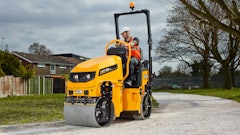
Rollers were watered similar to hot-mix asphalt, then a vibratory roller was used for one pass in the breakdown phase. "When it cools enough so you can almost put your hand on it, we hit it with the pneumatic roller, then finished with the steel roller with no vibration. The crew could roll faster than usual and rolling wasn't as much of a chore," says Rooney. "And roller marks seemed to roll out easier. If the pneumatic didn't take them out, the static steel would."
On the third pull, the crew had to wait before hitting it with the roller, but had no trouble compacting the mat. "It was about 195° F when we finally got the roller on it, and it rolled in well and the joints just disappeared," says Rooney. "Then we back-rolled to a smooth finish."
Plate compactors were also used on the job and didn't operate much differently than on a regular mix. "You could wait a little longer to get on it," says Rooney, "and it still smoothed right out."
County uses WMA to attack thermal cracking
Crow Wing County in Minnesota is in the second year of testing WMA to ameliorate thermal cracking and improve binder durability. Following a successful test project in late 2008, a second test was conducted on County Road 2 in 2009. It consisted of placement of two layers of bituminous mix containing a warm mix additive and 30% reclaimed asphalt pavement (RAP).
The base lift was compacted to 2 in. deep and was followed by a 1 1/2-in. friction course. The road was paved in two 14-ft. passes, resulting in a 12-ft. driving lane with 2-ft. paved shoulder each way, flanked by 4-ft. gravel shoulders. A total of 20,000 tons of WMA was placed on the just-under five-mile-long project.
For the project, the initial cost of the WMA PG 58-28 was $3 per ton less than the traditional HMA PG 58-34 binder. More data and time are required for long-term performance answers, but the initial indicators are positive.
The WMA test also permitted the county to boost the percentage of RAP used in the mix. RAP that had been removed from the pavement the year earlier was screened and crushed, and stockpiled during the winter prior to reuse in the warm mix.
"In Minnesota, the type of binder determines the maximum RAP that can be used, and because we are using PG 58-28 oil -- non-polymer modified -- we can use up to 30% RAP," says Wayne Dosh, senior engineering technician, Crow Wing County Highway Department. "If it were polymer modified, we would be restricted to 20% RAP. That was one of the benefits of using the warm-mix additive, as we were able to bump up the RAP another 10%, with further savings."
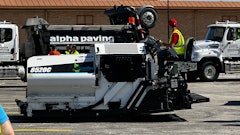
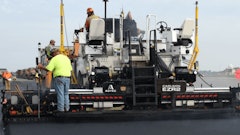
Warm mix was being delivered by bottom-dump trailers from a portable plant minutes away, and placed by an Ingersoll-Rand/Blaw-Knox PF-3200 paver. The paver was fed by a Cedarapids windrow elevator.
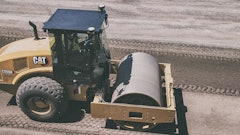
Breakdown rolling was done by a Caterpillar CB-534D vibratory steel tandem roller using three passes. A Caterpillar PS-360B pneumatic roller made seven passes in the intermediate spot. And the finish roller -- an Ingersoll-Rand DD-110HF articulated double-drum compactor -- made five passes in static mode.
Because WMA is not as dependent as HMA on heat to provide the workability needed to achieve density, the county may be able to extend its paving season, which is limited in the northern tier of states.
"From what I've seen, WMA will be an excellent way to extend the paving season," Dosh says. "We typically are not supposed to place asphalt after September 15, in the northern part of the state. And due to weight restrictions following the winter thaw, we can't start hauling heavy loads like asphalt from the middle to the end of May, depending on the kind of winter we've had. If there's been a long, cold winter, it might be the first of June before we can pave. [With WMA}, we are looking at a paving season of 120 days -- longer if there is a warm fall."
Greenville Paving puts shingles in the mix
Just over two years ago, James Ross, asphalt/quality control manager at Greenville Paving & Contracting Inc., Greenville, NC, returned from a recycling conference inspired by the information presented on recycled asphalt shingles (RAS). "At the time, AC binder prices were in the $700/ton range," he notes. "How do we save money and still put out a quality product? I felt RAS was the answer."
Greenville Paving & Contracting convinced the North Carolina Department of Transportation (NCDOT) to test the RAS mix on the US-258 resurfacing project, which consisted of nine miles of widening, resurfacing and shoulder reconstruction on two sections. Mixes used included 7,311 tons of B25.0B (base), 23,347 tons of I-19.0B (binder) and 13,721 ton of S9.5B (surface). Only the S9.5B surface mix had the tear-off shingles in its design.
The base and binder mixes were placed in May and June. Provisional approval was given on the tear-off shingle and RAP blend S9.5B surface mix design in late July. By mid-August, approximately 8,000 tons of S9.5B surface mix with recycled tear-off shingles and RAP was placed. The mat was laid at a rate of 168 lbs. per sq. yd. at 1 1/2 in. Equipment used included a Caterpillar AD1000 paver and two 634D rollers, plus a Roadtec material transfer vehicle.
Ross says they have seen improvements in items such as rutting and volumetric properties over traditional mixes. Another important improvement is less compactive effort.
"Density compaction on a RS9.5B mix is 92% per NCDOT specifications," says Justin Ross, certified roadway and density technician for Greenville Paving. "While using the mix that contained the tear-off shingles, product densities were running on average 93.2% with less compaction effort than the same mix type without the shingles."
Another benefit is the reduction in the amount of AC that must be added to the mix. Because they are used and worn, tear-off shingles tend to have more viable AC in them.
"Liquid binder is the most expensive component in a mix," says Ross. "As contractors, we have to be competitive. We have to be the low bidder to get the job, so you have to cut costs but give the same quality mix."
Ross is very optimistic about the future of RAS in mix designs. "We've had a real positive reaction from the DOT on the US-258 project. A RAS mix is comparable to any other mix, and in some cases it's even better," he says. "There are 11 million tons of asphalt shingle waste generated every year. Using RAS will reduce that waste -- who wouldn't think that's a good idea?"