
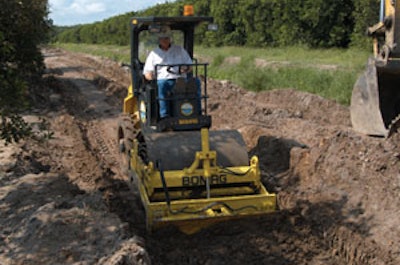
On the surface, soil compaction is pretty straightforward — a vibrating drum agitates soil particles until less air exists between them, creating a more stable structure. The machines that perform this task seem rather simple, as well. However, today's manufacturers are working hard to bring you models that are more productive, simpler to maintain and easier to operate.
According to Sakai America, vibratory soil compactor brands are available in a range of drum widths from 39 to 85 in. Frequency ratings typically range from 1,500 to 2,400 vpm, while the centrifugal force generated can range up to as much as 90,000 lbs.
The most popular size class of soil compactor tends to be a single-drum unit with an 84-in. drum. However, there are various features you should consider before choosing a size and configuration for your fleet. There are a number of specifications to compare, including operating weight, rolling width, drum amplitude, dynamic force and pli (pounds per linear inch) rating. But you should also take into account some of the latest technologies that can set certain machines apart from others.
Doing it smarter
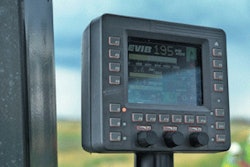
Many compaction equipment manufacturers have introduced automatic vibration control systems to help facilitate the most productive and efficient compaction performance. These systems work by utilizing a directed exciter mechanism so the roller automatically adjusts the output energy of the drum to optimize compaction. This allows the operator to know when maximum density has been achieved, eliminating unnecessary passes and over compaction of the soil.
While this technology increases the acquisition cost of the machine, manufacturers argue that it pays for itself by increasing productivity. Steve Wilson, manager marketing services/product manager at Bomag Americas Inc., notes that automatic vibration control technology offers several advantages. "It minimizes the time needed to achieve maximum results, there is no over compaction and it allows for proof rolling to find weak spots," he explains.
Machine control systems for enhanced traction and gradeability are another area of advancement. According to Wilson, systems such as these monitor the slip potential between the drum and rear rubber tires, then automatically adjust the hydraulic flow to deliver optimum performance for operation on severe grades or difficult traction conditions and to prevent the roller from stalling or "digging" itself into the material.
Enhanced climbing capability
Because soil compactors are being asked to perform at steeper grades and in challenging underfoot conditions, many suppliers have incorporated specialized traction control systems designed to improve the gripping ability of these machines.
For example, Ingersoll Rand has incorporated the Ultra-Grade traction control system on many of its mid-size and larger models. The Ultra-Grade system is designed to help ensure the compactor's ability to climb and maneuver in tough soil conditions. Heavy-duty axles with no-spin differential further enhance traction and climbing capabilities.
Sakai America has come up with an even more unique solution in the form of its track-driven CV550 soil compactor. The CV550's track drive system incorporates a traction valve that regulates power between the drum drive and track drive. A balanced weight distribution and no-spin differential further enhance climbing capability. Such features combine to deliver the traction and gradeability to climb slopes up to 45° while compacting.
Lower fuel costs
Everyone wants their equipment to be more economical, particularly the larger units that cost a lot to fuel. To this end, some soil compactor manufacturers are incorporating features specially designed to optimize fuel consumption.
For example, Bomag has incorporated an Eco-Mode on its Dash 4 Series. These machines offer three throttle positions, including one for idle, one for maximum rpm and another for Eco-Mode. "The engine senses load demand and adjusts the engine rpm to meet the needs of that demand," explains Wilson. "As a result, the engine consumes less fuel and there are fewer emissions and noise."
Like automatic vibration control systems, Eco-Mode adds to the cost of the machine, but the fuel savings helps offset the increase. "It lowers the cost of ownership while the machine still performs at top productivity," Wilson says.
Other manufacturers offer similar systems. The concept comes from Europe, where the cost of fuel tends to be much higher than it is in the United States.
Shell kits and blades
One feature that enhances compactor versatility is shell kits for converting smooth drums into padfoot and vice versa. Particularly desirable in areas with mixed soils, shell kits usually take about an hour to install and are able to improve the utilization of a single machine, thereby speeding your return on investment.
Other features that are becoming more popular include the two-way strike-off blade, along with options such as an angle blade, which can slew like a snowplow, and a tilting blade that rotates left to right and works on angled slopes. "These are useful because they help the soil compactor act in place of a skid steer or grader," says Wilson. "They really increase versatility."
Creature comforts
Many soil compactors today are offering more comfort features, as well. Units are available with cabins to shield operators from the elements, and some even offer heat and air conditioning, as well as glass with UV filters. What's more, manufacturers are striving to improve creature comforts such as the operator's seat, making the suspension more forgiving, and arranging the position of controls to make them easier and more comfortable to reach.
"These features reduce fatigue and improve safety," says Wilson. "The initial cost is more, but it's still not that much when you consider how much more productive the operator can be."
Dale Starry, manager of industry and governmental relations for Ingersoll Rand, agrees that ergonomic features are becoming the standard in ride-on compaction equipment. "There is more attention being paid to complying with ISO and SAE ergonomic standards," he says. "Machines offer better isolation of the operator platform, better placement of operator seating and controls, reduced noise, better all-around visibility of the work zone with one meter by one meter visibility to the front and the rear, and available enclosed cabins with HVAC systems."
Ease of service
According to Starry, productivity and uptime of soil compactors are being improved via extended engine service intervals, maintenance-free batteries and more. The incorporation of sight gauges on fluid reservoirs, grouped hydraulic test ports and extended-life fluids such as engine coolant go a long way toward making service and maintenance easier and less time consuming.
Other features assisting in this movement, says Starry, include tilting decks or removable panels for easier and faster access to major hydraulic components; more use of bolt-on rather than welded assemblies and components; and color-coded maintenance decals with instructions in multiple languages or in international symbols.
Is it worth it?
When equipment advances technologically, it's often difficult to justify the increase in cost that inevitably goes along with it. But as the manufacturers in this article point out, many of the advancements being seen on today's soil compactors increase productivity to the point that they arguably pay for themselves quickly. Even the creature comforts can be cost effective because they increase the potential resale value down the road.