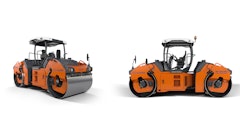
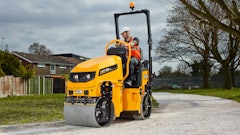
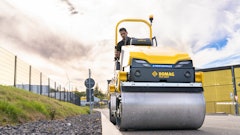
Both reversible plates and trench rollers can compact soil in confined spaces. When considering which type of compactor to use, the type of soil and the size of the job need to be taken into account. Here are some more things to consider when contemplating selecting these soil machines for your inventory.
Down & dirty
All vibratory plates, not just reversibles, are suited to granular soils, such as sand or gravel, whereas cohesive clay or silt-type soils are best compacted by a trench roller or rammer.
"To compact granular material, you need vibratory force," says Peter Price, manager of product and training for Bomag Americas Inc. "With cohesive material you need impact force. When looked at under a microscope, cohesive material is made up of very small pancake-shaped particles. In between those pieces will be either air or water, so what you have to do is use impact force to squeeze out the water and air.
"With granular material, what you have to do is excite the particles via vibratory frequency so they start moving in all different directions," he continues. "The frictional force between the particles is then reduced and the particles settle under their own weight."
This means if operators are working with smaller aggregate sizes (one inch and smaller), they need a higher frequency to move the material and achieve compaction. The rule of thumb tends to be that reversible plates have high frequency vibration, but low amplitude (the height at which the machine "jumps" off the ground); while rollers have low frequency vibration and high amplitude.
"Rollers, with their low frequencies and high amplitudes, are better in cohesive soils because they tend to push the soil particles together — like kneading bread — forcing molecules together and squeezing air out," says Frank Wenzel, vice president of engineering at Stone Construction Equipment. "Rollers won't work on granular materials as well, but plates, with their high frequencies and low amplitudes, vibrate the granular material better to compact it."
When equipped with polygonal drums with small pads, like Bomag Americas offers, trench rollers can be used in granular soils. "But," says Price, "they're not as productive in granular soils as reversible plates. Ninety-nine percent of the time trench rollers are used, it will be in cohesive soils."
On the other hand, some larger reversible plates, with triple shafts, can be used on cohesive soils. This will be discussed later.
Obviously, it's important to consider the type of soil your customers will be working in when deciding if a reversible plate or a trench roller is the answer. In areas of the country where the soil is predominantly sandy, such as Florida, reversible plates are more commonly used. However, in an area with more clay-like soil, such as Georgia, trench rollers will be seen on more jobsites.
If the job fits
Along with soil type, the size of the job needs to be taken into account when considering reversible plates and trench rollers.
Mickey Benedict, product manager - soil with Ingersoll-Rand, notes that it's common sense when choosing which machine to use. "It depends on the size of the job," he says. "If you have a small narrow trench, a rammer or small trench roller would suffice. As the job gets bigger, the machine gets bigger."
The name "trench roller" tends to pigeon hole these units. Trench rollers vary in width, from 24 inches up to 34 inches, depending on the manufacturer. "The narrower machines can be used for burying utilities. As the machines get bigger, the can be found doing foundation work, working around curbs and walls and for doing site prep," says Benedict.
Reversible plate compactors are also easy to maneuver in tight, confined areas such as trenches, along walls and around pipes. They can also compact thick lifts, says Udo Boersch, president of Ammann America Inc.
"If you have a pipeline trench with a really thick lift, then you'll want a reversible plate to do the job," he explains.
Some of the larger reversible plates can successfully compact lifts of material up to 30 inches thick.
"Due to the reversible plate's size and higher centrifugal force, they can compact deeper lifts than conventional forward plates," says Boersch.
Productivity points
The ability of reversibles to impart more energy into the ground and therefore compact thicker layers of materials is inherent to the plate design.
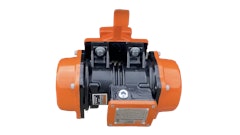
A forward directional plate has one exciter shaft with an eccentric weight that generates the centrifugal force to move the plate forward and also creates the vibration to the ground. With a reversible plate, there are two exciter shafts, each with an eccentric weight. They are timed in such a fashion that you can turn the shafts in the opposite direction and the same force that was carrying the plate forward now carries it in reverse.
Because reversible plates have two shafts and therefore two weights, they impart more energy into the ground than forward plates with only one shaft. As mentioned earlier, some manufacturers offer reversible plates with three shafts, designed to get more power and more compaction force out of the machine. Not only does this allow the units to pound through thicker lifts, but it allows the plates to be used in applications with cohesive soils.
"The triple shaft exciter system causes the plate to avoid erratic movements, allowing smooth travel even through heavy, cohesive soil," says Boersch. "The plate can climb obstacles and backfill with high moisture content without the usual suction effect, which can cause a plate to come to a complete standstill."
While trench rollers work basically the same way as reversible plates, they usually only have one exciter shaft in the center of the machine to create the vibratory force. Unlike reversible plates, which use the centrifugal force created to propel the machine, trench rollers usually have a separate drive system, which can be mechanically or hydrostatically driven.
Trench rollers also have the ability to turn in their own spot, says Benedict with Ingersoll-Rand. "A trench roller's maneuverability is excellent," he says. "Plates are sometimes harder to 'steer,' so they can be hard on the operator who has to 'push' the unit around.Because rollers have a separate drive system, they're easier to move."
And Wenzel with Stone says trench rollers can compact some pretty thick lifts themselves. "Most plates are only effective on an 8-inch lift," he says. "But most rollers can tackle 18-inch lifts."
Between reversible plates and trench rollers, the speed of the units is equitable. But when it comes to gradeability, trench rollers tend to win hands down, says Wenzel.
"Trench rollers definitely have the advantage when it comes to navigating grades," he says. "Some plates can hit the ground as hard as a trench roller, but they can't climb steep slopes like trench roller can."
Safety factors
There are several features on both reversible plates and trench compactors geared toward safe operation. Back-up belly bars or anti-crush bars help prevent operators from getting run over if they inadvertently back into a trench wall during operation.
Deadman controls or emergency stop buttons allow for quick stopping of machine operation if the operator runs into trouble.
One of the biggest developments to improve the operational safety of trench compactors has to do with the controls, mainly remote controls that keep operators in a safe position outside the trench. There are several types of controls available, including umbilical cord, infrared and radio frequency.
"By removing operators from the trench, safety hazards from trench collapse or falling objects are basically eliminated," says Price with Bomag.
Some manufacturers have added the remote control option to some of their larger reversible plates. Remote control is still a maturing technology when it comes to reversible plates, and right now it seems like it's more popular in Europe than in the States.
"You see the popularity of larger plates with remote controls in some pockets of the States," says Price. "You'll see it in some southern states, parts of California and Alaska and in some areas in Canada. It's mainly in regions where there are a lot of cave-ins."
When it comes to selecting which types of compaction equipment you should have in your rental inventory, it's all about knowing your market and the types of soils your customers will be dealing with, say sources.
"Who are your customers? What are they going to be doing? What type of soil is in your area? These are the questions you need to ask," says Benedict with Ingersoll-Rand. "Contractors want to rent the most productive machine they can without spending a lot. Most likely, they'll know what they need. So you're best bet is to talk to the contractors and find out what you need to have in inventory to best meet their needs."
Vibratory compaction: The science behind it
You might have various types of light vibratory compaction equipment in your rental inventory. But do you know what this equipment is actually doing? Here from Compaction and Paving, Theory and Practice from Dynapac, is a glimpse at what is happening.
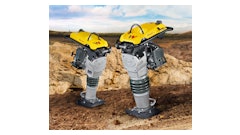
Vibratory compaction equipment makes use of a vibrating mechanism, which normally consists of a rotating eccentric weight.
Vibratory compactors use a combination of dynamic and static loads. They deliver a rapid succession of impacts to the underlying surface from where the vibrations, or pressure waves, are transmitted through the material to set the particles in motion. This virtually eliminates the internal friction, and facilitates the rearrangement of the particles into positions that result in as low a void space and as high a density as possible. The increase in the number of contact points between the particles leads to high stability and strength.
Owing to the cohesive forces between particles in most soils, the vibratory force must be combined with loads of a certain magnitude to overcome the cohesion. On sand and gravel, which have a low apparent cohesion, comparatively light loads are sufficient. This means that light rollers and plate compactors can be used with good effect.
Clay and other cohesive materials require heavier loads and therefore require the use of comparatively heavy compaction equipment. However, these types of material can only be compacted in relatively thin layers.
Initially vibratory compaction was only considered suitable for rock fill, sand and gravel, but as vibratory techniques developed, the method has come to be used for clay soils and successively for asphalt compaction, too.