According to the National Association of Home Builders (NHAB), new housing starts are only expected to increase by a paltry 1.0% in 2026. Considering this rather bleak outlook, in a marketplace with stubbornly high mortgage rates, a tightened lending environment, and the undeniable issue of affordability, the building of master-planned communities (MPCs) continues unabated in the U.S. Though these centralized and carefully crafted neighborhoods continue to outperform the broader housing market, builders have recently become creative, more akin to that of developers, in the ongoing attempt to attract buyer interest.
Just how creative? Enter the fascinating and brave new world of community-based amenities.
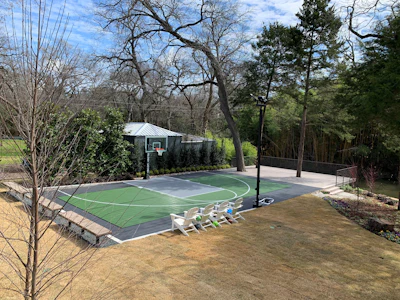
Ask your average home buyer what amenities they’d prefer to have access to in a communal living arrangement, and the most common answer remains swimming pools or splash parks. But don’t sleep on the newest upstart alternative – athletic sport courts. In a direct head-to-head comparison, pool installations still outmatch sport courts by a three-to-one factor, but the ever-increasing appeal of multi-use athletic facilities is happening on a scale that can’t be denied.
In a highly competitive housing market, these and other resort-style amenities are drawing more and more interest from highly discerning homebuyers. Examples such as centralized clubhouses, dog parks, hiking trails, fitness centers and putting ranges are being positioned as key differentiators in what many real estate agents are now referring to as “emotional accelerators.”
To belie the point, some recent studies have revealed that master-planned communities with convenient proximity to amenities can help homes sell as much as 8.2% faster and even boost overall property values as much as 20%. For builders, it appears as if the time has come to take advantage of this appeal, in a highly competitive marketplace striving to provide buyers with a high-quality living experience. Let’s review the stakes…
1. The Current Outlook for MPCs
According to industry experts, the overall market may have cooled somewhat, with home sales in master-planned communities sagging 6-7% year-over-year. But this has had little effect on the pent-up demand from would-be home buyers, anxiously awaiting their opportunity to live in density-optimized areas that offer attractive amenities. One can only imagine what would happen were mortgage rates to drop down a few points in the short term. Among other notable trends reveal builders are pivoting to smaller lot sizes, houses with slightly less square footage and a shift placing them into more of a developer role. And that brings us right back to how amenities have become a driving force in the current marketplace.
2. No Longer Reserved for Senior Living Crowd
When it comes to master-planned communities, the days of playing canasta, shuffleboard, and traipsing down to the clubhouse restaurant for the 4:30 p.m. early bird dinner special are no longer reserved for the 55 and over crowd. In geographic hotspots like Florida and Texas, MPCs are springing up everywhere you look. In some cases, the only factor that slows this growth is a lack of skilled and unskilled labor to drive the nails and saw the boards. And according to one study from John Burns Research & Consulting, demographics of the current buyer persona are shifting to younger, entry-level families – many of course who have kids. And these parents know their children desperately need access to engaging amenities – beyond mere pools and parks - to keep them both amused, occupied and satisfied. And builders hear them loud and clear.
3. Sport Courts Craze Takes Hold
Builders have rightfully taken note of their discerning customers, understanding that buyers want more than just square footage and countertop upgrades. They also desire both an emotional and social return on their investment, largely accomplished through attractive amenities such as multi-use sport courts. Using this one amenity as a prime example, let’s take a look at some numbers. No doubt driven largely in part to the current Pickleball Craze (currently the fastest-growing sport in America, with over 20 million players), people want access to multi-use sport courts where they can also play basketball, tennis and futsal – a hybrid five-on-five soccer variant played on a hard surface with a smaller, low-bouncing ball. What can recent data tell us? New athletic court construction has skyrocketed, with an estimated 14,000 new facilities installed in 2024 alone. According to Pickleheads, a leading Pickleball fan site, not only are there not enough courts to meet the current demand, but it’ll also take some $855 million in new builds over the next decade just to get us there. Thankfully, sport courts are much more economically feasible compared to swimming pool installations, to say nothing of the drastically lower upkeep and ongoing maintenance needs involved.
Taking everything into account, one can surmise that athletic sport courts are indeed having their moment in the sun as an increasingly preferred amenity. Which dovetails nicely with the steady proliferation of master-planned communities looking to add the most attractive communal features as centralized gathering places.
Thanks to this increasing consumer demand for add-ons, featured attractions, and countless other “emotional accelerators” designed to enhance our communal living spaces, it’s clearly a great time to be in the business of selling customized amenities.