Jean-Claude Fayat On Digitalization, Trade, And The Future Of Road Building
The president of FAYAT Group sat down with Asphalt Contractor at CONEXPO-CON/AGG 2026 to talk technology adoption, the economics of sustainability, tariff pressure, and what makes a wine truly great.
You don't often get face time with one the most influential people, not only in the asphalt industry, but in international construction as a whole. So when the opportunity comes, you take it. As I walked the FAYAT Group's massive booth footprint at CONEXPO-CON/AGG 2026, the scale of what Jean-Claude Fayat has built sunk in. BOMAG. Dynapac. Mecalac. Marini. Ermont. LeeBoy. ADM. The Bordeaux-born president of FAYAT Group oversees a privately held empire that generates €5.9 billion in annual revenue across 170 countries, and he has spent the last two years doubling down on North America with a speed that has the industry paying close attention.
FAYAT Group completed its acquisition of LeeBoy, the Lincolnton, North Carolina-based manufacturer of commercial asphalt pavers, in September 2025 for approximately $290 million. Months before that, the group took a controlling interest in Asphalt Drum Mixers (ADM), the Huntertown, Indiana-based portable and relocatable plant manufacturer. Those moves followed a $13.7 million investment in a new 100,000-square-foot parts distribution center in Ridgeway, South Carolina. All of that points toward a group that has decided its’ investments in the North American market are an essential part of its strategy.
FAYAT Group
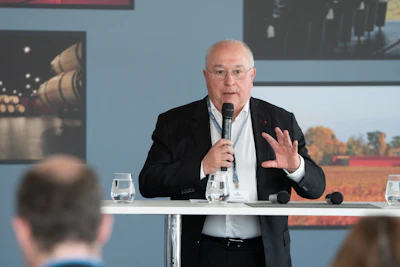
Fayat sat down with Asphalt Contractor on the show floor. What followed was a candid, wide-ranging conversation about what's keeping the industry from fully embracing new technologies, why he believes sustainability's timeline is being bent but not broken by politics, how contractors can survive a challenging cost environment, and why the era of single-country global dominance could be over.
Technology Transition: Adoption vs. Resistance
The road construction equipment market sits at a crossroads. The global machine control system sector alone is projected to reach $8.93 billion by 2030 — driven by GPS-integrated 3D machine guidance, telematics, and fleet connectivity that operators can access through an in-cab interface. But these aren’t the only types of emerging technologies in roadbuilding.
You could compare the current heavy equipment market to a similar transitional era the power-tool market was in decades ago, as it moved away from pneumatics and hardwires, to battery operated dominance. While it was met with similar skepticism, no one thinks twice about battery powered tools today. BOMAG and Dynapac have produced electric rollers in the North American market, and Dynapac has an electric highway class paver in Europe, but LeeBoy sells the only fully electric paver in the United States.
AC: With your global experience, what do you think is going to be the biggest change for this market over the next decade?
FAYAT: The digitalization of the equipment, for sure. That's the biggest one. Yes, that's the biggest one for the next years. After, I don't know. But for the next years, yes.
AC: How is that transition going? Do you see it progressing smoothly, or are there more challenges you foresee?
FAYAT: We face, of course, technological challenges. But I would say the main challenge is to be able to understand what will be the next steps, because you have the fully autonomous machine — fully autonomous — and between that and nothing, you have all different steps. And how it will happen, this is not so clear. Because what the market requires for the moment — you have many open things, but nothing very clear. That's a challenge for me. Technically, it's a challenge because we have to find technical solutions for that. But it's not the most complex challenge we face. The most complex challenge for us is to understand what will be the requirement of the market in the next year.
To Mr. Fayat’s point, researchers at multidisciplinary Digital Publishing Institute (MDPI) tracking autonomous earthwork machinery noted that academic publications on the topic rose 30-fold between 2015 and 2024 — a sign of serious industry investment. But investment in R&D and investment in market-ready solutions are not the same thing. The question that manufacturers, contractors, and DOTs are all wrestling with is: where exactly are we on that spectrum right now?
Adam Rahn
The problem is not engineering, rather, it's the sequencing. Manufacturers can build technology ahead of market demand, but they cannot force adoption. The spectrum between a manually operated machine and a fully autonomous one contains dozens of discrete capability steps, many of which are familiar terms now: collision avoidance, intelligent compaction, automated screed control, remote operation, semi-autonomous guidance. Contractors, unions, DOTs, and equipment operators each have different opinions about which steps make sense right now. Building the entire staircase before you know which steps will be needed most is an expensive bet.
AC: It’s always a surprise to see resistance to these sorts of technologies. Where do you believe that hesitation comes from? Can it be overcome?
FAYAT: You have resistance from the drivers. It's true. But here it's also the age. If you take a driver who is 25 years old, yeah, he will be happy to see tablets inside the machine, things like that. If you take a driver who is 65 or 70 years old, he is more in trouble to use this type of tool. So you will have a resistance. But I think it's true also in daily life. I would say that's true.
What I am sure is that everything that we will bring on a machine to help the driver — and that you need, of course, in a fully autonomous machine — will be sold, because at the end, it's more and more difficult to find skilled operators. So all what we can bring on a machine to help the operator will be welcome. I am sure that, starting with the safety, particularly on the compaction — big compaction machines, they are dangerous machines. So all the safety things to detect obstacles that we can bring on the machine will be welcome, because I think that nobody wants to injure somebody else.
This answer cuts to something important. The resistance, however, is a variable that can be anticipated and planned for. His argument is essentially that the operator shortage will do what persuasion cannot: force the market toward machine assisted technology. Their job is to be ahead of that outcome, positioned to fill that future demand.
The generational comment is also supported by the data. The average age of the U.S. equipment operator is rising, and the pipeline of younger workers entering the trades has not kept pace with retirements. In that demographic context, technology that reduces the skill threshold required to operate a machine is not a threat to existing skilled workers, but, instead, acts as a bridge to their eventual exit from the workforce.
Provided by FAYAT Group
Strategic Opportunities: Growth, Investment, And The Future
The FAYAT Group's North American strategy has accelerated faster in the past eighteen months. Combined with the $13.7 million distribution center in Ridgeway, South Carolina, FAYAT now holds three of the major asphalt paver brands operating in the U.S. market — BOMAG, Dynapac, and LeeBoy — and a complete asphalt mixing plant portfolio with domestic production. That portfolio raises an obvious question about where the innovation priority sits, and what previous customers loyal to these brands can expect going forward.
AC: Across all the FAYAT brands, including the recent acquisitions of ADM and LeeBoy, where do you see the biggest room for innovation in the North American space? Who has the most room to grow?
FAYAT: For all the product lines, we have to make innovations. So, I don't see somewhere special where we need more innovation. The reason why we did these acquisitions — I don't know if I told that during our last meeting three years ago, but it's that we want to balance our activities between Europe and the U.S. Our strategy was really to expand our presence in the U.S. through organic growth and through external growth. So, this is the reason why we made these acquisitions, which are fully complementary with what we have today. Inside the group, we are a big producer of mixing plants in Europe and Asia, but we were not present in the U.S. So it makes sense.
For LeeBoy, it's also complementary. We didn't have commercial pavers in the group. We produce maintenance equipment with Secmair, and we sell it in Europe and the Middle East — but not in North America, which is a bit of a different market. But I see possibilities to exchange technology between the brands. And of course, LeeBoy brings us a very strong production presence in the U.S. because they are very integrated. With a lot of assembly, but not real production — which is now existing inside LeeBoy. So, it should accelerate our knowledge here and help us go faster. Because this is also our intention: not all product lines, because that would be too complex, but the most important for us should be produced in the U.S. And we would like to accelerate that.
The balance between Europe and the U.S. is the strategic heart of his comments. FAYAT isn’t investing in North America for its own sake, it’s hedging against geographic concentration. A group that produces primarily in Europe that sells globally is vulnerable to currency swings, shipping disruptions, and the kind of political volatility that has fundamentally reshaped global trade expectations. This is consistent with what we’ve seen in recent years. The LeeBoy factory in Lincolnton presented a distribution advantage, the foundation of a genuine American manufacturing capability that FAYAT did not previously possess.
AC: Do you think there's more room for growth in the commercial side of the market, or the heavy highway, road building, infrastructure side?
FAYAT: Today, I think that the market is reasonably good on both sides. So, the responsibility for growth exists on both sides, it seems.
The U.S. paving market divides broadly into two segments: commercial paving (parking lots, driveways, private roads) and heavy highway and infrastructure work (interstate construction, DOT projects, bridge approaches). With LeeBoy's commercial paver strength and BOMAG and Dynapac's heavy equipment depth, FAYAT now straddles both segments. The question of which side of the industry is healthier could have real implications for how the FAYAT makes future moves. Without question, that health depends largely on the following months as congress looks to pass a new surface transportation reauthorization bill before September 2026 to prevent a gap in funding as The Infrastructure Investment and Jobs Act (IIJA) expires. However, other policy factors have already had their impacts felt.
The political headwinds against environmental regulation in the United States have created genuine uncertainty about sustainability investment timelines. Executive orders have paused certain EPA rulemakings, and the appetite for mandated green fleet transitions among state and municipal governments has cooled in some regions.
At the same time, the construction manufacturing industry, including FAYAT's own brands, have committed significant capital to electric equipment and architecture: Dynapac's Z.ERA program targets 50% fossil-free product lines by 2030, BOMAG has introduced battery-powered tandem rollers and tampers, and Ermont's TRX technology enables asphalt plants to process up to 100% reclaimed asphalt pavement (RAP), eliminating substantial virgin material consumption.
Additionally, they are major sponsors and participants with the National Asphalt Pavement Association’s (NAPA) The Road Forward decarbonization initiative. The question now is whether political headwinds in America change that calculation, or will they stay the current course, anticipating another reversal in the near future?
New Normal: Global Paradigm, Local Reach
AC: Over the last few years, sustainability was a widely used word in our industry, but the political direction in America has changed. Where does sustainability fit into the business plan for the FAYAT family of brands?
FAYAT: I consider this an evolution that will happen. Maybe it's going slower than we could imagine, but it will come. Because I think we can say what we want — an environmental problem exists in the world today. There is no discussion about that, at least from a scientific point of view. What the solutions are, you can have some discussions. But I'm quite sure this is the direction of history. So, yes, it's still important. But it's true that here, it's very difficult. All companies, including ourselves, have invested a lot putting electrical engines on machines. And today, the sales are still low. They are still low because the return on investment is not good.
At some moment, yes, to grow with a new technology, you will grow for two reasons: because there is an economic interest — otherwise we're in a capitalist world, so it will never work — and secondly, because it brings something positive for the people, for the operator, for those who care about the environmental situation. It brings something positive. But if it doesn't get feedback on the financial side, then, of course, it cannot grow. And our problem in the U.S. and Europe — because it's the same — is that we're missing the supplier network for that. In China, it exists because it was a policy of that country for 15 years. So, you find a network that is efficient. Both in North America and Europe, it doesn't exist for the moment.
The supply chain point is particularly important and often underreported in U.S. sustainability conversations. China's electric construction equipment sector developed the way it did because government policy created a market first, which then attracted suppliers, which then drove down costs. The United States and Europe lack that policy-driven ecosystem. In North America, charging infrastructure for heavy equipment is still largely project-specific and custom-built. Battery supply chains for large-format construction machines are thinner than those for passenger vehicles.
Until that infrastructure matures, either through a combination of policy, investment, and/or contractor demand, the economics Fayat described are unlikely to shift dramatically. The good news for the industry is that the ROI equation is not static: battery costs have declined significantly over the past decade, and as more manufacturers scale electric product lines, component prices will continue to fall. It is also worth noting that sustainability in paving is not exclusively an electrification story, because efforts are being made across a broad variety of fronts.
FAYAT Group
In recent years, the cost environment facing North American asphalt contractors has been shaped by overlapping pressures: inflation in materials and fuel, supply chain disruptions, labor cost increases, and the compounding effect of import tariffs that have raised prices on equipment and components. The AGC documented significant increases in construction input costs since 2021. Equipment manufacturers, including FAYAT's brands, have passed portions of those cost increases on to buyers, while contractors have faced bid environments where owners have not always been able to absorb corresponding price increases. The question of how to stay competitive in that environment is not theoretical for most readers of this publication.
AC: Contractors are facing real challenges in terms of affordability. Rising costs, the effects of tariffs — they've hit contractors hard. Do you see a possible return to normalization in the near future?
FAYAT: I don't think that the prices will go down. I don't think so. It's true that probably the tariffs are helping to create inflation. To which level, I also don't know. But at minimum, it's not going in the direction of decreasing prices. It's not going the right way for that. But for me, the most important transformation on our market, what we want to do: more and more, you see three areas in the world.
I'm speaking about important economic areas: North America, Europe, and Asia. As a global player, if you want to be everywhere, you need factories in all three of these areas. Can you be in one place? No. If you want to sell equipment being only a European player, you will be in trouble. But it's the same if you are only a U.S. player and you want to sell in Europe — it will not be easy. So I think that today, a global player needs factories in all three areas to try to balance a little, so not producing everything everywhere — that would be stupid — but the main products, yes, you need to produce locally.
AC: Of those three blocs — Asia, Europe, and North America — which do you see as the healthiest for the road building and heavy construction market right now?
FAYAT: Probably the two most healthy parts are Europe and the U.S. That's why, by definition, we are represented in Europe — it's where we were born. But we want to balance with the U.S., which is the other part, which is stable. We know that Asia is less stable, starting with China, where things can change quickly. India is still a developing country, so it's difficult to forecast as well what it will be in a few years — a lot of fast growth. We have to give interest to that. But it's still difficult to see stability. The U.S. and Europe, with all our struggles — at the end, we are stable markets. Stable populations. More or less, we have the same education base.
Fayat gives contractors a dose of straight medicine here: the price environment is not going to correct itself, and waiting for normalization is not a strategy. The era of sourcing everything from a single low-cost region and distributing globally is over. For equipment manufacturers, that means building production capacity locally, in the markets they serve.
His conclusion that they are structurally more stable as markets for heavy industrial investment reflects a conviction that has been validated by recent events. The geopolitical volatility he alludes to, including conflicts whose effects reach even heavy construction supply chains, reinforces why the era of a fully international vision built around one or two global production hubs is, in his words, finished.
AC: The FAYAT Group has grown and expanded over decades. You've seen a lot of trends come and go. How do you recognize what's going to last from what's just a passing fad?
FAYAT: I will answer because there are two questions in your question. If you are talking about a company acquisition — external growth — it must fit, first of all, to your strategy. First point: you must have a strategic vision, and it must fit to that. If it doesn't fit, you don't have to take it.
Second point: it has to be a reasonable investment in which you believe you will have a payback, because otherwise it's stupid. And then you need a good team to be able to integrate this company, because if you fail in the integration, you can destroy value. So, you have to be careful about that. So, these are the three things: it must fit your strategy, it must deliver payback, and you need a team to integrate it. If on one of these questions you say no, you don't do it.
For products, it's a bit different. You need a product vision — where you should be in three, five years — and then you try to make your research and development according to that vision. And sometimes you make a mistake, because obviously it's not easy to have this vision and to be sure that a product will be a success. But at minimum, you need this vision: where would you like to be in two, three, five years. And according to that vision, you decide where you will put your investment to make new products.
Any contractor deciding whether to purchase a new business, enter a new geographic market, or invest in a new product line is essentially asking the same questions, even if the vocabulary is different. The emphasis on integration is particularly worth noting. Value destruction in acquisitions almost always happens in execution, not evaluation.
Contractors evaluating whether to invest in electric equipment, telematics, or automated machine control, the same logic applies. Can the technology, piece of equipment, or product do what it says it can do, becomes a lot less important than whether or not that thing, whatever it is, is an investment that moves you closer to the vision of where you want your business to be.
Final Test: Good vs. Something More
Jean-Claude Fayat’s relationship to wine is well known. He grew up in Libourne, near Saint-Emilion, a wine town in the Gironde, and the FAYAT Group has sponsored the Grand Prix de Bordeaux. He knows wine the way he knows machines — as someone who’s spent decades considering what makes them work. So, the last question of our interview was the hardest one.
AC: For you, what separates a good vintage of wine from a truly magnificent one?
FAYAT: That's not an easy question [laughs]. You know, wine is a consumable product. It's something very personal. And for me, I will not make a definition of what is a perfect wine. I can tell you what is not a good wine. But what is a perfect wine — a perfect wine for you will not be, maybe, a perfect wine for me. For me, a perfect wine is that when somebody has an emotion in tasting it. It's like a painting. What is a nice painting? I don't know. If you buy a painting, it's not because you invest — for me, it's a mistake if you do it like that. It's because at one moment, you have an emotion in front of what you see.
For wine it's the same. You will buy a bottle because when you taste it, you have an emotion. You are happy. And you are happy to share it with friends. Because also — wine — I never drink a wine alone. It's something you share. And so at one moment, you have an emotion that you want to share with friends. For me, this is the best wine. It's not chemistry. You could see it as chemistry, which is partially true, but it's more than that.
There is something telling about the way the most technically rigorous answer in the entire conversation came in response to the least technical of my questions. Fayat builds road equipment for a living, but his definition of excellence is not reducible to a specification sheet. Rather, it lives in the instinct that the thing you are evaluating moves you. Such a framework does not likely appear in any acquisition model, but, perhaps, it should.


 FAYAT Group
 Adam Rahn
 Provided by FAYAT Group
 Provided by FAYAT Group

 FAYAT Group