
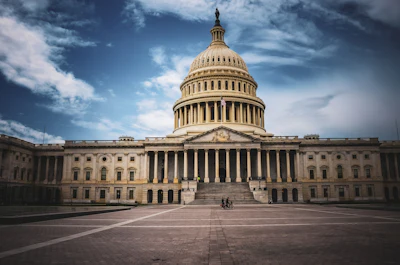
On Thursday, June 25, 2026 Congressional Republican leadership decided to recess a day early ahead of the scheduled July 4th weekend and the 250th anniversary for the United States. A day later, the Transportation Construction Coalition (TCC), made up of 34 national associations and construction unions, pressed Congress to prioritize a new surface transportation (presumably the Build America 25 Act) reauthorization before the current law (IIJA) expires on September 30.
The timing seemed to carry a message of its own: every day counts.
Now, lawmakers begin a two-week break, and won't return to legislate until July 13. Additionally, since House leaders scrapped a slate of scheduled Friday votes and stranded a stack of major bills, that stack will be there waiting for them ahead of any movement on the $580 billion BA250.
"From supporting supply chains to connecting communities, America's Interstate Highway System has powered economic growth and opportunity in every region of the country for decades," the coalition said, and tied continued performance directly to federal dollars: "As this system ages and demand continues to grow, sustained federal investment through a new surface transportation reauthorization is essential to ensure it remains safe, reliable, and efficient for the millions of Americans who depend on it every day."
The coalition expressed the urgency of getting the bill done by the deadline.
"Advancing a new surface transportation reauthorization bill by September 30 will support continued economic growth for communities nationwide and keep America moving," the group said, pointing to bridge work, freight projects, and work-zone safety programs as priorities that hang on the outcome.
However, here is the problem the coalition did not put a number on. The congressional calendar makes that September 30 target very difficult to hit.
The Runway Is Shorter Than It Looks
The leading vehicle, the BA250 (H.R. 8870), cleared the House Transportation and Infrastructure Committee on a 62-2 vote in late May, but that is also only one step. The bill still needs action from the Ways and Means Committee on its Highway Trust Fund and electric-vehicle fee provisions, then a merger of committee titles, then a full House floor vote. The Senate has not released its own bill or even announced a timeline for one.
Now count the days. Between now and the deadline, the Senate holds roughly 30 scheduled session days, and they fall into three short windows:
- A stretch in mid-to-late July
- A single week in early August
- And a final run from mid-September to the deadline.
Both chambers go dark together from August 10 into early September. The House schedule runs even thinner. Because a bill becomes law only when both chambers pass identical text and the President signs it, the number that matters is the count of days when both are in town at the same time. That number is small, and it shrinks every week. That's what makes the loss of one of those days so meaningful at a time like this. But it's not all bad news.
The IIJA Missed It's Deadline Too
Recent history removes most of the suspense, but the IIJA, the law now expiring, did not arrive on time either.
The House introduced the bill on June 4, 2021, and passed its version on July 1. The Senate passed a bipartisan rewrite on August 10. Even with a finished, Senate-approved bill in hand, the House did not clear the final text until November 5, and the President did not sign it until November 15. A completed bipartisan deal still took roughly three more months to cross the line.
The prior authorization lapsed at midnight on September 30, 2021, and the U.S. Department of Transportation began shutdown procedures the next morning. Federal-Aid Highway programs stopped until Congress passed a short-term extension on October 2, and then finished the full bill six weeks later.
Unfortunately, this year's effort sits further back in the process than the 2021 effort did at the same point on the calendar, and it has less time to make up the distance. In 2021, Congress entered its final sprint with a bipartisan bill already through the Senate and still blew the deadline. In 2026, the House bill has not reached the floor, and the Senate has not started.
What You Need To Know
A clean, on-time, five-year reauthorization signed by September 30 is really a long shot. It's much more likely to have a stop-gap situation, as happened prior, though it will likely be longer than that six week interruption.
Watch state DOT lettings for a pause if and when things don't happen by deadline, keep bid pipelines flexible into the fourth quarter, or later, and treat any pre-deadline passage as a bonus rather than what you're basing your expectations or projections upon.