
In an industry where precision determines pavement performance, few roles carry more day-to-day responsibility than field quality control. It’s the kind of work that demands technical confidence, physical stamina and the ability to make confident decisions in unpredictable conditions. That challenge is exactly what drives Quality Control Inspector Tracy Richard.
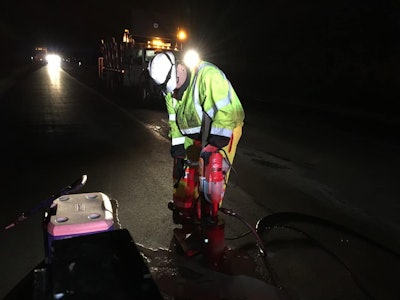
Richard specializes in the real-world application of mix designs and job-specific specialty designs. While she participates in winter design-team work, she is quick to note that the lab supervisor is “truly the genius behind design.” Her job begins once the designs leave the lab. With the designs in hand, she’s then responsible for sampling, coring, density testing and keeping close oversight on best practices during paving to ensure those designs perform exactly as intended.
Born and raised in New Bedford, Massachusetts, and the youngest of four siblings, Richard credits her family’s perseverance with shaping her own. The granddaughter of Portuguese immigrants, she grew up with a clear understanding of hard work and resilience — qualities that would one day become a calling card throughout her career in the aggregate and construction materials industry.
Paving a Path in Quality Control
Richard’s journey started when she learned of an apprentice laborer position through a personal connection and found herself intrigued by the opportunity despite having “little experience in quality control or construction.” What she lacked in exposure, she made up for in enthusiasm.
 Tracy Richard
She spent her first six years in the industry gaining hands-on experience through her employer, working her way from apprentice to journeyman and building a strong understanding of what it takes to construct and maintain infrastructure. When she was asked to take on milling inspection work, she found both a challenge and a passion, eventually developing the milling inspection program still used today and training others in the process. By 2015, Richard transitioned full time into Quality Control, where new expectations and a steep learning curve pushed her further. Observing, testing, asking questions and applying new skills onsite shaped her understanding of both the science and the craft behind asphalt quality.
She has now found a passion for the technical side of mix designs. Working with a team to develop mixes that meet stringent project demands and bringing innovation into practical field use led to further growth. A standout project involved a specialized waterproofing mix for bridge decks, an effort that later informed similar infrastructure applications. That experience helped her master the mix and eventually create a best-practices manual, which she later presented to the Department of Transportation.
Teamwork Turns into Quality Work
Richard’s early years in laborer roles gave her a perspective many technicians may not experience. She understands firsthand how each position on a paving crew connects to the next and how each task influences the final product.
“I have a solid understanding of how each role on a crew connects and supports the next,” she said. That understanding informs her approach to leadership. She focuses on collaboration, communication and safety as the foundation for high-quality work. “We work and succeed as a team,” Richard said.
She has made it a priority to reinforce safety, appreciate hard work and check in on her colleagues while also taking every dent or setback as an opportunity to uphold standards of workmanship and strengthen relationships.
Evolving With the Industry
Over the course of her career, Richard has seen safety culture evolve in meaningful ways. “Safety remains the core,” she said, noting that the entire industry has become more intentional about integrating safety into every operational step rather than treating it as a separate checklist. She sees this shift as a positive sign of maturity across construction and an important foundation for long-term workforce development. That’s not the only change she’s noticed – and hopes to see more of.
 Tracy Richard
As a longtime participant in the Women of Asphalt mentorship program, she uses her voice to advocate for women and underrepresented groups navigating a field that remains predominantly male. Mentorship played a pivotal role in her growth, and she encourages new workers to seek it out. “You only need curiosity, a willingness to learn and faith in yourself.”
Supporting the Next Generation
Richard emphasizes the importance of mentorship, particularly for young professionals entering the field. The construction industry is seeing more apprentices and new workers, and she wants them to feel supported. She offers guidance, answers questions and works to create an environment where curiosity is welcomed.
“When my career ultimately reaches its finish line, I hope someone coming up behind me knows there was someone who believed in them and helped carry the baton forward.”
As far as a career in quality control is concerned, Richard’s advice is simple: take the first step. “You have nothing to lose by trying.”