
Trenching remains one of the most hazardous activities on any construction site. A cubic yard of soil can weigh as much as a small car, and an unprotected trench wall can fail in seconds, giving workers little to no time to react. That's why OSHA requires a protective system for excavations 5 feet deep or greater, unless the excavation is made entirely in stable rock.
OSHA recognizes four main methods of trench protection: sloping, benching, shoring and shielding. Shoring and shielding are common on jobsites where sloping or benching isn't practical due to a small site footprint or the need to limit ground movement to protect adjacent structures.
The terms “shoring” and “shielding” are sometimes used interchangeably, but they describe distinct methods of protecting construction crews working in trenches and other excavations. Simply put, shoring is designed to prevent a trench collapse, while shielding is designed to protect workers if a collapse occurs.
Neither is inherently safer, but both have their best use cases. Knowing when to choose which can help contractors protect workers and stay OSHA-compliant.
Trench Shoring: Active Excavation Support
Trench shoring supports the walls of an excavation by applying positive pressure to hold them in place. A shoring system typically uses vertical posts, horizontal walers, lateral braces and sheeting to actively resist the forces that would otherwise cause the walls to move or collapse.
By preventing ground movement, shoring helps protect the integrity of nearby structures, roadways and underground utilities.
Hydraulic vs. Weld-in-Place Shoring
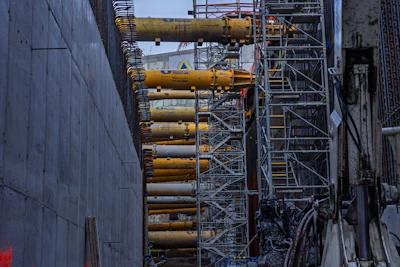
Modular hydraulic bracing and shoring systems are a safer, faster, more cost-effective alternative to weld-in-place shoring. Adjustable braces and high-load-capacity hydraulic struts all but eliminate welding and other hot work and can accommodate deep, long and irregularly shaped excavations. Hydraulic bracing systems are often ideal for installing fuel tanks and constructing clear span buildings, tunnels, heavily loaded cofferdams and deep basements.
Weld-in-place shoring is an older method frequently used on many sites. It requires more time, labor and equipment to install. United Rentals
Common Shoring Applications
Shoring tends to be used for deeper and more complex excavations as well as projects where no soil movement can be tolerated. Applications include pipe installations near active roadways, railways or structures; underground work in congested areas with existing utilities; and excavations that abut an existing foundation or footer.
Because shoring actively resists ground movement, it's well suited to longer-duration projects. The longer a trench stays open, the greater the risk of soil movement over time.
What Is Trench Shielding?
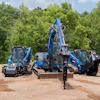
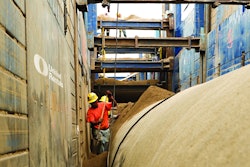
A trench shield, also known as a trench box, creates a protected space inside the excavation where workers can safely perform their tasks. The shield is engineered to protect workers inside from falling soil, rock and debris if the trench walls collapse. Internal spreader bars, usually steel, keep the box rigid even under significant soil loads.
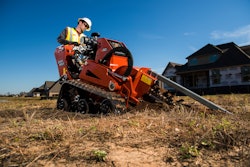
Trench boxes come in different heights, lengths and wall thicknesses. They are customizable for heights up to about 10 feet and lengths up to about 40 feet. They can be stacked to provide protection in deeper excavations. A backhoe or excavator is typically required to install them.
 United Rentals
Trench boxes are positioned as close to the trench wall as the manufacturer's tabulated data allows. They are often stabilized from lateral movement by backfilling the space between the shield and the wall. They can be pulled along an excavation with an excavator or other machine for projects such as laying sewer pipes.
Types of Trench Shields
- Aluminum trench boxes — Aluminum boxes are light and easy to transport, install and move along the work area as the project progresses. They are often well suited for smaller jobs at shallow to medium depths and can be installed using a smaller excavator or zero tail-swing excavator.
- Steel trench boxes — Steel boxes are heavier than aluminum boxes, have greater depth ratings and require larger equipment to install.
- Modular aluminum trench box systems — Contractors can use these systems to build trench boxes with custom dimensions. The components can be pinned together on site to build two-, three- or four-sided configurations.
When choosing a trench box, check the manufacturer's tabulated data, which dictates the placement and depth at which it can be used.
Common shielding applications
Shielding is often a practical choice for shallower or moderately deep excavations where some soil movement around the trench is acceptable.
Because trench boxes can be installed relatively quickly, they are a common choice for shorter-duration work such as installing foundations in stable soil, repairing or installing pipelines and utility lines in remote areas away from critical structures, and repairing and replacing fire hydrants.
Aluminum Hydraulic Shoring: A Hybrid Option
Aluminum hydraulic shoring uses the same aluminum rails found in an aluminum trench box with the addition of a telescoping hydraulic cylinder in place of the static spreaders. The cylinder applies positive pressure to the trench walls, giving the system cave-in protection.
These lightweight, versatile systems are often useful on sites where access is tight or utility crossings are present.
Making the Best Choice
Shoring vs. shielding isn’t always a cut-and-dried decision. Sometimes the choice comes down to contractor preference. At other times, conditions clearly call for one or the other.
- Adjacent structures — Shoring or a similar method of soil stabilization is required when the trench is adjacent to a structure (building, road, etc.) and could threaten its stability.
- Crossing utilities — Shoring offers more room for working around pipes and conduits when the trench will cross with utilities.
- Narrow trenches — If the working width of the trench is tight, shoring provides workers more space compared with shielding.
- Poor, loose soil — In poor, loose soil, shielding is the better option. Vertical shores aren’t allowed in certain soils and should not be used.
Under OSHA regulations, the designated competent person for excavation work is responsible for evaluating soil conditions, the dimensions of the excavation and proximity to surface loads and other encumbrances before choosing a protective system. The competent person should consult the manufacturer's tabulated data for any shoring or shielding equipment under consideration to understand its rated limitations.
Site logistics matter too. Shielding requires enough access for heavy equipment to move and set an assembled trench box, along with sufficient overhead room for maneuvering. Shoring is typically installed sequentially using smaller equipment, which can make it a better fit for sites with limited access or overhead clearance.
Taking the time to match the protective system to the excavation isn't just a compliance requirement, it's one of the most effective ways to prevent injuries and fatalities on the jobsite.