In today’s industrial construction environment, concrete floors are high-performance assets expected to withstand constant abuse from forklifts, pallet jacks, and heavy equipment. For engineers responsible for concrete floor specifications, the challenge is to deliver long-term durability under real-life operating conditions.
Integral hardening admixtures are increasingly part of that conversation. They represent a shift away from surface treatments toward performance engineered into the concrete, itself. For contractors and engineers, alike, understanding when to use these systems and how to justify their cost requires a clear view of both technical performance and financial return.
The Real Problem: Why Industrial Floors Fail
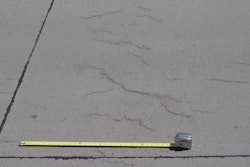
What starts as light dusting can evolve into aggregate loss, rebar exposure, and ultimately operational disruption.
Concrete floors in high-traffic environments fail for predictable reasons. Despite their compressive strength, traditional concrete floors often wear at the surface level, specifically within the cement paste.
Under repeated loading and movement, forklifts and steel-wheeled equipment generate abrasion and micro-impact forces. Over time:
- The cement paste begins to abrade
- Fine particles are released, leading to dusting
- Aggregates become exposed and loosen
- Surface roughness accelerates further wear
This degradation is progressive. What starts as light dusting can evolve into aggregate loss, rebar exposure, and ultimately operational disruption.
For the engineer, the key insight is this: standard concrete mix designs are not optimized for abrasion resistance, even when they meet compressive strength targets. A 35 MPa slab may perform structurally, yet still fail prematurely in a harsh industrial setting.
Durability failures often ripple throughout a facility’s operations. Owners may experience:
- Increased maintenance cycles and patch repairs
- Reduced operational efficiency from uneven or damaged floors
- Accelerated wear on forklift tires and wheels
- Safety concerns from dust and surface defects
Most importantly, repairs require access. In active facilities, that often means downtime. In high-throughput processing or manufacturing environments, even temporary shutdowns can carry significant costs. Lost production, labor disruption, and logistical delays often outweigh the cost of the original concrete installation.
Why Surface Treatments Fall Short
Surface treatments do not address the underlying vulnerability of the cement paste to abrasive wear.
Traditionally, abrasion resistance has been addressed using dry shake hardeners or liquid-applied densifiers. While these systems can improve surface hardness, they have inherent limitations:
- They treat only the top layer of the slab
- Performance depends heavily on installation quality
- Delamination or uneven application can reduce effectiveness
- They introduce additional trades, timing constraints, and variability
From a contractor’s perspective, these systems also complicate scheduling and job execution. Coordination between concrete placement and surface application can create bottlenecks and risk inconsistencies across large floor areas.
Most critically, surface treatments do not address the underlying vulnerability of the cement paste to abrasive wear.
Integral hardening admixtures take a fundamentally different approach when compared to surface treatments. Rather than treating the surface after concrete placement, it is added directly into the concrete during batching.
This avoids the problem entirely.
Hardening admixtures work by enhancing the microstructure of the cement paste, fortifying it with a mineral-metal composition that improves its resistance to abrasion and erosion. Because it is distributed throughout the mix, abrasion resistance extends consistently through the full depth of the slab without risk of delamination, thin or missed spots.
For engineers, this means durability is no longer dependent on field-applied processes. It becomes part of the mix design — just like air entrainment or water reducers.
What This Means for Pumping & Placement
From a practical standpoint, using an integral hardening admixture has minimal impact on placement operations. The admixture is introduced at the batch plant and does not require additional steps on site.
Key considerations include:
- Confirming the dose with the manufacturer
- Achieving proper mixing to ensure uniform distribution
- Understanding any minor mix adjustments
In most cases, placement, pumping, and finishing proceed as they would with conventional concrete. This simplicity is one of the major advantages for contractors. It removes the variability associated with surface-applied systems and reduces the risk of installation errors, allowing the contractor to focus on placing and finishing the slab.
Not every slab requires enhanced abrasion resistance. The decision should be driven by the expected operational intensity of the service environment.
Situations where integral hardening admixtures make sense include:
- High-volume warehouses and distribution centers
- Manufacturing facilities, including food, beverage and agriculture
- Cold storage facilities with hard wheels and tight turning radii
- Mining, material handling, or heavy industrial environments
- Super flat floors and automated facilities
In these applications, the cost of failure is high, and the benefits of extended service life are clear.
Building the ROI Case
For decades, concrete specifications have focused on compressive strength, finish, and basic durability metrics. In high-traffic environments, these parameters are no longer sufficient.
For owners, the decision ultimately comes down to economics. Engineers and contractors play a critical role in framing durability as an investment rather than an expense.
A simple ROI model compares two scenarios: conventional concrete versus concrete with an integral hardening admixture.
Costs to consider:
- Initial installation cost (including admixture premium)
- Maintenance and repair frequency
- Downtime associated with repairs
- Replacement or resurfacing cycles
In a typical industrial floor, conventional concrete may require periodic, localized repairs every couple of years and major rehabilitation within 10 years. Each intervention carries direct costs and operational disruption. By contrast, a more durable slab can extend these intervals significantly or eliminate some repair cycles entirely.
The financial return of hardening admixtures is driven by avoided costs rather than immediate savings.
Key sources of value include:
- Fewer repair events over the life of the slab
- Reduced downtime and operational disruption
- Lower maintenance labor and material costs
- Extended replacement timelines
Even a single avoided shutdown can offset the upfront cost of the admixture. In facilities with continuous operations, this is often the tipping point in the decision. Downtime costs can vary significantly depending on the size and nature of the operations, but costs between $5,000 and $25,000 per hour are not uncommon. This makes the cost of a concrete hardening additive almost negligible. If multiple maintenance shutdowns are required, the financial impact is exponential.
A Shift in Mindset
For decades, concrete specifications have focused on compressive strength, finish, and basic durability metrics. In high-traffic environments, these parameters are no longer sufficient.
Integral hardening admixtures represent a shift toward performance-based thinking, where the goal is not just to build a slab, but to optimize its lifecycle value.
For the owner who will depend on the slab for their business to operate, the question is straightforward: Will this slab still perform under real operating conditions five, 10, 20, or even 50 years from now?
If the answer is uncertain, it may be time to look beyond traditional approaches. Because in today’s industrial environments, durability is a critical driver of ROI.